

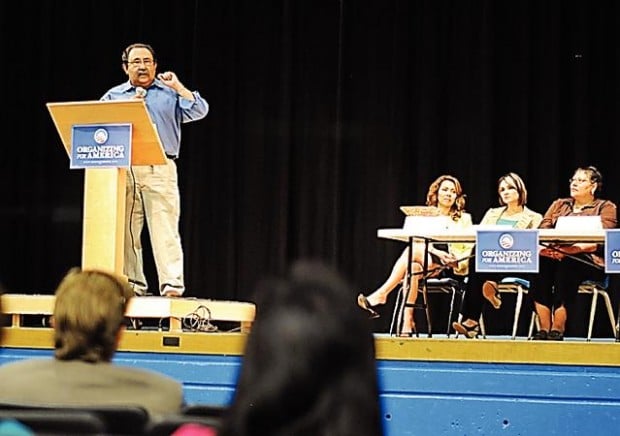
About 100 people attended a calm and conflict-free Spanish-language health-care forum Saturday morning at Sunnyside High School.
"It was a discourse instead of a headbangers concert," said U.S. Rep. Raúl Grijalva, D-Ariz., who spoke at the forum. "There were sincere questions looking for information as opposed to people getting up and stating their position."
Other recent health-care forums held around the country, including in Southern Arizona, have been contentious affairs with shouting, booing and bickering. There were no loud protesters at this forum, and the Sunnyside High School auditorium was half-filled.
Organizers of the event said it was the first Spanish-language forum on health-care overhaul the country. It was organized by a group called Organizing for America, a special project of the Democratic National Committee dedicated to supporting President Obama's agenda.
People are also reading…
"Health care is important to every American, whether you speak English, whether you speak Spanish, whether you speak French," said Jessica Jones, the organization's Arizona director.
Reaching Hispanics is important in the health-care debate due to the high numbers who are uninsured or who have chronic illnesses, and because many Latinos are young, Grijalva said.
"In terms of who needs the attention, that is a population that could probably benefit most from health reform than any other," Grijalva said. "We thought we had to make a special effort to reach them."
The emphasis during the two-hour forum was on providing information about proposals for revamping health care.
Grijalva was joined by Sandra Leal, the clinical pharmacy supervisor at El Rio Community Health Center; Laura Elías de la Torre, a family physician at El Río Community Health Center; Cecilia Rosales; and Josefina Iturralde, a cancer patient undergoing chemotherapy who has trouble paying her insurance premiums. All spoke in Spanish, but headsets with an English translation were offered to those attending.
The audience was a mixture of Hispanics and non-Hispanics, and Spanish-speakers and non-Spanish-speakers. The audience was allowed to ask questions after the panelists' presentations.
Most of the speakers supported the idea of health-care overhaul, although some questioned how it would affect Medicare, whether the U.S. could afford comprehensive health insurance coverage, and why changes would take so long to implement. Grijalva said it would likely take until 2013 to get the new program up and running.
Abel Serratos started crying while telling his story of losing his electrician job after 15 years and not having health insurance for his wife and two children.
Because his wife was still working, they were denied government help, he said. Through tears, he asked Grijalva if health-care overhaul would help middle-class families such as his who don't have enough money to pay for private insurance but make too much money to qualify for government aid.
"Why is there so much money in war, so much money in space, but there isn't money to take care of ourselves?" Serratos asked after the forum.
Grijalva said Serratos is a prime example of what's wrong with the current health-care system.
"We are stuck in this philosophical fight: Is it public option? Do we need health reform? Is this creeping socialism?" Grijalva said. "And then you have him, who loses his job and for five months couldn't get insurance even though he paid for 15 years. That story is more common than the philosophical fights that we are having."
While one man took the microphone and said the panelists should repeat their speeches and answers in English, most of the audience applauded the decision to hold the forum in Spanish.
"It's very important. This is a program that has to be inclusive," Raymond Rodriguez said. "People are more comfortable in their language."
"If it is in Spanish for the better understanding of the Spanish-speaking population, well, then it's for the advantage of society in general," said Florencio Zaragoza, president of Fundación México. The organization works to strengthen the influence of Hispanics.
Laura Alameda and Maria Fuentes, both uninsured mothers who take their families to El Rio Community Health Center, attended the forum to learn more about the proposed changes. The women, who are native Spanish-speakers, were happy to hear that there would be a forum in their language.
"In English, you don't always understand everything," Fuentes said in Spanish.


