

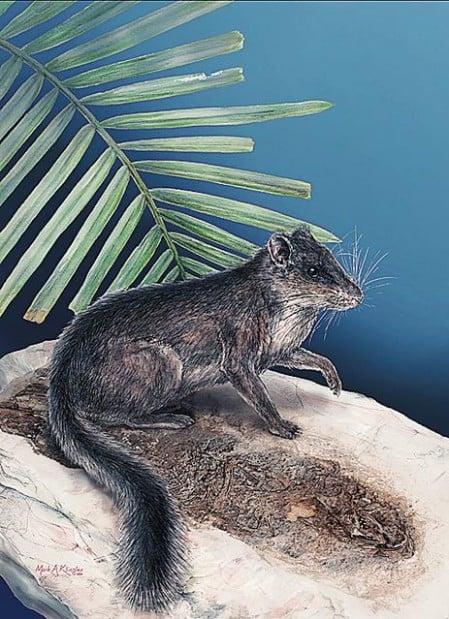
WASHINGTON — It has the face of a rat and the tail of a skinny squirrel — and scientists say this creature discovered living in central Laos is pretty special: It's a species believed to have been extinct for 11 million years.
The long-whiskered rodent made international headlines last spring when biologists said they'd discovered a brand-new species, nicknamed the Laotian rock rat.
It turns out the little guy isn't new after all but is a rare kind of survivor: a member of a family until now known only from fossils.
Nor is it a rat. This species, called Diatomyidae, looks more like a small squirrel or tree shrew, said paleontologist Mary Dawson of Pittsburgh's Carnegie Museum of Natural History.
Dawson, with colleagues in France and China, report the creature's new identity in today's edition of the journal Science.
People are also reading…
The resemblance is "absolutely striking," Dawson said. As soon as her team spotted reports about the rodent's discovery, "we thought, 'My goodness — this is not a new family. We've known it from the fossil record.' "
They set out to prove that through meticulous comparisons between the bones of today's specimens and fossils found in China and elsewhere in Asia.
To reappear after 11 million years is more exciting than if the rodent really had been a new species, said George Schaller, a naturalist with the Wildlife Conservation Society, which unveiled the creature's existence last year. Indeed, such reappearances are so rare that paleontologists dub them "the Lazarus effect."
"It shows you it's well worth looking around in this world, still, to see what's out there," Schaller said.
The nocturnal rodent lives in Laotian forests largely unexplored by outsiders, because of the geographic remoteness and history of political turmoil.
Schaller calls the area "an absolute wonderland," because biologists who have ventured in have found unique animals, such as a type of wild ox called the saola, barking deer, and never-before-seen bats. Dawson describes it as a prehistoric zoo, teeming with information about past and present biodiversity.
All the attention to the ancient rodent will be "wonderful for conservation," Schaller said. "This way, Laos will be proud of that region for all these new animals, which will help conservation in that some of the forests, I hope, will be preserved."


