

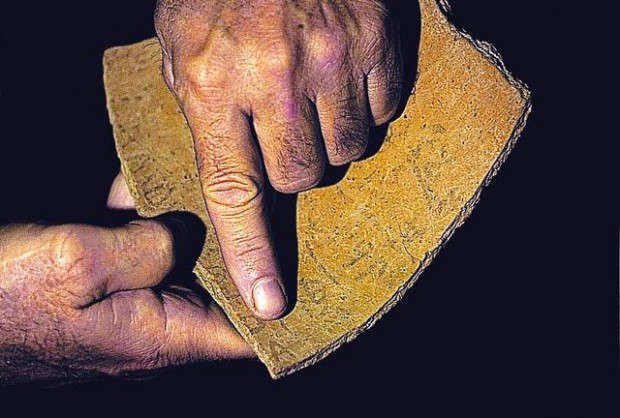
HIRBET QEIYAFA, Israel — An Israeli archaeologist has discovered what he believes is the oldest known Hebrew inscription on a 3,000-year-old pottery shard — a find that suggests biblical accounts of the ancient Israelite kingdom of David could have been based on written texts.
A teenage volunteer discovered the curved shard bearing five lines of faded characters in July in the ruins of an ancient town on a hilltop south of Jerusalem. Yossi Garfinkel, the Israeli archaeologist leading the excavations at Hirbet Qeiyafa, released his conclusions about the writing Thursday after months of study.
He said the relic is strong evidence that the ancient Israelites were literate and could chronicle events centuries before the Bible was written. This could suggest that some of the Bible's accounts were based on written records as well as oral traditions — adding credence to arguments that the biblical account of history is more than myth.
People are also reading…
The shard was found near the stairs and stone washtub of an excavated home. It was later discovered to bear characters known as proto-Canaanite, a precursor of the Hebrew alphabet.
The Israelites were not the only ones using the proto-Canaanite characters, and other scholars suggest it is difficult — perhaps impossible — to conclude the text is Hebrew. However, Garfinkel based his identification on a three-letter verb from the inscription meaning "to do," a word he said existed only in Hebrew.
Hirbet Qeiyafa sits near the modern Israeli city of Beit Shemesh in the Judean foothills, an area that was once the frontier between the hill-dwelling Israelites and their enemies, the coastal Philistines. The site overlooks the Elah Valley, said to be the scene of the showdown between David and the Philistine giant Goliath, near the ruins of Goliath's hometown.
Carbon-14 analysis of burnt olive pits found in the same layer of the site as the pottery shard helped archaeologists date it to between 1,000 and 975 B.C., the same time as the Biblical golden age of King David's rule in Jerusalem.
Modern Zionism has traditionally seen archaeology as a way of strengthening the Jewish claim to Israel and regarded David's kingdom as the glorious ancestor of the new Jewish state.
As a result, finding evidence of his rule has importance beyond its interest to scholars.
The script, which Garfinkel suggests might be part of a letter, predates the next significant Hebrew inscription by between 100 and 200 years. History's best-known Hebrew texts, the Dead Sea scrolls, were penned on parchment beginning 850 years later.


