

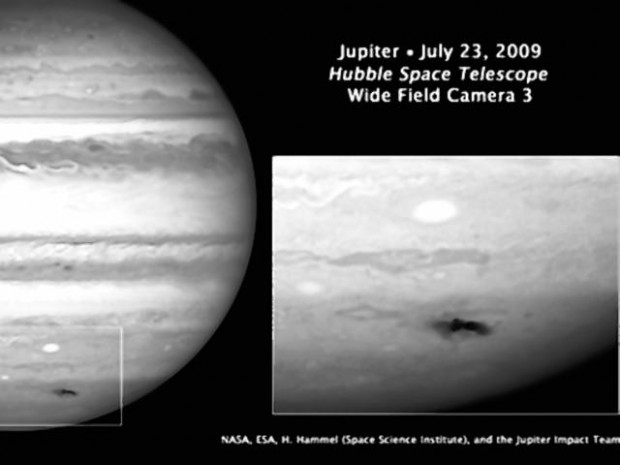
The Hubble Space Telescope, pressed into service before being fully tested after a recent repair mission, has sent back images of an immense scar that suddenly appeared on the surface of Jupiter.
Some unknown comet or asteroid must have crashed into the giant planet's upper atmosphere to cause the scar, astronomers believe.
For only the second time in the 400 years since Galileo trained his primitive telescope on Jupiter, professionals and amateurs alike are observing how the planet has been blasted by a cosmic collision, and excitement is mounting about the mystery.
"Because we believe this magnitude of impact is rare, we are very fortunate to see it with Hubble," said Amy Simon-Miller of NASA's Goddard Space Flight Center in Greenbelt, Md. "Details seen in the Hubble view shows a lumpiness to the debris plume caused by turbulence in Jupiter's atmosphere."
People are also reading…
The images show that a May repair of Hubble by space shuttle astronauts was successful.
For the past several days, Earth-based telescopes have been trained on Jupiter to capture the unfolding drama 360 million miles away, a NASA press release said.
A team of astronomers led by Heidi Hammel of the Space Science Institute in Boulder, Colo., is using the Hubble.
"Hubble's truly exquisite imaging capability has revealed an astonishing wealth of detail in the impact site," Hammel said in the NASA press release.
"By combining these images with our ground-based data at other wavelengths, our Hubble data will allow a comprehensive understanding of exactly what is happening to the impact debris."
Simon-Miller estimated the diameter of the object was the size of several football fields. The force of the explosion on Jupiter was thousands of times more powerful than the suspected comet or asteroid that exploded over the Siberian Tunguska River Valley in June 1908.
The only similar impact occurred 15 years ago, when chunks of Comet Shoemaker-Levy rained down on Jupiter at interplanetary speeds for five days and pitted the gaseous surface with clusters of huge black spots.
That crash has intrigued astronomers who have been hard at work analyzing its effects on the planet in scientific papers.
The new scar was first detected Sunday by Anthony Wesley, an amateur astronomer in Australia, who promptly posted on a blog for other astronomers.
If the object that hit Jupiter was an asteroid rather than a comet, it might well have been one of those millions of objects that normally fly around the sun in the "asteroid belt" between Mars and Jupiter. But so far, no one knows.
on the net
NASA's Hubble site:
www.nasa.gov/mission_pages /hubble/main/jupiter-hubble. html


