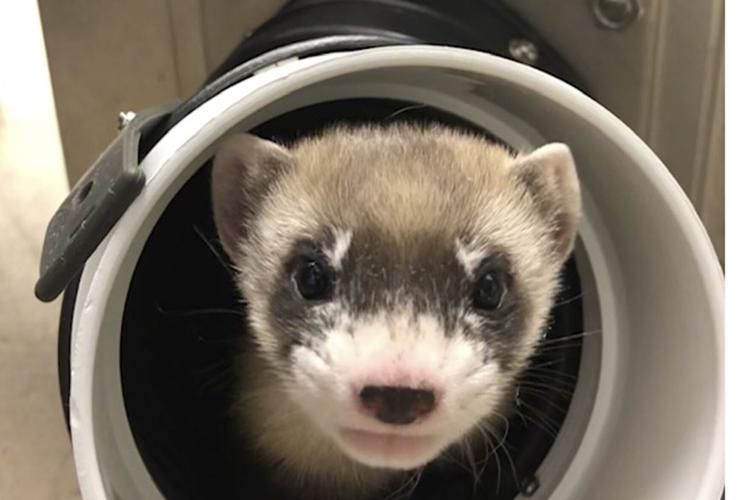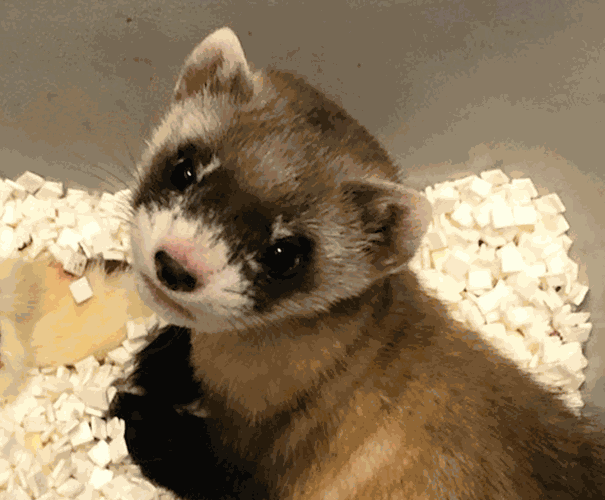
Scientists in 2021 cloned the first U.S. endangered species, a black-footed ferret duplicated from the genes of an animal that died over 30 years ago. Two more black-footed ferrets have been cloned from the genes used for the first clone of an endangered species in the U.S., bringing to three the number of slinky predators genetically identical to one of the last such animals found in the wild, the U.S. Fish and Wildlife Service announced.
CHEYENNE, Wyo. — Scientists have cloned the first U.S. endangered species, a black-footed ferret duplicated from the genes of an animal that died over 30 years ago.
The slinky predator named Elizabeth Ann, born Dec. 10 and announced Thursday, is cute as a button. But watch out: Unlike the domestic ferret foster mom who carried her into the world, she's wild at heart.
"You might have been handling a black-footed ferret kit, and then they try to take your finger off the next day," U.S. Fish and Wildlife Service black-footed ferret recovery coordinator Pete Gober said Thursday. "She's holding her own."
Elizabeth Ann was born and is being raised at a Fish and Wildlife Service black-footed ferret breeding facility in Fort Collins, Colorado. She's a genetic copy of a ferret named Willa who died in 1988 and whose remains were frozen in the early days of DNA technology.
People are also reading…

Elizabeth Ann is the first cloned black-footed ferret and first-ever cloned U.S. endangered species. Scientists hope the slinky predator and her descendants will improve the genetic diversity of a species once thought extinct but bred in captivity and reintroduced successfully to the wild.
Cloning eventually could bring back extinct species such as the passenger pigeon. For now, the technique holds promise for helping endangered species including a Mongolian wild horse that was cloned and last summer was born at a Texas facility.
"Biotechnology and genomic data can really make a difference on the ground with conservation efforts," said Ben Novak, lead scientist with Revive & Restore, a biotechnology-focused conservation nonprofit that coordinated the ferret and horse clonings.
Black-footed ferrets are a type of weasel easily recognized by dark eye markings resembling a robber's mask. Charismatic and nocturnal, they feed exclusively on prairie dogs while living in the midst of the rodents' sometimes vast burrow colonies.
Even before cloning, black-footed ferrets were a conservation success story. They were thought extinct — victims of habitat loss as ranchers shot and poisoned off prairie dog colonies that made rangelands less suitable for cattle — until a ranch dog named Shep brought a dead one home in Wyoming in 1981.
Scientists gathered the remaining population for a captive breeding program that has released thousands of ferrets at dozens of sites in the western U.S., Canada and Mexico since the 1990s.

This photo provided by the U.S. Fish and Wildlife Service shows Elizabeth Ann, the first cloned black-footed ferret and first-ever cloned U.S. endangered species, at 48 days old on Jan. 27, 2021.
Lack of genetic diversity prevents an ongoing risk. All ferrets reintroduced so far are the descendants of just seven closely related animals — genetic similarity that makes today's ferrets potentially susceptible to intestinal parasites and diseases such as sylvatic plague.
Willa could have passed along her genes the usual way, too, but a male born to her named Cody "didn't do his job," and her lineage died out, said Gober.
When Willa died, the Wyoming Game and Fish Department sent her tissues to a "frozen zoo" run by San Diego Zoo Global that maintains cells from more than 1,100 species and subspecies worldwide. Eventually scientists may be able to modify those genes to help cloned animals survive.
"With these cloning techniques, you can basically freeze time and regenerate those cells," Gober said. "We're far from it now as far as tinkering with the genome to confer any genetic resistance, but that's a possibility in the future."
14 endangered or threatened species that play crucial roles:
14 endangered or threatened species that play crucial roles
Monarch butterflies

The U.S. Fish and Wildlife Service has been petitioned to determine the endangered status of monarch butterflies, which pollinate wildflowers that support ecosystems.
Cork oak

The tree from which wine corks come is home to endangered species like the Iberian lynx and Iberian Imperial Eagle, according to the World Wildlife Fund for Nature. The industry that makes wine corks is environmentally sustainable and provides a home for these creatures, but the rise in artificial wine corks threatens the trees and the shelter they create. While the trees themselves aren’t endangered, threats to the cork industry threaten the endangered species that call these trees home.
Bats

Many bat species consume insects, including agricultural pests. Many also pollinate plants and disperse seeds. The International Union for Conservation of Nature lists 24 bat species as critically endangered, three as endangered and 104 as vulnerable.
Sharks

As a top predator, sharks maintain population levels in their environment. Shark populations are threatened by overfishing and bycatch (being caught accidentally by fishers fishing for other species). Scalloped and great hammerhead sharks are listed as endangered by the International Union for Conservation of Nature.
Bees

Between $235 billion and $577 billion in annual food production relies on pollinators like bees. Colony collapse disorder and pesticides threaten bee populations, according to the United Nations Food and Agriculture Organization. Although many species of bees are not officially endangered, the U.S. Fish and Wildlife Service added seven species of bees native to Hawaii to the endangered species list in 2016.
Whales

Many large whales serve their ecosystem by managing populations and distributing nutrients by feeding deep in the ocean and disposing of waste closer to the surface, according to the University of Vermont. Six of the 13 great whale species are listed as endangered.
Cacti

Cacti are an important source of food and water to desert animals. Illegal collection of seeds and plants threatens cacti, and so does habitat loss. The IUCN lists 25 species of cacti as endangered and 27 as critically endangered.
African teak

The African teak is a tree that grows up to about 50 yards tall and is used for boat building, joinery, flooring and decoration, according to WWF. It is listed as endangered by the International Union for Conservation of Nature.
Gorillas

Gorillas are important to biodiversity, spreading seeds of the fruit they eat as they roam through large areas. All subspecies of gorilla are considered either endangered or critically endangered by the IUCN.
Coral

There are 22 coral species listed as threatened and three listed as endangered under the Endangered Species Act, according to the National Oceanic and Atmospheric Administration. Coral reefs not only provide habitats for an entire ecosystem, but they also protect coastlines from erosion and storm damage and provide nutrients to marine life.
Sea otters

Sea otters are listed as endangered by the International Union for Conservation of Nature. They are considered vital to their ecosystem, partially because they eat sea urchins, which would otherwise destroy kelp forests, according to the World Wildlife Fund.
Tuna

Tuna is a highly commercially valuable fish. Some species, particularly the endangered bluefin tuna, have been hit hard by overfishing.
Polar bears

At the top of the food pyramid in the arctic, polar bears play an important role in managing marine populations. Their International Union for Conservation of Nature status is vulnerable, one step above endangered.
Orangutans

Similar to gorillas, orangutans improve biodiversity by spreading seeds of fruit they eat. The Tapanuli orangutan is the most endangered great ape, with no more than 800 alive, according to the WWF.