

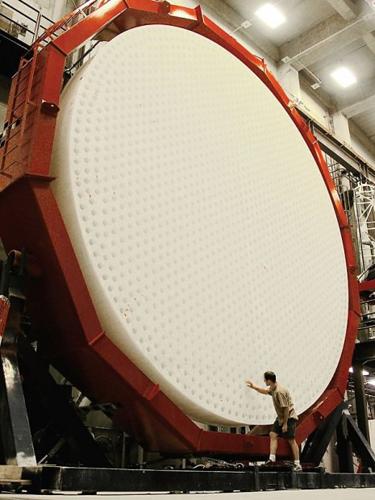
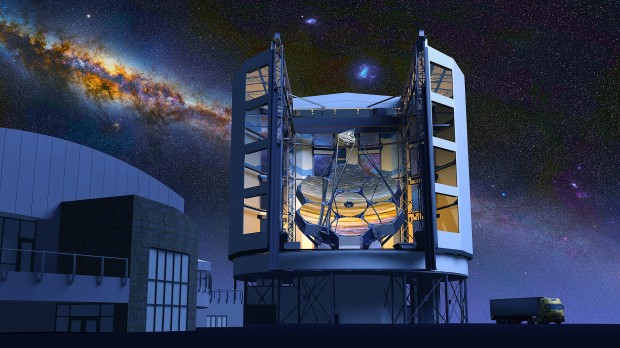
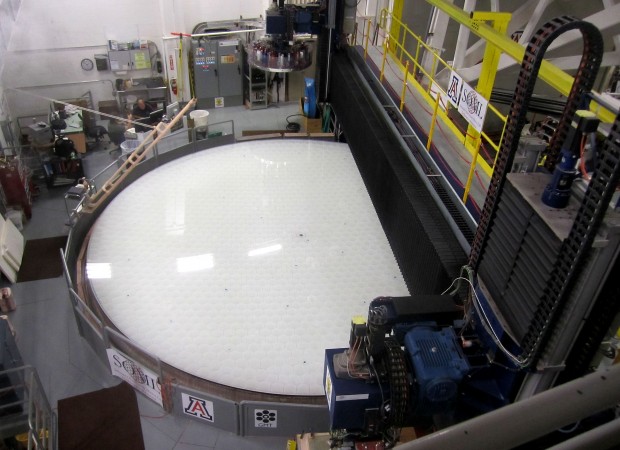
The Steward Observatory Mirror Lab recently completed polishing a $23 million, 8.4-meter (27.5 feet) diameter mirror for the Giant Magellan Telescope (GMT).
It is the first of eight giant mirrors that will be produced at Steward for the GMT - a $120 million undertaking over the next decade. About 40 people are employed on the project at the Mirror Lab.
It is the most "aspherical" mirror of its size ever fabricated, its deviation from "roundness" required by the telescopes' design of six giant mirrors around a central mirror with more conventional geometry.
The scientists compare the shape of the aspherical mirrors to saddles or Pringle's potato chips, though this mirror appears completely flat. The "departure" of half an inch from a standard parabola is not visually detectable.
And it's tough to measure.
People are also reading…
"In a lot of ways, it is the most difficult astronomical mirror ever made," said polishing scientist Buddy Martin.
A team of optical scientists led by Jim Burge had to devise four tests for measuring its shape. That required the Mirror Lab to cast a 4-meter test mirror and build an 80-foot test tower.
When all the mirrors are finished and installed on a mountaintop in Chile, the Giant Magellan Telescope will provide a light-gathering surface of nearly 4,000 square feet and the telescope will have an effective diameter of 25 meters (82 feet).
Built today, it would be the largest telescope in the world, but it is has rivals. The European Southern Observatory plans a nearly 40-meter Extremely Large Telescope in Chile, and a consortium led by California universities wants to build the Thirty-Meter Telescope in Hawaii. Both those projects use a mosaic of smaller mirrors.
The polished mirror deviates from perfect by 19 nanometers, said Martin. That's about 1/5,000th the width of a sheet of paper.
Now the Mirror Lab's challenge is to use what it has learned in this process to speed up production of the remaining mirrors. There will be eight in all, including a spare.
A second mirror blank has already been cast in the Mirror Lab's rotating furnace beneath the bleachers of Arizona Stadium. The third mirror is scheduled for casting in August of next year.
Martin said the Mirror Lab should be able to produce a mirror every 12 to 14 months now that the infrastructure for testing and polishing is in place.
This particular mirror was cast in the UA's furnace in July 2005, and has been undergoing testing and polishing since then.
Jeff Kingsley, associate director of the Mirror Lab, said he is confident it can speed production to meet the project's timetable.
A site is being leveled for the giant telescope at Las Campanas Observatory on a peak in the high, dry Atacama Desert of Chile, where blasting began in March. The observatory is run by the Carnegie Institution for Science, one of the GMT's partner institutions.
Other partners are the University of Arizona, the Australian National University, Astronomy Australia Limited, Harvard University, the Korea Astronomy and Space Science Institute, The Smithsonian Institution, Texas A&M University, the University of Chicago and the University of Texas at Austin.
Contact reporter Tom Beal at tbeal@azstarnet.com or 573-4158


