Antarctica is turning green due to the climate crisis, and the phenomenon is potentially offering sustenance to other species, according to the first large-scale algae map of the peninsular by University of Cambridge scientists.
Green snow created by blooming algae in the Antarctic Peninsula is likely to spread as temperatures increase as a result of climate change, researchers have said, after creating the first large-scale map of the organisms and their movements.
Satellite data gathered between 2017 and 2019, combined with on-the-ground measurements over two summers in Antarctica, allowed scientists to map the microscopic algae as they bloomed across the snow of the Antarctic Peninsula.
Warming temperatures could create more "habitable" environments for the algae, which need wet snow to grow in, researchers told CNN.
Green snow alga is microscopic when measured individually, but when the organisms grow simultaneously, they turn the snow bright green and can even be spotted from space, researchers said in a study published in the Nature Communications journal on Wednesday.
People are also reading…

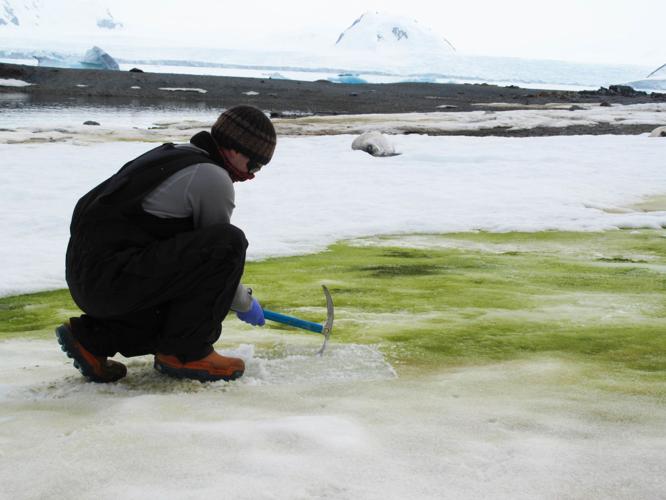
Researcher Matt Davey samples snow algae at Lagoon Island, Antarctica, in 2018.
Researchers from the University of Cambridge and the British Antarctic Survey used European Space Agency satellite data with measurements from Antarctica's Ryder Bay, Adelaide Island, the Fildes Peninsula and King George Island.
Patches of green snow algae can be found along the Antarctic coastline, usually in "warmer" areas, where average temperatures are a little above zero degrees Celsius during the Southern Hemisphere's summer months of November to February.
The Antarctic Peninsula is the part of the region that has experienced the most rapid warming in the latter part of the last century, researchers say.
Unusually high temperatures were recorded in February while a nine-day heatwave scorched the continent's northern tip earlier this year.
Scientists identified 1,679 separate blooms of green algae on the snow surface, covering an area of 1.9 km2, equating to a carbon sink of around 479 tons per year. A carbon sink is a reservoir that absorbs more carbon than it releases.

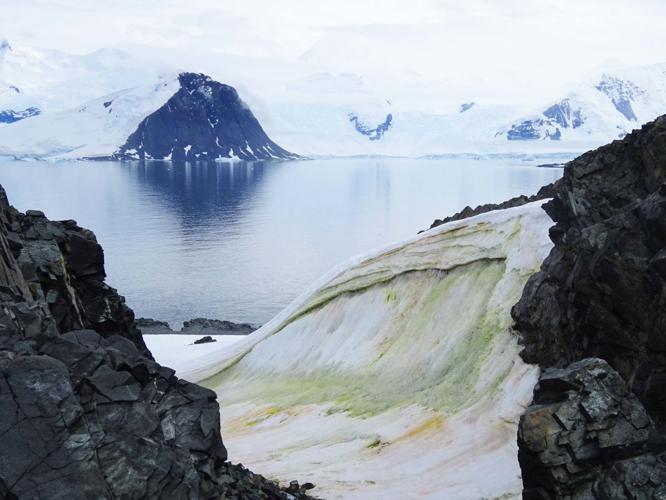
Multi-colored snow algae on Anchorage Island, Antarctica, in 2018.
Researchers believe the organisms will expand as global temperatures increase.
"As Antarctica warms, we predict the overall mass of snow algae will increase as the spread to higher ground will significantly outweigh the loss of small island patches of algae," Dr Andrew Gray, lead author of the paper and a researcher at the University of Cambridge, said in a statement.
He told CNN that rising temperatures would create more "habitable" environments for the algae.
However, while an increase in snow melt could lead to more algae growing, Gray told CNN that the distribution of the organisms is heavily linked to bird populations, whose excrement acts as a fertilizer to accelerate growth.

As bird — particularly penguin — populations are affected by warming temperatures, "the snow algae could lose sources of nutrients to grow," he said.
An increase in the blooms could also lead to further snow melt, he said.
"It's very dark — a green snow algal bloom will reflect about 45% of light hitting it whereas fresh snow will reflect about 80% of the light hitting it, so it will increase the rate of snow melt in a localized area," he explained.
Researchers found that almost two thirds of the blooms were on small, low-lying islands and said that as the Antarctic Peninsula warms due to rising global temperatures, these islands could lose their summer snow cover and algae — although in terms of mass the majority of snow algae is found in areas where they can spread to higher ground when snow melts.

April 25 was World Penguin Day. Here are 25 photos of the aquatic, flightless birds, whose populations are affected by global warming.
25 photos to celebrate World Penguin Day

A Gentoo penguin feeds its chick at Station Bernardo O'Higgins in Antarctica on Jan. 22, 2015. (AP Photo/Natacha Pisarenko)

Seen through glass, a penguin looks out of the water in a pool in the zoo of Frankfurt, Germany, on Jan. 27, 2012. (AP Photo/Michael Probst)

African penguins gather to keep warm as others are fed sardines by staff at the South African Foundation for the Conservation of Coastal Birds after they were found covered in oil on Robben Island, Cape Town, South Africa, on Sept 20, 2012. Some 200 penguins were found covered in oil following a spillage by a stricken bulk carrier. (AP Photo/Schalk van Zuydam)

In this Jan. 20, 2015 photo, a Chinstrap penguin stands on the coast near the town of Villa Las Estrellas on King George Island in Antarctica. (AP Photo/Natacha Pisarenko)

In this Jan. 27, 2015, photo, penguins walk on the shore of Bahia Almirantazgo in Antarctica. (AP Photo/Natacha Pisarenko)

Penguins play soccer at the Hakkeijima Sea Paradise aquarium-amusement park complex in Yokohama, Japan, May 23, 2010. (AP Photo/Itsuo Inouye)

Penguins dive into the water as an aquarium employee cleans the penguin habitat in Tokyo, July 23, 2007. (AP Photo/David Guttenfelder)

A woman directs penguins as they are released on the outskirts of Blouberg, South Africa, May 21, 2009. The Southern African Foundation for the Conservation of Coastal Birds released 84 African penguins back into the wild after they were treated for oil pollution that they obtained in Namibia. (AP Photo/Schalk van Zuydam)

Rockhopper penguins, usually living in sub-Antarctic islands, are seen in their enclosure as they ignore a zookeeper, not seen, holding fish to attract them in order to scan them in London Zoo, June 1, 2010. The photo opportunity was organized to mark the process of the annual scanning of the birds, which have been microchipped. (AP Photo/Lefteris Pitarakis)

Dudley Wigdahl, a curator of marine mammals and birds, feeds a rescued Magellanic penguin at the Aquarium of the Pacific in Long Beach, Calif., April 7, 2011. Five Magellanic penguins arrived at the aquarium after they were rescued after being found stranded off a beach in Brazil. (AP Photo/Jae C. Hong)

Dudley Wigdahl, a curator of marine mammals and birds, looks at rescued Magellanic penguins at the Aquarium of the Pacific in Long Beach, Calif., April 7, 2011. The penguins were rescued after being found stranded off a beach in Brazil. (AP Photo/Jae C. Hong)

Veterinary nurse Sarah Papageorgiou cares for an Antarctic penguin that wound up stranded on a New Zealand beach and resorted to eating sand at Wellington Zoo in Wellington, New Zealand, June 27, 2011. (AP Photo/New Zealand Herald, Mark Mitchell)

A Rockhopper penguin swims beneath a colony of penguins at the Shedd Aquarium in Chicago, April 11, 2007. (AP Photo/Charles Rex Arbogast)

Pierre the Penguin, 25, wears his wetsuit at the Academy of Sciences in San Francisco, April 17, 2008. Pierre, who was going bald, began wearing a wetsuit and began growing back his feathers. (AP Photo/Eric Risberg)

Kyoto, a three-week-old king penguin, nestles up to a toy penguin in the nursery at the Cincinnati Zoo, Aug. 21, 2008. The toy plush penguin was placed with Kyoto to simulate a parent. The baby penguin, taken from its parents and placed in the zoo's nursery as standard procedure, was re-introduced to his family when his down feathers came in. (AP Photo/Al Behrman)

Humboldt penguins enter the water area of their new habitat for the first time, April 7, 2009, at the Woodland Park Zoo in Seattle. (AP Photo/Ted S. Warren)

Steven Sarro, right, the director of animal programs at the National Aviary in Pittsburgh, looks over the African penguin colony in the birds' new exhibit, May 27, 2009. (AP Photo/Keith Srakocic)

In this photo taken June 21, 2011, a woman photographs an Emperor penguin lying on Peka Peka Beach along the Kapiti Coast in New Zealand. (AP Photo/New Zealand Herald, Mark Mitchell)

A penguin chick whose oil-encrusted feathers have been cleaned recovers in the South African Foundation for the Conservation of Coastal Birds after being rescued from Robben Island in Cape Town, South Africa, Sept. 3, 2012. (AP Photo/Schalk van Zuydam)

In this Jan. 22, 2015, photo, a Gentoo penguin regurgitates food to feed its chick near Chile's station Bernardo O'Higgins, Antarctica. (AP Photo/Natacha Pisarenko)

A women watches penguins swimming at Taman Safari in Bogor, West Java, Indonesia, Nov. 19, 2008. (AP Photo/Achmad Ibrahim)

In this undated file photo, a lonely penguin appears in Antarctica during the southern hemisphere's summer season. (AP Photo/Rodrigo Jana)

In this June 30, 2000, file photo, an oil-stained penguin is seen in the water on Dassen Island near Cape Town, South Africa. (AP Photo /Obed Zilwa, File)

A rescued Magellanic penguin shakes water off at the Aquarium of the Pacific in Long Beach, Calif., April 7, 2011. (AP Photo/Jae C. Hong)

Rescued Magellanic penguins are seen at the Aquarium of the Pacific in Long Beach, Calif., April 7, 2011. (AP Photo/Jae C. Hong)
The-CNN-Wire
™ & © 2020 Cable News Network, Inc., a WarnerMedia Company. All rights reserved.