

GENEVA — Jacques Piccard, a scientist and underwater explorer who plunged deeper beneath the ocean than any other man, died Saturday, his son's company said. He was 86.
Piccard died at his Lake Geneva home in Switzerland, the company Solar Impulse said.
Exploration ran in the Piccard family. Jacques' physicist father, Auguste, was the first man to take a balloon into the stratosphere and his son, Bertrand, was the first man to fly a balloon non-stop around the world.
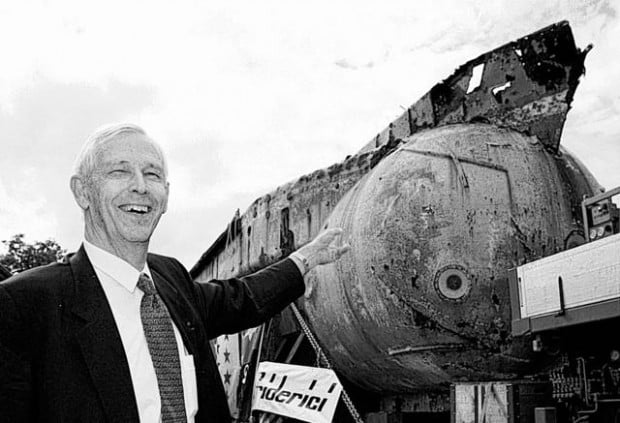
Jacques Piccard helped his father invent the bathyscaph, a vessel that allows humans to descend to great depths.
On Jan. 23, 1960, he and U.S. Navy Lt. Don Walsh took the vessel into the Pacific's Mariana Trench, diving to a depth of 35,800 feet — nearly seven miles below sea level.
It remains the deepest dive ever carried out.
People are also reading…
"By far the most interesting find was the fish that came floating by our porthole," Piccard said of the dive. "We were astounded to find higher marine life forms down there at all."
Solar Impulse said the discovery of living organisms at such a depth played a key role in the prohibition of nuclear waste dumping in ocean trenches.
After the dive, Piccard continued to research the deep seas and worked for NASA.
He also built four mid-depth submarines, including the first tourist submarine. During the Swiss National Exhibition in 1964, he took 33,000 passengers into the depths of Lake Geneva. He continued taking high school children into the lake well into his 70s.
Piccard, who was born in Brussels in 1922, studied in Switzerland and worked as a university teacher of economics, but abandoned his teaching to help his father design the bathyscaph.
Auguste Piccard's great bathyscaph, the Trieste, made several descents in the Atlantic Ocean.
In April 1999, when Bertrand Piccard completed a round-the-world balloon trip with Briton Brian Jones, his team drew on Jacques' experiences of traveling in the waters of the Gulf Stream to work out how best to use the jet stream to speed the balloon around the world.


