

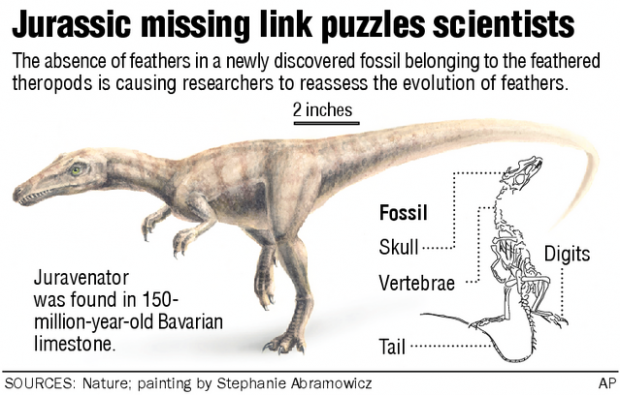
NEW YORK — A beautifully preserved fossil from southern Germany raises questions about how feathers evolved from dinosaurs to birds, two paleontologists argue in a study published today.
The 150-million-year-old fossil is a young carnivorous dinosaur about 2 1/2 feet long that scientists named Juravenator, for the Jura mountains where it was found.
It would have looked similar in life to the fleet-footed predators that menaced a young girl on the beach during the opening scene of "The Lost World," the second Jurassic Park movie.
The fossil's well-preserved bone structure clearly puts it among feathered kin on the dinosaur family tree. Because all its close relatives are feathered, paleontologists would expect Juravenator to follow suit.
But a small patch of skin on its tail shows no sign of feathers. And the skin doesn't have the follicles typical of feathered dinosaurs, said Luis Chiappe, director of the Dinosaur Institute at the Natural History Museum of Los Angeles County. He and Ursula B. Gohlich of the University of Munich describe the fossil in today's issue of the journal Nature.
People are also reading…
"It has a typical scaly dinosaurian skin," Chiappe said.
The paleontologists believe Juravenator's closest known relative may have been a fully feathered dinosaur from China, Sinosauropterix.
There are a number of possible explanations for Juravenator's nakedness. Feathers could have been lost on the line leading to Juravenator after arising in an ancestor to both it and its feathered relatives. Or feathers could have evolved more than once in dinosaurs.
It is also possible that this fossil of Juravenator, which appears to be a juvenile, grew feathers only as an adult or lost its feathers for part of the year.
Mark Norell, curator of paleontology at the American Museum of Natural History, said it also could be that Juravenator did have feathers, but they simply failed to fossilize.


