

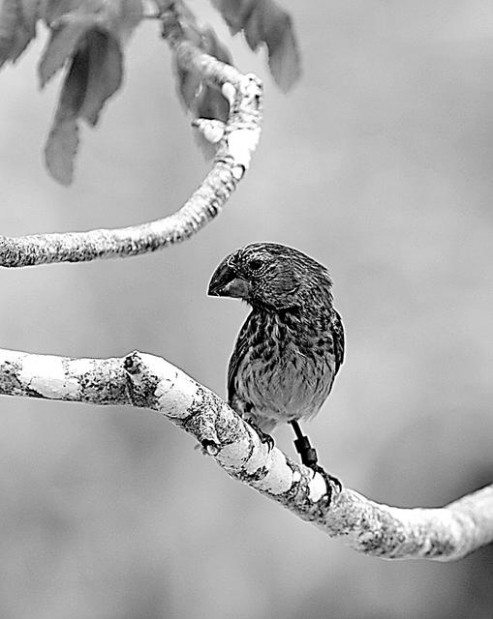
Finches on the Galapagos Islands that inspired Charles Darwin to develop the concept of evolution are helping confirm it — by evolving.
A medium-size species of Darwin's finch has evolved a smaller beak to take advantage of different seeds just two decades after the arrival of a larger rival for its original food source.
The altered beak size shows that species competing for food can undergo evolutionary change, said Peter Grant of Princeton University, lead author of the report appearing in today's issue of the journal Science.
Grant has been studying Darwin's finches for decades and previously recorded changes responding to a drought that altered what foods were available.
Grant studied the finches on the Galapagos island Daphne, where the medium ground finch, Geospiza fortis, faced no competition for food, eating both small and large seeds.
People are also reading…
In 1982 a breeding population of large ground finches, Geospiza magnirostris, arrived on the island and began competing for the large seeds of the Tribulus plants. G. magnirostris was able to break open and eat these seeds three times as fast as G. fortis, depleting the supply of these seeds.
In 2003 and 2004 little rain fell, further reducing the food supply. The result was high mortality among G. fortis with larger beaks, leaving a breeding population of small-beaked G. fortis that could eat the seeds from smaller plants.
That's a form of evolution known as character displacement, where natural selection produces an evolutionary change in the next generation, Grant explained.


