

Some neighbors on Tucson's far East and Southwest sides have taken their love for the desert to the next level.
Karen Reifschneider, for one, has always loved nature and wildlife and regularly hikes and rides horseback in and around Saguaro National Park East.
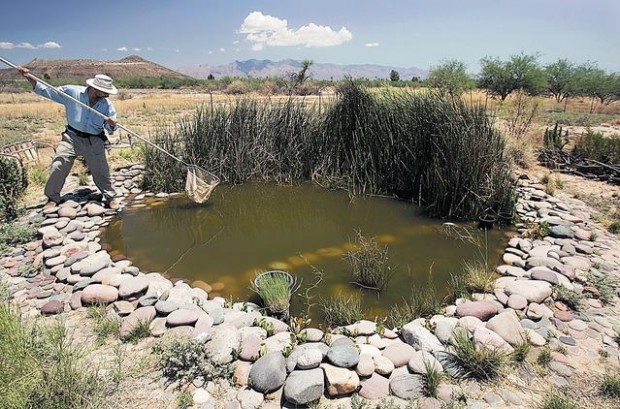
In the past few years, she and some neighbors have dug eight ponds, mostly in their backyards, to nurture an increasingly rare breed of native frogs.
Working with biologists and nonprofit groups, they hope to breed enough lowland leopard frogs so some can be transplanted to the national park.
Frogs have declined dramatically in Saguaro Park in recent decades from drought and the filling in of once-wet canyons with sediment, flushed downstream from the mountains after forest fires.
Transplants of the leopard frogs from Tucson's backyard ponds to the wilds of the park may begin as soon as next year.
People are also reading…
"We've tried to adopt a culture of preservation and educating ourselves,'' said Reifschneider, a 15-year resident of the Notch neighborhood, bounded by East Speedway, East Broadway, North Freeman Road and Saguaro National Park East.
"We do the best we possibly can to live here with wildlife rather than exclude wildlife from our properties," she explained. "The only way wildlife can survive in an urban or suburban area is to adjust to people, and people have to figure out how to adjust to nature."
Far across Tucson, neighbors Beryl Baker and Judy Fraser have worked with researchers and federal officials to have frog ponds dug in their yards, lying near the once-lush, now arid and nearly barren Santa Cruz River and east of Mission Road.
They live less than 1,000 feet from a tributary to the Santa Cruz, the West Branch, that has one of the last remaining mes-quite bosques in the region.
They want to restore a once-pristine area and to breed enough frogs to bring more wildlife into the city.
What is now urban Tucson had large leopard frog populations when its rivers ran wilder a century ago. The numbers dropped dramatically after the rivers died because of groundwater pumping, diversion for farming and other causes.
"What I'm doing is really for the city, in all the places that leopard frogs might live in the city: backyards, parks and ecological restoration sites," said Phil Rosen, a University of Arizona herpetologist and research specialist. "For me, this is not just a hedge against extinction. I just think it would be cool to have a lot of wildlife in Tucson."
Baker, a 28-year resident of the West Branch area, echoed that sentiment.
"We're trying to bring back and maintain some of the habitat so that critters that have managed to hang on with their teeth have a place to be," she said. "We want to show that people are really serious about conservation and that it wasn't just a bunch of people saying NIMBY (not in my backyard)."
The leopard frogs once lived in three Southwestern states, but have disappeared from Southern California and New Mexico. Their population is still secure in Central Arizona's mountain streams. But here in Southern Arizona, drought as well as pumping have dried up isolated canyons and other streams where they once lived. Disease and invasive species have also taken their toll.
They're not a federally protected species, but they're a candidate for state protection, and the federal government calls them a species of concern.
In the backyard ponds, by contrast, the leopard frogs are doing quite well.
Between 35 and 50 leopard frog tadpoles originally were dropped into each pond when the experiments began about four years ago. Now, the East Side pond populations peak at 300 but can drop to as low as 70 after many frogs hop away, on their own, into the wild.
The two West Side ponds contain a total of 100 frogs.
Leopard frog reintroduction into Saguaro National Park could start in a year or two, says Don Swann, a National Park Service biologist.
"There are factors we are evaluating: Whether there are places that are ready for frogs and whether we have the resources to do it properly," Swann said.
He takes heart at the efforts of the individuals willing to dig ponds to make a difference.
"The optimism — what people are willing to do to help conserve a species that's not doing that well — that's great to see," Swann said.
The ponds are striking, rich with such native grasses as bulrush, spike rush, poundpenny and deer grass, often bright green and standing up to five feet high.
In some cases, mesquite and palo verde trees shroud them, offering shelter for the frogs.
The ponds are usually no more than 2 or 3 feet deep, and 8 to 20 feet in diameter.
Besides the occasional frog seen hopping in and around the pond, native longfin dace dart around. And in the West Side ponds, native and endangered fish such as Gila chub or Gila topminnow swirl in the water. They're there to eat mosquitoes, as well as to help native species.
The ponds have drawn bobcats, coyotes, blue herons, black phoebes, vermillion flycatchers and other flycatcher birds, deer, and all kinds of reptiles.
Two javelina regularly spend their mornings asleep at an East Side frog pond owned by U.S. Geological Survey herpetologist Cecil Schwalbe.
But a constant threat is the non-native bullfrog, which not only eats leopard frog tadpoles but carries a fungal disease that can be deadly to the native leopard frogs. "Bullfrogs are like Typhoid Mary carriers — they don't suffer the consequences," Schwalbe said.
Every other week, researcher Dennis Caldwell visits the ponds at night to look for bullfrogs. If he sees one, he sometimes stays all night, trying to catch it and occasionally has to return three nights in a row.
"If I leave them, they stay, eat leopard frogs, or worse, they reproduce," he said. "If one bullfrog lays eggs, we've got 100 times the problem."
It cost Reifschneider $1,600 and fellow Notch resident Joann Caruso $1,300 for equipment for the ponds, including pumps, liners, skimmers and filters. The park service provided the frogs and advice. The Rincon Institute, a non-profit group that restores waterways, paid for technical support, including continued monitoring by biologist Caldwell.
"Not one frog, not one tadpole has been moved without documentation, without reporting to Game and Fish," Reifschneider said.
Caruso, after having her pond dug last November, got 100 frog eggs in March. When Caldwell came to her house last week, he counted 75 frogs — although Caruso finds them hard to see because they roam so much.
She has a standard backyard swimming pool not far from her frog pond, and at the end of June after the first monsoon rain, she found 15 in the pool. She quickly pulled them all out, but two were dead.
Caldwell then built a small, screened-in rescue "island" for frogs to hop onto in the pool, but Caruso's seen very few in the pool since then. "It's like they learned their lesson," she said.
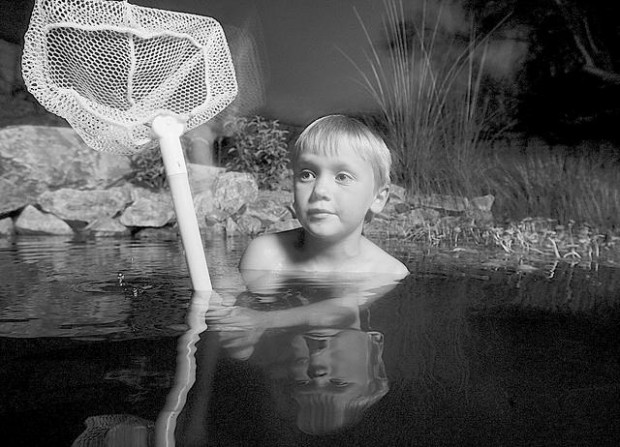
Caruso's 8-year-old grandson, Austin Amaral, says he likes to watch the splashes in the pond.
"They're pretty cute," his grandmother said. "They're just little guys, hopping around."
Frogs, toads
The croaking you often hear on a rainy summer night that sounds like a frog often, but not always, comes from toads. They're both amphibians. Some examples:
• The Great Plains toad.
• The Couch's spadefoot toad, an ancient species that's really a short-legged frog.
• The Sonoran Desert toad, also known as the Colorado River toad. They are dangerous to dogs, which can pick up their toxin by biting them.
• Red spotted toads.
• Bullfrogs, usually heard on Tucson's far Northeast Side near the upper reaches of the Tanque Verde Wash.
• Narrowmouth toads, actually frogs, that thrive along the Santa Cruz River and in the desert south of Interstate 10 and west of Houghton Road.


