

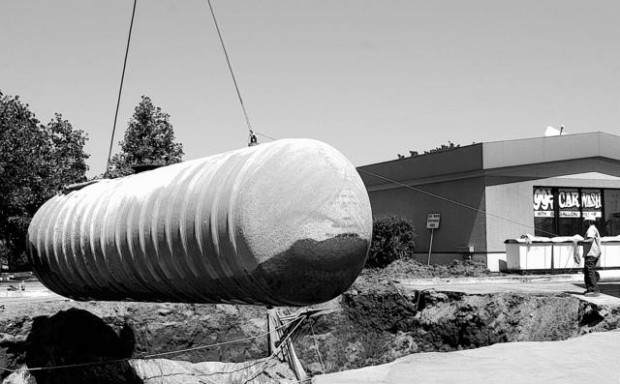
WASHINGTON — The government owns hundreds of underground fuel tanks — many designed for emergencies back in the Cold War — that need to be inspected for leaks of hazardous substances that could make local water undrinkable.
The Federal Emergency Management Agency has known since at least the 1990s that tanks under its supervision around the country could be leaking fuel into soil and groundwater, according to Associated Press interviews and research.
The agency knows of at least 150 underground tanks that must be inspected for leaks, says spokeswoman Debbie Wing. FEMA also is trying to determine by September whether an additional 124 tanks are underground or aboveground and whether they are leaking.
There has been no documentation of reported leaks or harm to communities from the FEMA tanks, Wing said, although former agency officials and congressional testimony suggest that the federal tanks have long been considered a problem.
People are also reading…
Many of these tanks were built to store 5,000 gallons of diesel fuel and placed around the country at the height of the Cold War in the 1960s to fuel electric generators that could sustain emergency broadcasts by radio stations in case of a nuclear attack or other catastrophe. Made of steel, the tanks inevi-tably rust and allow fuel to escape.
Steel tanks left in the ground for decades rot like Swiss cheese, said Pat Coyne, director of business development for Environmental Data Resources Inc. Coyne said a joke in the industry is: "What percentage of steel tanks leak? 100 percent!"
In the late 1980s and early 1990s, the government insisted on better-made tanks. The underground tanks of today must have safety measures, including leak detection and an extra shell made with material resistant to gasoline, diesel and ethanol, Coyne said.
The FEMA tanks are part of a larger problem. More than 500,000 leaking storage tanks — most of which are filled with fuel and oil — are buried across the country, according to Environmental Data Resources, based in Milford, Conn. That's about half of all the underground tanks in the country, the consulting company says. Those tanks are owned privately or by local, state and federal agencies.
Because they're underground, leaking tanks can go undetected for years. If diesel leaks into drinking water, affected people could be at a higher risk of cancer, kidney damage and nervous system disorders, said Rochelle Cardinale, a lead coordinator for underground tank cleanup in Iowa. A gallon of fuel can contaminate 1 million gallons of water.
FEMA says the hundreds of federal tanks have not always been its responsibility. The Federal Communications Commission also has had oversight, although FCC spokesman Clyde Ensslin said the commission believed FEMA was responsible for monitoring and maintaining the tanks. FEMA said it spent $8 million in the 1990s removing and repairing some of them.
FEMA now acknowledges it is the agency responsible for all of the tanks in question.
local angle
In Arizona, the Federal Emergency Management Agency is studying for possible leaks of underground fuel-storage tanks in Flagstaff and two locations in Phoenix.
The Associated Press


