

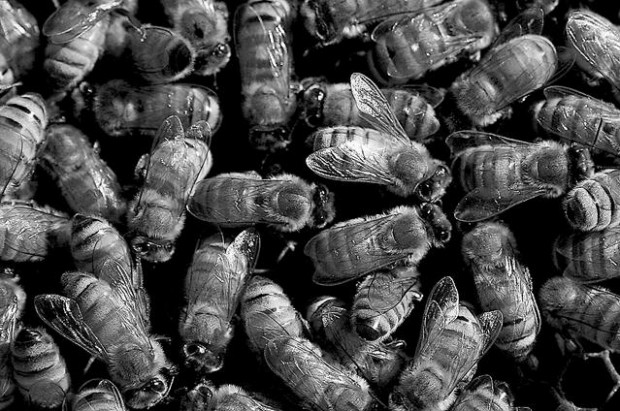
Welcome to Bee Month.
Desperate to protect their young in hives for the upcoming winter, bees are more likely to sting people and pets en masse in the fall, says a Tucson bee expert and managers and owners at seven bee-removal companies.
"The month of October is when we have more bee attacks than the rest of the year combined," said Steve Thoenes, an entomologist who has helped make and been interviewed on nature documentaries for the National Geographic Channel and the Discovery Channel.
Africanized honeybees, which account for nearly all of Arizona's feral bee population in urban areas, are less aggressive in the spring because bees are focused on food gathering rather than protecting nest sites, said Tom Martin, a bee researcher and president of AAA Africanized Bee Removal Specialists.
Scientific evidence does not back up the assertion that mass attacks are more common in October, said Gloria DeGrandi-Hoffman of the Carl Hayden Bee Research Center in Tucson.
People are also reading…
But Thoenes says his conclusion comes from observation and experience. And he has plenty of both: He breeds and studies bees at an apiary near Red Rock and also runs a no-kill removal service called Beemaster. His gold Humvee license plate reads "BMASTER."
Although it may be the most dangerous time for mass bee stings, researchers and most pest-control companies say there is less bee activity than normal this year. We have the monsoon, or lack thereof, to thank for that. During this year's monsoon, the official rainfall recorded at the Tucson International Airport was 2.8 inches, less than half of the average 6.06 inches.
"Today versus last year there are not nearly as many bees around," Thoenes said. "What the drought has done is delayed the whole season. The fall bee season has just started."
Martin said that while the overall number of bee colonies in Southern Arizona was down this year, bees are more active in urban areas because there are fewer natural food sources available. Thus, calls to his company for bee removals have increased between 30 percent and 35 percent over last year.
At an assisted-living facility in Marana on Sept. 16, two AAA employees took 10 hours to exterminate a 75,000-bee colony, then 15 hours the next day to remove 420 pounds of honeycomb from the ceiling.
The winged insects have proved to be a stinger all over Southern Arizona of late:
• On Sept. 26, Bugwiser Exterminating tarped a house in Catalina in preparation for termite fumigation. Bees inside the house swarmed and attacked the exterminators, who called Pat McCracken, owner of HTS Bees, to come down and kill the estimated 40,000 bees. McCracken cut a 2-foot-square hole in the roof to carve out the 45-pound honeycomb, which was drawing other bees from the area looking to harvest the honey.
"This late in the season, the bees are starving, looking for any source of nectar they can find," McCracken said.
• On Sept. 25, Chris Brinton, owner of Bee Bustin, killed an estimated 30,000 bees lodged underneath a wooden playhouse in the backyard of a home near Mountain View High School, on the northwest side. He used a jack to scrape out 100 pounds of honeycomb that served as a nerve center for bees that were attacking kids and dogs all over the neighborhood.
The honey, Brinton said, was pink and red: The bees had been feasting on hummingbird feeders with colored sugar water.
• In July, bees attacked a Green Valley man, stinging him 1,000 times and killing his dog, which he was walking. Firefighters who rescued him said he had so many stingers in him, they looked like dust.
Luckily for humans, Bee Month will buzz away as cool weather blows in.
We see fewer feral bees in cold months, DeGrandi-Hoffman said, when the insects generate warmth by clustering together in hives.
HOW TO KEEP BEES OUT OF YOUR HOME
• Caulk cracks in walls, foundations and roofs.
• Fill or cover holes larger than one-eighth of an inch in trees, buildings and walls.
• Put mesh screens over openings to attics, irrigation control boxes and water-meter boxes.
• Remove trash or debris that might serve as shelter for bees.
• Fill or cover animal burrows.
• Keep shed doors tightly closed and in good repair, and be cautious when entering buildings that are not used often.
Source: Carl Hayden Bee Research Center


