
It's still a deep-cut, saguaro-studded slice of paradise on the edge of our daily lives — but flood-struck Sabino Canyon will never be the same.
"The canyon is forever changed," said Heidi Schewel of the U.S. Forest Service as she trekked up Sabino this week.
"Whole sections of some slopes just collapsed and fell away. There are new channels entering the main channel that weren't there before. The creek blew right through one section of the road and covered others with boulder fields. ... Sabino is a different place now."
No wonder.
The torrent that scoured the treasured recreation site northeast of Tucson July 31 was the worst flood ever recorded there — topping out at about 17,000 cubic feet per second, said Robert Lefevre, watershed program manager for the Forest Service.
People are also reading…
He said the previous record in the canyon was about 16,000 cubic feet per second in 1999.
Emmet McGuire, supervisory hydrologic technician with the U.S. Geological Survey, confirmed that the flood was a record flow — and he provided data on water depth to put the flow rate in perspective.
"This thing peaked at 6:30 a.m. on July 31 with a depth of about 7.5 feet," McGuire said. "That's in a creek that can have no flow at all" and typically runs at a depth measured in inches.
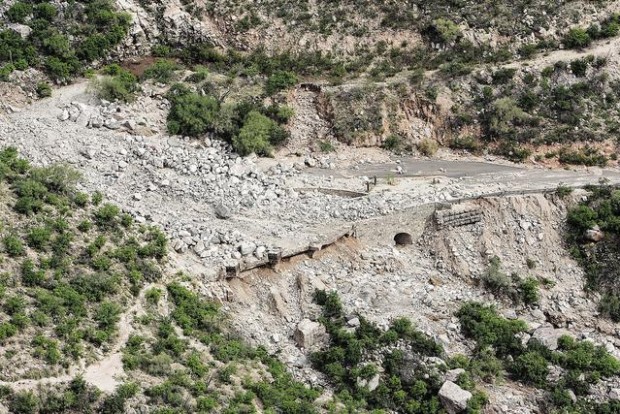
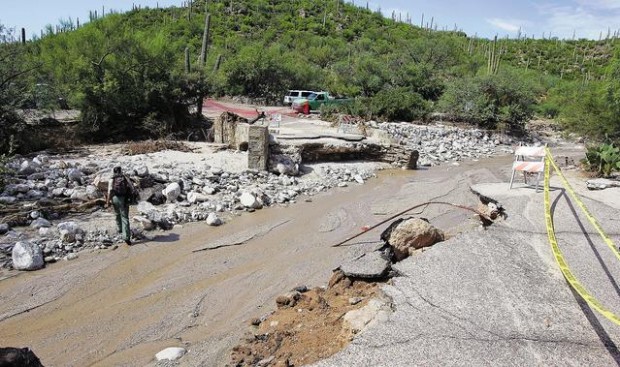
Damage — in addition to numerous rock slides, uprooting of cacti and erosion of slopes and trails — includes an impassable washout of the road at Rattlesnake Creek 1.5 miles up the canyon. Restrooms at shuttle stop 9 at the top of the 3.8-mile road were destroyed and washed downstream.
Remarkably, all nine bridges in the canyon — built in the 1930s by public-works program laborers — survived the flood.
Schewel said she couldn't provide even a ballpark damage estimate in dollars "until engineers have taken a deep look from a scientific standpoint."
Most of the canyon road and most trails remain closed while the damage is being assessed.
What happens next in Sabino depends on two potent forces: nature and public opinion.
On the nature front, new monsoon torrents could bring more flooding, more geologic remodeling, to the canyon.
On the opinion front, federal officials say they'll ask the public to help decide what should be rebuilt and what shouldn't.
Plans call for public tours of the flood-ravaged canyon beginning as early as next month.
"People love Sabino Canyon. The point of these tours is to let people see the magnitude of what happened up there — and to invite the public to tell us what they want us to do," said Schewel. "That could range from 'do nothing' to 'do everything possible' " to restore the canyon road, shuttle stops and other facilities. See the box on A1 for information on voicing your opinion.
Suggestions for Sabino's future are likely to run a broad gamut — from eliminating the road and shuttle tours entirely, to improving the road and expanding tourist facilities.
"My preference would be to consider the road and the bridges as something historic that should be preserved," said David Lazaroff, author of a 1993 book called "Sabino Canyon: The Life of a Southwestern Oasis."
"I'd like to see the road repaired and keep the shuttles running," Lazaroff said.
Others think this could be an opportune time to consider other options.
"I think we can find a new and improved way to match the ecological needs of the canyon with its outstanding educational opportunities," said Matt Skroch, executive director of the Sky Island Alliance, an environmental group in Tucson.
"One thing we would suggest is a nonmotorized, multiuse path," Skroch said.
But he emphasized that such a path might share the canyon with a shuttle carrying visitors at least part of the way up the road.
"If the tram is to continue, an electric tram is a good option to look at," Skroch said. "It would be quieter and cleaner" than a motorized vehicle.
As federal officials and the public begin to ponder the future of Sabino, those who know the canyon well would remind us that it's a dynamic, sometimes surprising place.
"In my 1993 book, I wrote that changes in Sabino Canyon are seldom dramatic," Lazaroff said. "What I wrote is no longer true. We are now in a period of very apparent and dramatic change."
Said Schewel of the Forest Service: "The 100-plus years we've been using this canyon is not even a speck on the geologic time scale.
"This flood damaged some of the things we attach value to. But it's nature. It's natural. The natural purpose of this canyon is to drain water from the Santa Catalina Mountains — and that's exactly what it's doing."
End of the road
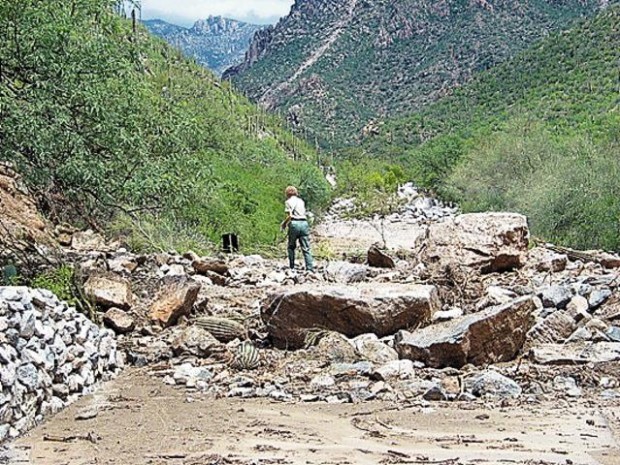
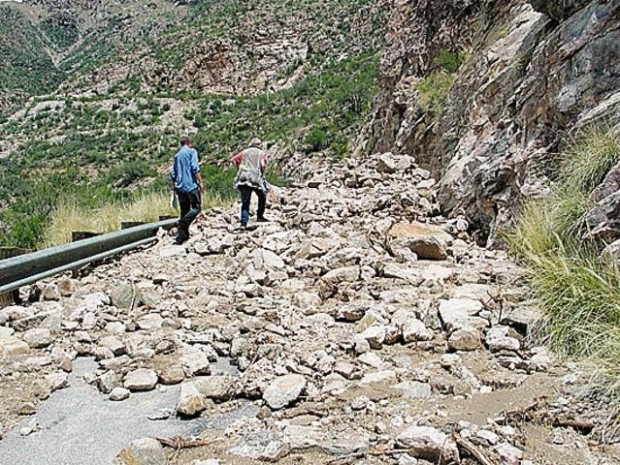
The record-setting flood that scoured Sabino Canyon on July 31 ripped out a section of the canyon road, destroyed the final shuttle stop (see photo above) and left other parts of the canyon strewn with boulders and debris. For more photos of the damage, see Page A4.
Shuttle stop 1
A wall of water surged from Rattlesnake Creek into Sabino Creek — taking out a segment of the canyon road on its way.
North of shuttle stop 7
Floodwaters swept over the canyon road just above shuttle stop 7 — depositing large boulders and plant debris in the road.
Between shuttle stops 8 and 9
Rocks completely cover the flood-ravaged canyon road between shuttle stops 8 and 9.