

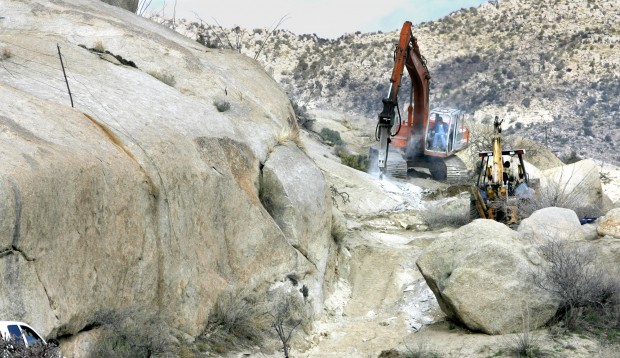
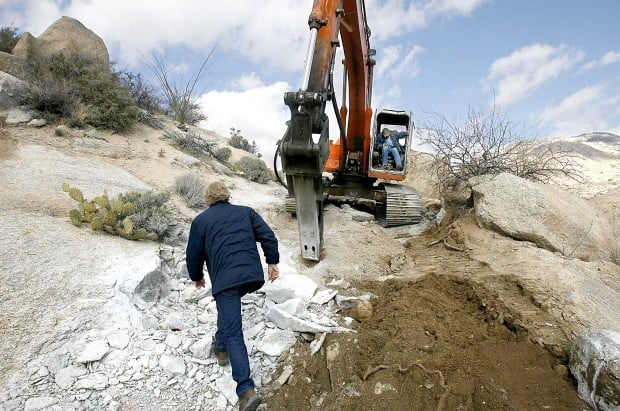
The roar of a jackhammer drilling into a windy, rutted forest road east of Catalina is drowned out only by the debate over whether the drilling should be going on.
The drilling is for roadwork in which boulders have been split to make a forest road snaking through the Catalina Mountains more accessible to the public and to U.S. Forest Service fire and trail crews.
The debate is over whether the project is an overly harsh blast at the landscape or essential upkeep of an asset.
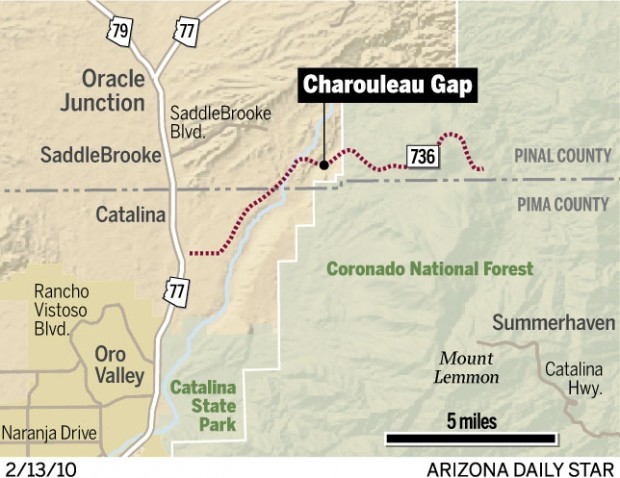
Forest Road 736, dating to the 1940s in some stretches, rises from a field full of prickly pear and mesquite and vaults Samaniego Ridge as it heads from the village of Catalina to the back side of the Catalinas.
As forest roads go, this one is a doozy, defying all but the hardiest four-wheel-drive vehicles. It twists like a pretzel, is dotted with bumps, pockmarks and huge holes and climbs almost at a 90-degree angle in spots. Much of the road is covered with granite, and most of it, including dirt-covered areas, is underlain with bedrock.
People are also reading…
It's been eight years since it was last maintained.
But because of its remoteness and ruggedness, it's popular with four-wheelers, who chug up there at up to 100 to 200 per weekend. It is particularly appealing to rock crawlers, people who spend thousands of dollars to outfit their vehicles so they can drive more closely to the ground and more slowly.
The debate stems from the nature of the fix, in which parts of the granite surface have been broken into 2- and 3-foot pieces and removed, leaving behind exposed dirt and a smoother if still steep roadway. To be finished in a week, the $29,000 project covers three miles at the road's north end near Oracle and two to three miles at the south end.
An unlikely band of critics ranging from the Center for Biological Diversity to four-wheel-drive groups calls it an environmental assault that could trigger massive erosion, aggravating downstream flooding problems. But a Forest Service engineer, Walt Keyes, said the agency needs to maintain this road as if it were a car or a roof that shouldn't be allowed to waste away.
"We need to get people up and down this road because it's a road," said Keyes. "That goes for our fire crews, the trail crews, the rancher permittee here, our range conservationist and everybody else who wants to come up here, including weekenders and hikers and birdwatchers. Right now, even our road maintenance equipment has trouble getting in there."
The existing road is in such bad shape that many four-wheelers bypass it, creating illegal spur roads to either side, he said, and he pointed to three or four such roads in a three-mile drive.
"In some spots, we won't take the main road up there because it's not safe. We have to take the illegal roads ourselves," Keyes said. "It was getting to the point where people were spilling oil and damaging vehicles on this road, so they had to bypass it."
Four-wheel-drive vehicle owners, who have driven this road for years, say this fragile landscape can't tolerate the extra vehicles that will be drawn to the area once the upgrade is finished. While even the finished road will be limited to four-wheelers, those who drive it now still envision a road overrun by litter, graffiti, beer bottles and crowds.
To four-wheeler Jim Diller, a Tucson real estate investor who is leading the criticism, the work goes far beyond maintenance. "They are destroying stuff that has been there 100 years. They are tearing boulders apart."
While some four-wheelers have given the practice a bad name by getting drunk and driving over bushes and shrubs, most four-wheelers on this road clean it, pick up trash and try not to damage it, said Tim Helzer, a longtime four-wheeler who is active in Wheeling Arizona, an online forum group.
The illegal roads are created by irresponsible four-wheelers and ATVers, Helzer said. But pointing to a group of split rocks, he added, "This damage is far worse than any drunk teenager has ever done."
Keyes is unsympathetic to the four-wheelers, saying, "They want it to be their playground."
But the Center for Biological Diversity, which has campaigned against what it says are abuses by four-wheelers elsewhere, agrees with them here. When the Forest Service was recently preparing a plan for which roads should stay open or closed in the Catalinas, the center and another environmental group, Sky Island Alliance, even supported keeping this road open to four-wheelers.
This roadwork will expose dirt that will wash into the Cañada del Oro wash, said Cindy Tuell, a center conservation advocate. The two groups are concerned that sediment washing into the CDO could plug up the stream, alter its banks or wash out vegetation, aggravating flood risks to downstream homes.
Nobody knows how much damage could result, because the Forest Service legally did this work without environmental analysis, Tuell said. As an existing road, 736 was excluded from such rules that apply to many federal projects. Yet when groups such as the center want to get existing public roads closed, even illegally built ones, they must conduct environmental studies.
In reply, the Forest Service's Keyes noted that the existing road already produces plenty of erosion of exposed soils. There wouldn't be an erosion problem if people weren't driving the road, added Jeff Pankow, a service contractor who was doing the hammering Thursday.
"Any use of the road will cause material to be loosened," said Keyes. "The whole place is flush with sediment."
On StarNet: Find more photos at azstarnet.com/gallery
DID YOU KNOW
Charouleau Gap along Samaniego Ridge in the Catalina Mountains was named for a French family of pioneers who traveled to this area in the late 1800s.
The north end of Charouleau Gap Road, also known as Forest Road 736, dates to 1910-1920, while the south end to the Cañada del Oro Wash dates to the 1940s, says the U.S. Forest Service.
Contact reporter Tony Davis at tdavis@azstarnet.com or 806-7746.


