


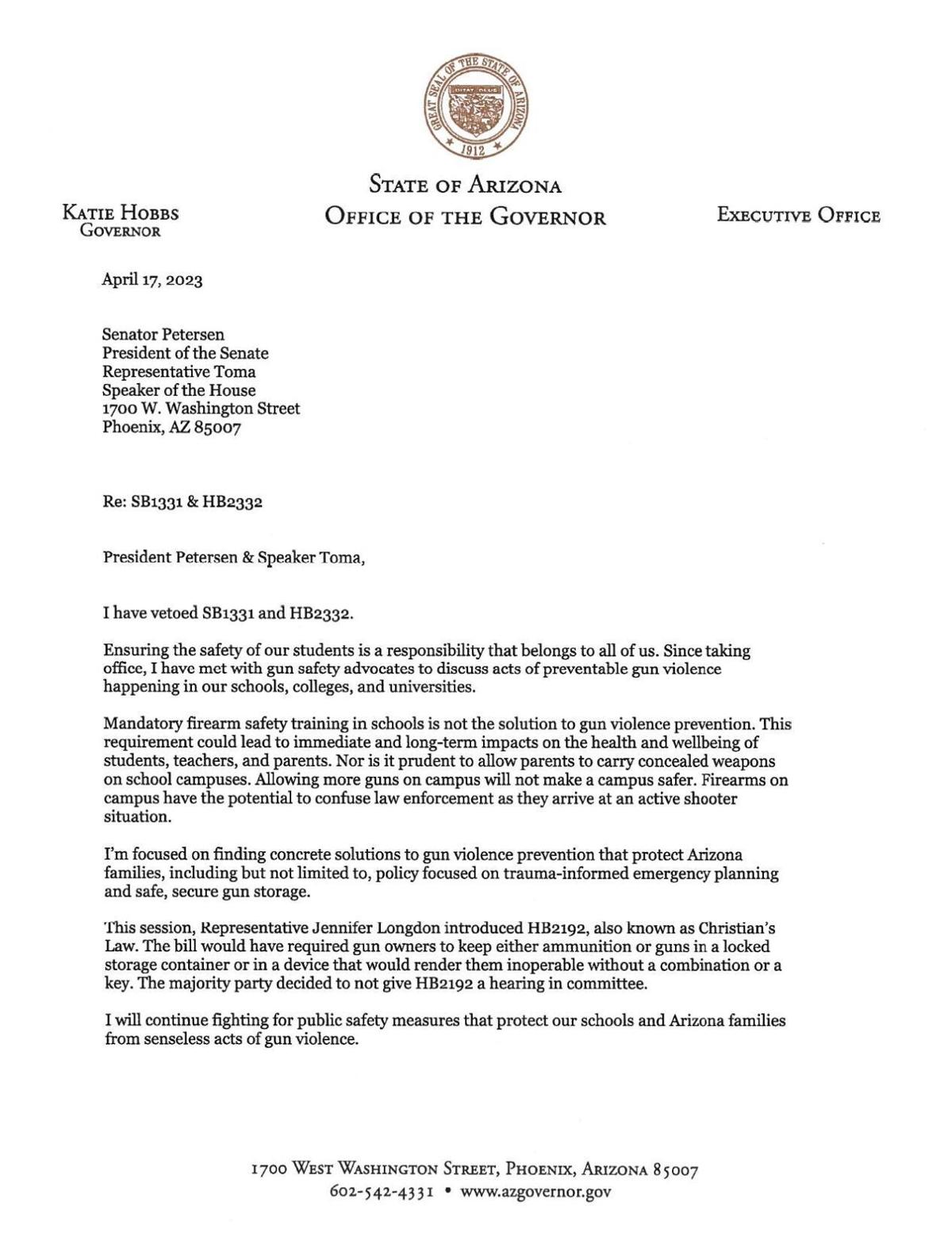
Two bills that would have allowed parents with concealed carry permits to be shielded from prosecution if they brought their firearms into gun-free zones and would require mandatory firearm training for students were vetoed on April 17 by Gov. Katie Hobbs.

A Lee Enterprises review reveals that lawmakers in 31 states have not passed red-flag laws even as most of those states received federal funding through the Bipartisan Safer Communities Act.
One of the bills, HB 2332, would have installed a gun safety program for middle and high school students that has been used by the National Rifle Association for more than 30 years. Hobbs, a Democrat, wrote in her veto letter allowing more guns onto Arizona’s campuses will “not make a campus safer” and that “firearms on campus have the potential to confuse law enforcement as they arrive at an active shooter situation.”
The other bill, SB1331, would enforce mandatory firearms safety training in schools.
“I’m focused on finding concrete solutions to gun violence prevention that protect Arizona families, including but not limited to, policy focused on trauma-informed emergency planning and safe, secure gun storage,” Hobbs said.
People are also reading…
Research experts and advocates of gun control argue that red-flag laws could significantly curb gun violence.
Red-flag laws allow family members and law enforcement – along with in some cases, health care providers and school officials – to petition a court to temporarily prevent a person from accessing firearms if they are found to be a danger to themselves or others, according to the Department of Justice. There are 19 states including D.C. that currently have red flag laws.
Arizona received $6.11 million through President Joe Biden’s Bipartisan Safer Communities Act, which aims to help states create and implement the red-flag laws, also referred to as extreme risk protection order programs. Alabama is among several states to receive the funding — most either noted in their federal funding application that they don’t intend to pass the laws or top lawmakers there have previously stated their opposition.
The funding comes with requirements including that states implement a Crisis Intervention Advisory Board that would assist in the implementation of efforts to prevent gun violence. In Arizona, the board will play a key role in deciding the priorities of addressing gun violence in the state.
Tony Vidale, deputy director for the Arizona Criminal Justice Commission, said while extreme risk protection orders, also referred to as red-flag laws, may be unlikely given the political climate in Arizona, there are a number of things the state can implement including crisis intervention and mental health programs at the municipal, state or county levels and they are open to working with nonprofits as well.
The efforts could also include: specialized court-based programs, including those that specifically accept clients with firearm violations, behavioral health deflection for those at risk to themselves or others and law enforcement agencies to safely secure, store, track and return relinquished guns.
“It is going to be a combined effort,” Vidale said.
Lisa Geller, director of state affairs at the Johns Hopkins Center for Gun Violence Solutions, discusses red-flag gun laws in the United States.


