

Needing more water to keep up with growth, Arizona and the six other Colorado River Basin states are looking to the sky.
The states plan to hire a consultant this spring to evaluate cloud-seeding and make recommendations for whether, where and how to pursue it.
The purpose is to create more snowfall in the Upper Rockies to feed the Colorado and its tributaries.
In three years, officials hope to launch the first phase of a regional cloud-seeding program. Most likely, the seeding would be done in Utah, Wyoming and Colorado, where it snows more.
Today, cloud-seeding is a popular but still-controversial practice. Four Western states have major programs — Utah, Wyoming, Colorado and Nevada — but many experts are divided about its effectiveness, 60 years since seeding experiments began.
People are also reading…
If seeding worked, it could nourish an over-allocated Colorado River. The states and Mexico have the rights to far more water than runs down the river in a typical year.
The U.S. Bureau of Reclamation estimated this month that seeding could produce up to 67 percent of the water each year that the Central Arizona Project annually delivers to Arizona, including Tucson, where it is used for drinking water.
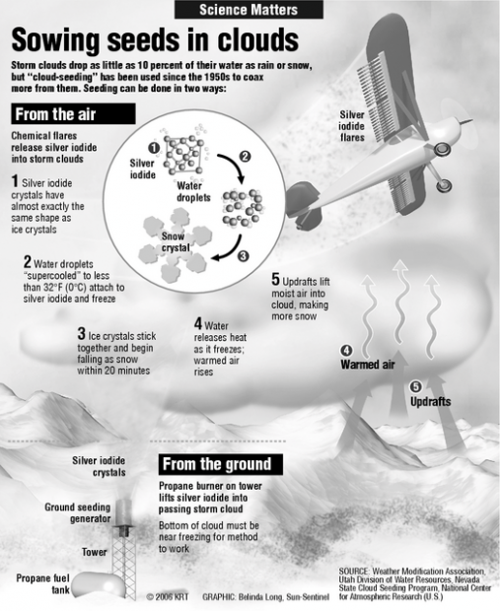
Seeding — which injects chemicals such as silver iodide into clouds to increase moisture content — is just one of many water-enhancing technologies that the consultant will review.
Others are desalinization, treating water from coal-bed methane in Wyoming and Utah, removing water-sucking salt cedar trees from rivers and cleaning up brackish groundwater near Yuma.
But seeding is considered a prime candidate because several Western states do it on a smaller scale. It's not very expensive, costing from $1 to $20 per acre-foot of water.
"We're going to seed the clouds," said Herb Guenther, director of the Arizona Department of Water Resources.
"To what degree and how we do it and how we fund it is yet to be determined," he said, adding, "It's very likely that it will have the desired result based on all the information I've seen to date."
In 2003, a National Academy of Sciences panel said there hasn't been much research to prove cloud-seeding successes that have been reported didn't occur by chance.
"One of the frustrations we have in the science field is that we don't know the processes well enough on how the precipitation is made, on cloud physics, to say that if you do this, this will happen," said Paul Try, who worked on the academy report and runs a science-technology consulting firm in the Washington, D.C., area.
The Weather Modification Association, a national group that promotes research and development of cloud-seeding, has fired back with a report that says that there have been statistically proven seeding success stories. The academy's standards are unrealistically strict, the group said.
Arizona and the other six states aren't sure how big a program they would want to do quickly, said a spokesman for the Southern Nevada Water Authority, which is overseeing hiring a consultant. Answering that question will be the consultant's job.
It certainly is difficult to measure seeding's success, said Kay Brothers, the authority's deputy general manager. If clouds are seeded and it snows, you don't know if it would have snowed anyway, she said. States could compare results of one 10-year seeding period with a nonseeded period, she said, but one may not know whether seeding or natural climate variations made the difference.
"The states think that if you can get some additional water, and cloud-seeding is not that expensive, it's probably worth doing," she said.
Utah experiments found a 10 percent snowfall increase from seeded compared with nonseeded clouds. In Nevada, the Desert Research Institute has traced the presence of chemicals from cloud-seeding in snowpack.
Kelly Redmond, a federal climatologist in Nevada, said seeding seems to work when done properly in the right situations, and because of its low cost it need not be wildly successful to pay for itself.
But he's skeptical that seeding could boost regional snowpack by more than a few percent. "It would have to be practiced on a pretty large scale. Can you produce it in a lot of places at once?"
Southern California's Metropolitan Water District found several reasons to pursue seeding, however — the drought, a trend toward reduction of snowpack since the 1950s, increased water demand and several studies showing that air pollution can reduce precipitation.
But while seeding is a drought management tool, it's best used under normal weather conditions to produce water for future dry spells, that water district wrote:
"During droughts there are few clouds available for seeding, and during wet winters there is enough precipitation so seeding operations would not be necessary."
● The Colorado River's estimated annual flow is 14.2 million to 14.8 million acre-feet through Lee's Ferry.
● Total demand — 18 million acre-feet, including 1.5 million acre-feet delivered yearly by the Central Arizona Project.
Where will the rest of the needed water come from?
● Cloud-seeding in the Colorado River Basin could provide:
● 1.87 million acre-feet, according to U.S. Bureau of Reclamation estimate in 1967-68.
● 903,000 to 1.515 million acre-feet, according to North American Weather Consultants estimate in 1972-73.
● 867,000 to 1 million acre-feet, according to Bureau of Reclamation estimates in 2006.
* An acre foot is enough to cover 1 acre of land a foot deep — or about 326,000 gallons.


