

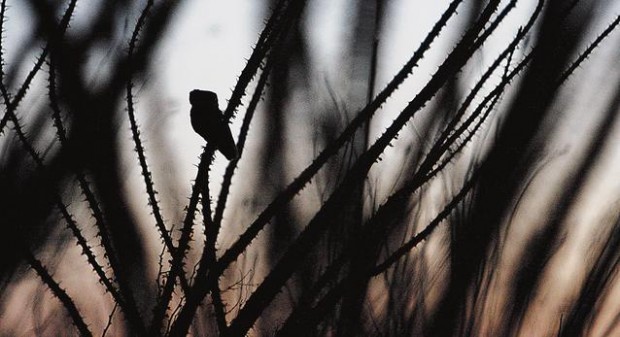
The glimmer of stars gradually gives way to a few scattered lights as the four-mile dirt road turns to pavement. Then it's another 25 or so miles before the stars have all but disappeared, and the lights of Tucson dominate.
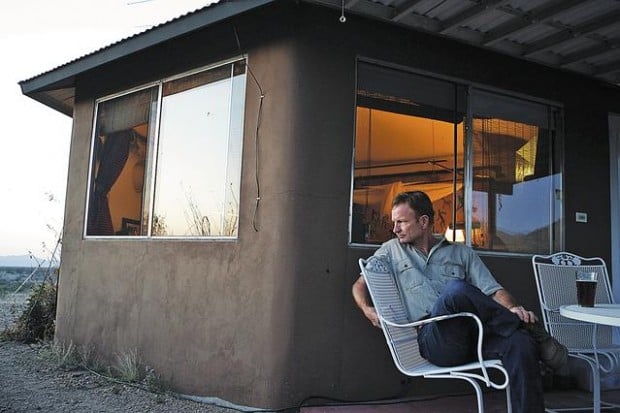
For Jonathan and Roseann Hanson, living under the stars and away from the pavement is the ideal — almost like living on safari, which suits them fine.
The Hansons, like all the residents in their neighborhood south and west of Ryan Airfield — south on Sierrita Mountain Road, past Diamond Bell Ranch Road and south of Pyle Road — live off the grid. No power lines, no water lines, no gas lines and no phone lines.
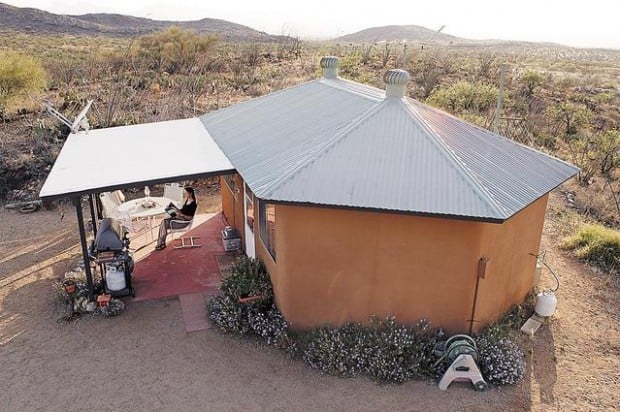
Sharing a 300-square-foot home — until the 1,000-square-foot home they have planned is built — keeps their needs minimal.
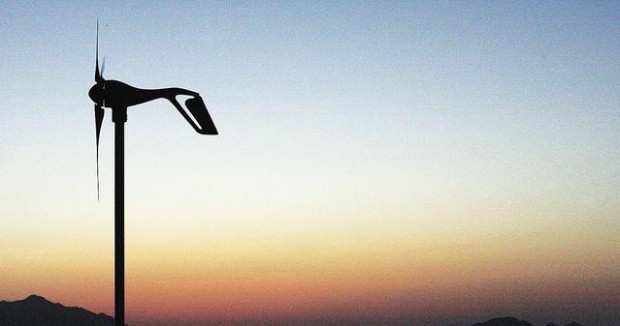
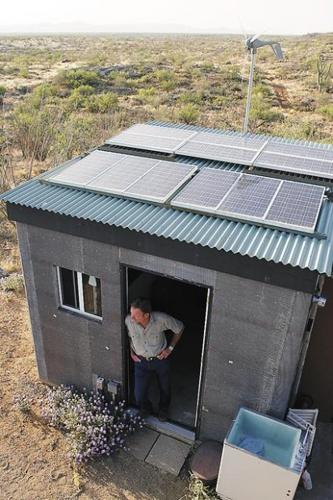
Solar cells and a wind generator supply their modest electrical needs. They have water on the property, pumped to a holding tank via a solar-powered pump. Netflix and satellite Internet complete the mix.
People are also reading…
The couple, who previously lived in Midtown Tucson, had been looking for property out west. When the opportunity came up four years ago to buy the 20 acres they now call home, the couple drew not only on their experience living off-grid in Brown Canyon as naturalists for the Buenos Aires National Wildlife Refuge, but also on their extensive travels in Africa.
"We didn't hesitate to jump into it again," said Jonathan, after topping off the water level of the 10 lead-acid batteries used to store their electricity.
By American standards, their energy needs, and consumption, are small. The solar cells produce a theoretical 1,000 watts per hour: "In other words, theoretically enough to constantly power 10 100-watt light bulbs. In actual use, we rarely see over 700 watts coming in — still plenty," Jonathan said.
"The wind turbine produces 20 to 50 watts with a normal breeze. Not much, but over the course of a breezy night it will keep the batteries topped up when there is no other charge coming in."
Living off-grid is easy, the couple say, but recent improvements in communication make it feasible to work from a remote location as well.
"We couldn't have done this without satellite Internet," Roseann said. The two are freelance writers, and Roseann is director of the African Conservation Fund (www.africanconservationfund.org), so communications are important.
"Our remoteness and small footprint allow us to live not just close to nature but within it," said Jonathan, noting that that is the best thing about their lifestyle.
Focus on tucson: alternative energy


