

PHOENIX — Democratic Gov. Katie Hobbs rolled out her executive proposal for the state budget Friday, focusing on bread-and-butter affordability issues she believes are critical for helping Arizonans — and for helping her win a second term.
But the $18.7 billion spending plan relies on political sleight of hand and some good luck to be balanced, including leaning on President Donald Trump's administration to dole out nearly $760 million to reimburse the state for money it has spent on border security since 2021.
To make the math work, she also relies on the Republican-controlled Legislature to raise taxes, something they are politically opposed to, and to cut spending on the universal school voucher program that GOP lawmakers consider sacrosanct.
The proposed tax increases include a $146 million boost in levies on sports betting, which was legalized in 2021 and is currently taxed at 10% of profits; as well as ending $38 million in yearly tax breaks handed out to new or expanding data centers.
People are also reading…
Together, the border reimbursements, tax increases and voucher cuts add up to nearly $985 million, about 5.5% of the proposed state budget.
Not to worry, Hobbs' spokesman Christian Slater said, at least on the border security money.
He said Trump has made clear he's all in on border security as a top priority, and Hobbs and Republican former Gov. Doug Ducey spent that money securing the border. With Trump's One Big Beautiful Bill, including $13 billion for border states that spent on border security, the Governor's Office expects Arizona to get its share.
"We have bipartisan agreement among our Republican state legislators, Governor Hobbs, Democratic state legislators, that this is going to be something that we fight for,'' Slater said. "And we feel very confident that we are going to be able to get that (money.)''
It may take some time.
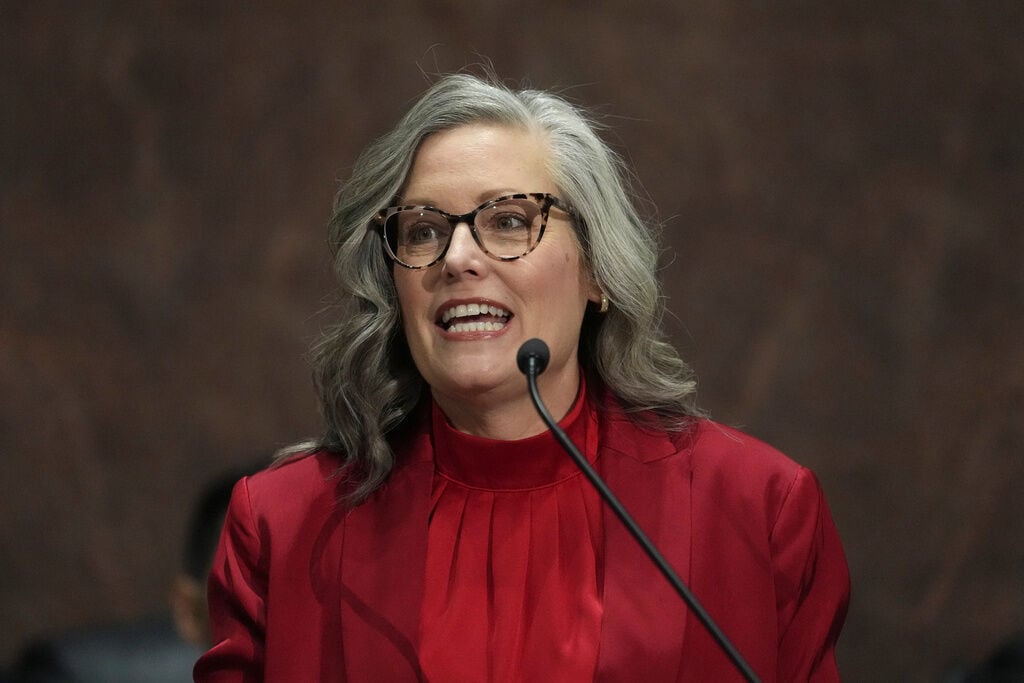
Arizona Governor Katie Hobbs says she will veto all legislation that reaches her desk until lawmakers deliver their long-promised budget proposal. Her $17.8 billion spending plan — panned by GOP lawmakers — has been out since January.
The U.S. Department of Homeland Security is charged with distributing the money to border states and has yet to come up with application rules. And Texas alone is asking for $11 billion of the $13 billion.
The cuts to school vouchers — Hobbs wants to eliminate eligibility for the so-called Empowerment Scholarship Accounts for those earning $250,000 or more — are unlikely to come to pass. That change in eligibility would save the state $89 million.
And then there is the proposal to boost taxes on the profits of firms that conduct sports betting, from 10% to 45%, which will need at least some Republican support to become law.
Tax increases generally require a two-thirds legislative vote.
But Slater said the Governor's Office believes the law legalizing sports betting allows changes with just a majority vote. Even that, however, would need some GOP support, since Republicans hold majorities in both the House and the Senate.
Republican Rep. Jeff Weninger, who sponsored the original 2021 legislation that legalized sports betting, was flabbergasted at the size of the proposed state take on profits made by gambling companies.
"Oh my gosh!'' he exclaimed.
First off, he believes that under the state constitution, Hobbs will need 20 of 30 senators and 40 of 60 representatives to approve such a move. Secondly, he fears raising the tax that much would increase costs for companies that they would then pass on to customers, driving legal gamblers to the illegal market and backfiring by actually lowering state revenue.
Hobbs also proposes a one-time expenditure of $6 million in marketing the Lottery, arguing that will convince Arizonans to gamble more and boost state revenue by $26.5 million.
Hobbs is counting on all of these revenues to support her "middle income tax cuts program'' and its nearly $250 million price tag.
GOP tax-cut plan vetoed
On Friday, the governor followed through with her threat to veto a more extensive $440 million tax-cut proposal pushed by Republicans, which would have scrapped some of what she wants, including enabling anyone 65 and older to deduct $6,000 from their taxable income.
Instead, the GOP plan would have provided a $6,000 deduction — but only against what people are getting in pension benefits and withdrawals from retirement accounts. Democrats say that won't help those who lack the finances to have such accounts in the first place.
Republicans also want some tax breaks for businesses that Hobbs has declared a non-starter.
Aside from whatever she and GOP lawmakers eventually agree on about tax cuts, Hobbs wants a number of new and expanded programs.
All of that translates into her request to increase year-over year state spending by 4.8%.
By contrast, state population is up 1.2%, and the most recent inflation figures show a 2.2% annual increase.
Slater said people should look instead at the fact that the state has 10% fewer employees now than in 2000, yet a much larger population. He also said the cost continues to increase to help Arizonans who use the social safety net the state provides, through programs including Medicaid and aid to the developmentally disabled and other populations.
"We feel as though the governor is doing a very wonderful job making sure that state government is right-sized,'' he said.
As for building a budget on money that's not guaranteed, Slater said, "I think we have a very reasonable and balanced budget based on, I think, some pretty reasonable assumptions,'' including more money from sports betting "and the federal government's willingness to reimburse us" on the border.
Slater called the plan to limit vouchers based on family income "very reasonable.''
He noted that Trump's federal version of school vouchers has a cap of its own.
But the federal plan is different, limiting those vouchers to families with income that does not exceed three times the area median gross income.
That income eligibility cap would translate to about $328,000 in the Phoenix metro area, using figures from Fannie Mae, and to about $288,000 in Tucson and smaller numbers in rural areas.
'Affordability' proposals
Governors' executive budgets are mainly starting points for negotiations with the Legislature. Hobbs' plan is packed with what she is calling "affordability'' items she hopes will win voter support.
In addition to the tax cut package, she wants to expand utility assistance for middle-class Arizonans, using $15 million in COVID funding and another $15 million in general fund money, plus about a third of that spending to help people add insulation and other upgrades to save energy.
She plans to keep that fund going with a $3.50-a-night fee on vacation rentals, which also would help with weatherization and home repair, as well as put money into the state Housing Trust Fund, which helps finance new affordable housing.
Hobbs is also seeking to boost spending on school lunches, planning nearly $4 million to eliminate co-pays some families are charged and to expand a summer vacation food program.
She also wants to increase spending on child-care assistance, a program with a large waiting list, by $45 million. The program helps pay for child care, expenses that sometimes push low-income workers to quit their jobs rather than see much of their paycheck got to babysitting costs.
And she wants to boost new affordable housing construction by using $2.5 million in federal COVID relief cash and private dollars, a plan she said will leverage up to $300 million in new apartments.
Taking a page from the Trump administration's Department of Government Efficiency, or DOGE, Hobbs on her own is directing her staff to seek money-saving moves by simplifying operations, boosting data and technology use and pairing agencies to get better deals.
However, she plans to save money and eliminate waste in a far different way than Elon Musk's knee-capping methods, where thousands of federal workers were fired, and whole parts of the federal government's operations were slashed.
"We're going to show the federal government how to do it right,'' said Slater. "We're not going to slash and burn indiscriminately. We're not going to slash vital programs that are going to end up impacting Arizonans in a negative way.''
That also means that, unlike DOGE, no state employee will lose a job under the plan, he said.
"We're going to find efficiencies, we're going to find cost savings, and we're going to work across all of state government to make sure that every penny of taxpayer dollars is used to deliver important services for the people of Arizona,'' he said.


