PHOENIX — What's coming out in the Epstein files spilled over Tuesday into state Senate debate.
The issue came up because Flagstaff Republican Sen. Wendy Rogers wants to rename a state road as the Donald J. Trump Highway.
The 193-mile stretch of State Route 260 from Cottonwood to Eagar is now designated as the General Crook Trail because it largely follows an original dirt road built in the 1870s as a military supply wagon road. But Rogers wants the Arizona State Board on Geographic and Historic Names to replace its name with Trump's.
Her proposal lists a host of reasons she says Trump deserves the honor, ranging from construction of additional border walls, to his role in enacting tax relief, to his canceling of U.S. participation in the Paris Climate Agreement.
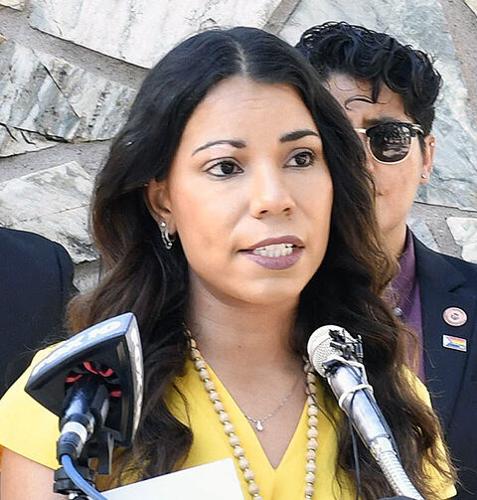
But when the measure came to the Senate floor on Tuesday, Phoenix Democratic Sen. Analise Ortiz had questions.
People are also reading…
Rogers wouldn't agree to respond. So Ortiz laid out her case for why such an honor is misplaced.
That specifically includes reports in the New York Times that the president's name is mentioned more than 38,000 times in the Epstein files.

Sen. Wendy Rogers, R-Flagstaff
Ortiz also referred to recent news reporting by NPR and The New Republic an FBI "tip sheet'' — essentially a record of complaints the agency received, which was part of the latest document release — mentions a 13-year-old girl who was introduced about 35 years ago to Trump by Jeffrey Epstein. The unverified report, filed by a friend of the girl, contended she performed a sex act on Trump. There was no independent corroboration of the allegation, with the tip sheet simply saying the lead "was sent to Washington Office to conduct interview.''
There has not been independent corroboration of that allegation. And Ortiz's comments were ruled out of order by Republican Sen. Frank Carroll, who was presiding over the state Senate.
But it did not stop Ortiz from saying there's more in the files that should make lawmakers question having Arizona honor Trump with a road.
"These files ... dictate horrific sexual abuse, the most heinous sex trafficking ring possibly in history,'' she said.
"President Trump has been hiding these documents,'' Ortiz said. "His Department of Justice has been scrubbing these documents from the law that passed to make these public.''
Before the state takes any action to honor Trump, she said, there should be full disclosure of what else is in the Epstein files.

Sen. Analise Ortiz, D-Phoenix
"We should not even be entertaining or talking about this right now,'' Ortiz said of honoring Trump.
But with Republicans in support of Rogers' proposal — and in control of the Senate — none stood up to speak in favor of Rogers' proposal. The Rogers measure gained preliminary approval on a voice vote.
While Rogers did not defend her measure on Tuesday, she did rise to its defense when the proposal first went before a Senate panel in January.
"Needless to say, our president is bigger than life,'' Rogers told colleagues.
That, in turn, provoked a response from Sen. Mitzi Epstein.
"We should name our public places after people who have led exemplary lives, not after a person who has led a disgraceful personal life,'' said the Tempe Democrat. She said this isn't partisan because there are many Republican politicians who could be honored in this fashion.
"But not this one,'' Epstein said.
She also said it's not just about what's in the Epstein files.
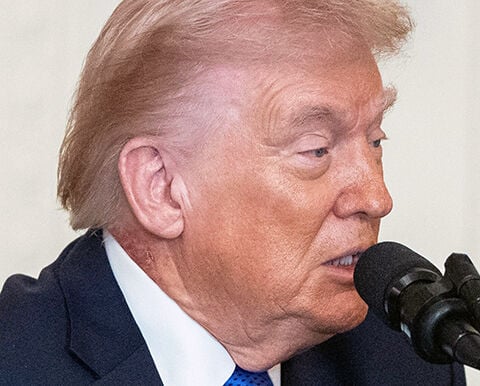
President Donald Trump
She also mentioned Trump's 34 convictions involving what prosecutors said were falsified business records designed to conceal payments he made to cover up an extramarital affair. He was separately found liable in a civil trial for sexually abusing E. Jean Carroll and then defaming her in denying the allegations; he was ordered to pay $5 million in damages.
And then, Sen. Epstein said, there was the recorded comment in which he said he could "grab women" by the "you've heard of it," as she put it. '
But her objections gained no traction.
Sen. Mark Finchem, R-Prescott, responded with just two words: Bill Clinton, a reference to issues that the former president faced about his sexual activities when he was in the White House.
Tucson Republican Sen. Vince Leach had his own reason for supporting the road naming in Trump's honor. He said President Abraham Lincoln has been called perhaps "the most divisive in our history," "and yet he is recognized all over this country."
And Senate Majority Leader John Kavanagh, R-Fountain Hills, called Sen. Mitzi Epstein's comments an "unjustified and untrue slandering of our president.''
Rogers' measure still requires a final roll call vote in the Senate before going to the Republican-controlled House.
Because of the way it is worded, it would not require the approval of Democratic Gov. Katie Hobbs.
But it also would not necessarily guarantee that the State Board on Geographic and Historic Names would honor the request.
The board has independent authority to decide which names are appropriate. It also has a policy of not naming geographic features after individuals until they have been dead for at least five years.
This proposal differs from that of Arizona Senate President Warren Petersen to designate a highway in Maricopa County as Charlie Kirk Loop 202 in honor of the slain founder of Turning Point USA. That one simply directs the Arizona Department of Transportation to erect signs with the name along the 78-mile road. Approved by the Senate on a party-line vote, Petersen's bill awaits action in the House. It would need Hobbs' approval; she hasn't commented.
Rogers' attempt is actually her fourth to try to get State Route 260 named after Trump. Efforts in 2021 and 2022 did not even get out of committee; a 2025 bill did make it to the full Senate, only to fall one vote short.
Howard Fischer is a veteran journalist who has been reporting since 1970 and covering state politics and the Legislature since 1982. Follow him on X, Bluesky and Threads at @azcapmedia or email azcapmedia@gmail.com.