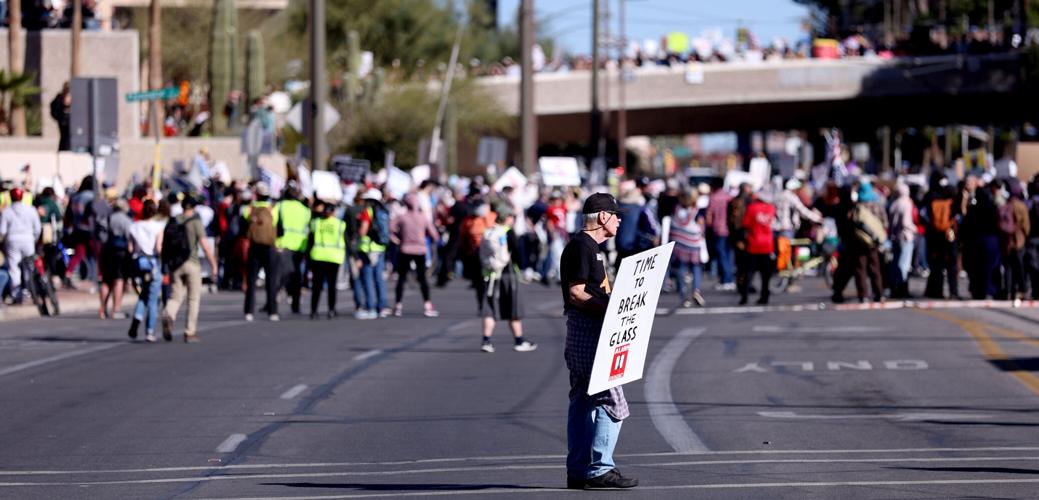
PHOENIX — State lawmakers are moving to create broad new crimes of "civil terrorism'' and "subversion.''
But the proposal that is set for a roll-call vote in the House this week is not as radical as originally proposed. And that's only because a Scottsdale Republican lawmaker convinced colleagues to remove key provisions.
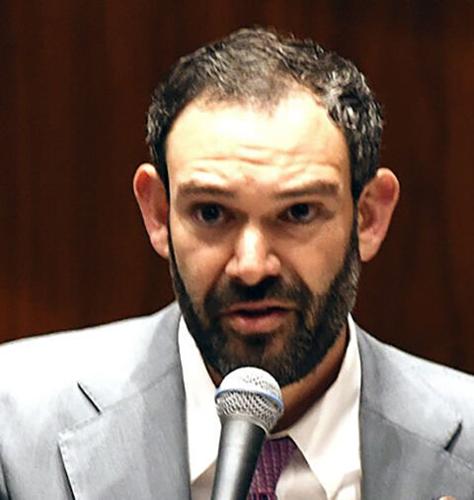
Rep. Alexander Kolodin said there's nothing wrong with creating laws designed to prevent people from interfering with the constitutional rights of others.
But he said the legislation, crafted and promoted by the Manhattan Institute in the name of dealing with civil disturbances, was so extensive that it would make criminals out of people engaged in actions protected by the First Amendment. In fact, Kolodin said that, as worded, it even would have allowed prosecutors to charge him with a felony because of public statements he made about the state's diminishing water supply — statements that could be interpreted as causing fear, which the law would ban.
People are also reading…
And in a word of warning to fellow Republicans, he said that the original plan could have even undermined their own efforts to curb the size and scope of government.
Kolodin managed to convince colleagues during floor debate this past week to make the changes he wants.
The measure, however, is still far from becoming law. HB 2136 still requires a roll-call vote.
House Minority Leader Oscar De Los Santos said that, even in amended form, it still would provide government with broad authority to use the threat of prison time to crack down on protests. And the Laveen Democrat suggested to Republicans they may want to take a closer look at what they are proposing.
"It seems to me that, under the definition of civil terrorism in this bill the January 6 insurrectionists are civil terrorists,'' he said, when some people assaulted police officers, broke into the Capitol and tried to stop the electoral vote count in an effort to prevent certification of the results, which showed that Joe Biden had won the presidential election.

An Arizona measure would create new felony crimes of civil terrorism and subversion punishable by 18 months in state prison. HB 2136 says someone commits civil terrorism for planning, preparing or coordinating acts "that are designed to cause widespread fear.''
Even if it gets final House OK, it then goes to the Senate. And even if approved there, it still would have to withstand a potential veto from Democratic Gov. Katie Hobbs.
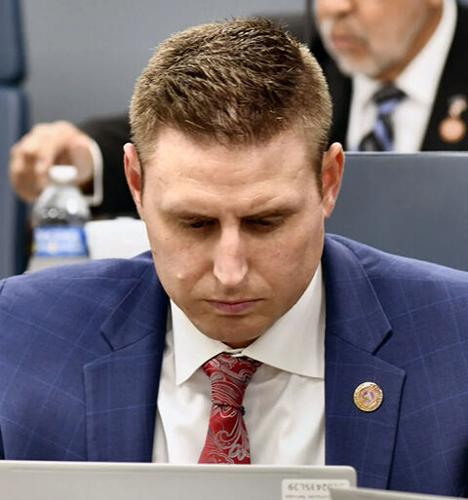
The legislation is being promoted by Rep. Michael Way, R-Queen Creek, in the wake of anti-ICE disturbances in other cities.
But the language comes from the Manhattan Institute. Co-founded by William Casey, who later became the director of the CIA under Ronald Reagan, its self-proclaimed goals include advancing "creative, evidence-based policy ideas for better policing, public safety and criminal justice.''
Tal Fortang, a legal policy fellow at the Manhattan Institute, testifying at a committee hearing last month, told lawmakers that in Arizona and elsewhere, "extremist groups'' are making increased use of "civil terrorism.''
"That term refers to the mass commission of minor crimes in order to intimidate or coerce civilians into taking unpopular political positions,'' Fortang said.

Rep. Michael Way
"Instead of persuading their fellow Americans through free and robust speech, they break laws by doing things like blocking roads, or vandalizing, or destroying property,'' he said. "When you engage in democratic politics, actions that inconvenience your fellow citizens are the worst things you can do.''
And that led to the measure to create new crimes of civil terrorism and subversion and make them felonies, punishable by 18 months in state prison.
It cleared the Republican-controlled House Judiciary Committee on a 6-3 party-line vote.
Kolodin, during debate of the full House this past week, told his colleagues they need to understand what they were being asked to approve.
Consider, he said, language in HB 2136 spelling out that someone commits civil terrorism for planning, preparing or coordinating acts "that are designed to cause widespread fear.''

Rep. Alexander Kolodin
"Well, I recently put out a communication that was designed to cause widespread fear,'' Kolodin said.
He proposed legislation that would have required water suppliers to notify all of their customers of what happens if there is no longer water from the Colorado River available, including what it will cost to find alternate sources and treat and deliver them. That drew criticism from Rep. Teresa Martinez, R-Casa Grande, who said sending out that kind of notice, without further explanation, might cause "mass hysteria.''
Kolodin gathered no traction for the notice requirement, and his bill died. But he said lawmakers should not be adopting language in HB 2136 which would criminalize such warnings.
The bigger problem, Kolodin said, is a lack of understanding by some of what the founders of this country had in mind when they crafted the First Amendment. And he told his colleagues they have to stop thinking of them as "staid old men.''
"The framers of the United States Constitution were some of the most radical people who ever lived,'' he said. "And that's a very good thing for our country because they endowed Americans with a right that no other people in the world possess: the right to speak freely, totally freely, free of the fear of government consequence.''
More to the point, Kolodin said this right goes farther than most people think, "even perhaps many people who have been members of this body.''
He cited a U.S. Supreme Court ruling which sets a two-part test on when the government can restrict speech.
First, he said, it needs to call for "imminent lawless action.'' But that, too, remains legal unless `there's a reasonable chance it actually will provoke that imminent lawless action.''
Kolodin said that makes illegal the language in HB 2136, which would have defined civil terrorism to include any unlawful act "with the intent to coerce or intimidate a civilian population.'' And he convinced lawmakers to vote to replace that with language that makes it a crime only if someone intentionally commits vandalism or destruction of property in a way that "imminently threatens to cause unlawful and serious physical injury to another person or actually causes unlawful or serious physical injury to another person.''
Also gone as a result of Kolodin's amendment is language that would have made it a crime to make statements, communications, manifestos or directives before, during or after the act that advocates the use of violence or unlawful force to influence the behavior of a civilian population.
But HB 2136 also includes a whole new section of law making "subversion'' a crime. And that, in the form promoted by Way and approved by the Judiciary Committee, included "subvert the government of this state or the United States.''
That language, Kolodin said, should alarm some lawmakers. So he insisted it be removed.
"In our country, it is arguably a civic duty to work to undermine the government,'' he said.
"As conservatives, we view that as a large part of our job: to limit, narrow and fetter the government so that it is not a threat to people's liberty,'' Kolodin told colleagues.
"Americans owe no loyalty to a government,'' he said. "Americans owe loyalty to one thing and one thing only. And that is the Constitution.''
What replaces the stricken language, Kolodin said, is language that allows someone to be convicted of subversion only if that person attempts to deprive anyone else of their liberties under the Bill of Rights of the U.S. Constitution or key portions of the Arizona Constitution.
"Now the language is very firm, very rigorous, very detailed,'' he said. "And I hope that it will be used as a way to keep government in check more than it will be used against normal citizens.''
Even in an amended fashion, it still could be rejected by Hobbs.
The governor vetoed a measure last year that would have made it a felony to intentionally interfere with traffic if it results in more than 25 vehicles being held up.
"Recognizing the sanctity of constitutionally protected rights, it is critical we approach these matters with precision to avoid infringing on Arizonans' freedoms,'' she wrote.
Howard Fischer is a veteran journalist who has been reporting since 1970 and covering state politics and the Legislature since 1982. Follow him on X, formerly known as Twitter, Bluesky, and Threads at @azcapmedia or email azcapmedia@gmail.com.