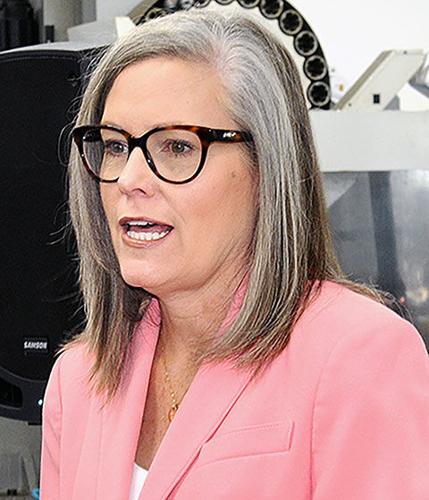
PHOENIX — Beset by multiple investigations and political charges of "pay-to-play,'' Gov. Katie Hobbs unveiled her own plan Tuesday she says will make public any links between businesses and the money they provide to elected officials.
The proposal would forbid anyone who owns more than 5% of a company from giving more than $50 to any candidate for statewide legislative office between the time of submitting the bid and it being awarded. That would apply to contracts of up to $100,000.
It would also set up a public database with the names of individuals and companies who are awarded contracts.
But none of that would provide information on how much they gave, to whom, and when. Instead, anyone interested then would have to look up the names of the donors in campaign finance reports to find out which candidates and elected officials benefited.
People are also reading…
There is also a big loophole: The law would apply only if the donation went to the elected official or that person's political action committee. But there would be no way of knowing if the donor gave money to one of the politician's causes — like an inaugural fund.
That became an issue with the discovery that Sunshine Residential Homes, which provides care to children removed from their homes by the state Department of Child Safety, had kicked in $100,000 to Hobbs' 2023 inaugural.
Sunshine later got the state to agree to two increases in what it was paying. Those increases and Sunshine's donations, not only to Hobbs but another $300,000 to the Arizona Democratic Party, are at the heart of probes by Attorney General Kris Mayes, Maricopa County Attorney Rachel Mitchell, as well as a special committee of House Republicans who hired an out-of-state attorney to review the dealings.

Gov. Katie Hobbs
Aides to the Democratic governor dismissed any concern about the fact that, as structured, her plan would not allow someone to look up how much was given to inaugural funds. They acknowledged those donations are exempt from public disclosure but pointed out Hobbs eventually did make them public.
But what Hobbs has never publicly disclosed is that she also got money into a separate "legal defense fund.'' The only reason that fund even became public is because the Arizona Corporation Commission forced Pinnacle West Capital Corp., the parent company of Arizona Public Service, to publicly disclose all of its political activity.
A spokesman for the Hobbs campaign has refused to disclose others who have given to the defense fund — or even the total amount the governor has collected for her legal fees. Instead, spokesman Michael Beyer said creation of the fund was justified because Hobbs has to fight legal challenges to the 2022 election results from losing Republican candidate Kari Lake.
An aide to Hobbs would not address Tuesday why her proposal does not include donations to a legal defense fund. That's particularly significant because, like inaugural accounts, there is no public portal to find who donated to those funds.

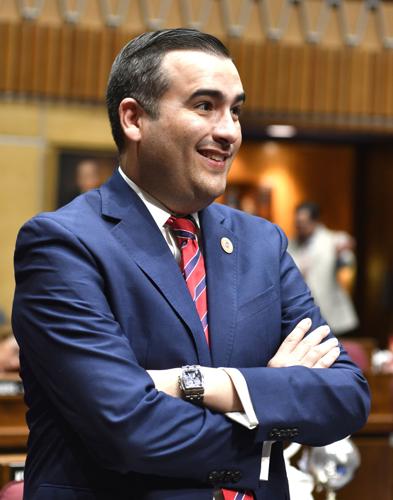
Sen. T.J. Shope
The governor's plan was unveiled less than 24 hours before the Senate Committee on Regulatory Affairs and Government Efficiency is slated to hear a competing proposal from Coolidge Republican Sen. T.J. Shope.
His Senate Bill 1168 turns the process on its head. It would be up to anyone responding to a request for bids from the state to affirmatively disclose "anything of value'' the company, its officers, directors or family members provided in the prior five years to the governor or any campaign for that person.
"Her proposal focuses on releasing information after contracts are awarded,'' Shope said. "Our bill requires transparency before decisions are made, when it actually matters.''
But a spokesman for the governor said it is Shope who has it backwards. He said that what the senator wants would make available to the public — and to state employees awarding a contract — a company's donation before a contract is awarded, something that could seem to influence a decision.
Shope, however, described Hobbs' approach — having to look through a database of business owners and then compare that to campaign finance reports filed with the Secretary of State's Office — "not user-friendly.''
He also questioned how much it would cost to set up and maintain this database.
Shope also said his bill does include inaugural funds, with an amendment planned to also require disclosures about legal defense funds.
All this comes nearly a year after Hobbs vetoed a similar proposal offered by Shope that covered all state contracts. In her veto, she never explained her concerns with the bill, but said the current procurement practices for managed care contracts "are consistent with Medicaid industry best practices.''
But investigations have been multiplying about the links between donations to Hobbs and the Arizona Democratic Party from the owners of Sunshine.
Sunshine had sought a rate increase in what the state paid to house foster children in early 2023. But that was rejected by Matthew Stewart, who had been the governor's first nominee to head the Department of Child Safety.
But in May, the agency agreed to raise the standard rate from $140 per bed to $195, a 30% increase.
Agency spokesman Darren DaRonco said Sunshine made the case that unless it got more money, it would transfer more of its beds to the federal government to house immigrant children. He said such a move — the feds were paying $225 — would have meant fewer places for DCS to place its foster children.
Then Sunshine got a new contract, boosting its rate to $234.
Hobbs has consistently denied any involvement in the rate hikes. But with the multiple probes, she said in November she was "looking at proposals'' for laws to ensure the disclosure of political gifts from companies seeking government contracts from the state.
Shope said he finally got a "concept'' for a bill from the Governor's Office earlier this month. But by that point, he had already crafted SB 1186 and had it set for a hearing.
In fact, he said, he did not see the exact statutory language in the governor's plan until Tuesday afternoon. And he said he did not receive it from the Governor's Office.
Both sides accused the other of playing political games.
Gubernatorial press aide Liliana Soto, however, said the Governor's Office "worked in good faith'' with Shope.
"But he rejected our policy ideas and issued a press release instead,'' she said. That release came just hours before Hobbs issued her own release.
"Now we're showing the public our policy ideas,'' Soto said. "We're calling on the Legislature to include them in their reform to ensure a bill gets signed rather than making a political statement."
That came with the threat of another Hobbs veto unless she gets a plan to her liking.
Shope, however, said that at this point, he will proceed with seeking to get Senate approval for his plan. But he said he's willing to consider incorporating what Hobbs wants when the measure goes to the House — assuming that the two different approaches are even compatible with each other.
Howard Fischer is a veteran journalist who has been reporting since 1970 and covering state politics and the Legislature since 1982. Follow him on X, Bluesky and Threads at @azcapmedia or email azcapmedia@gmail.com.