

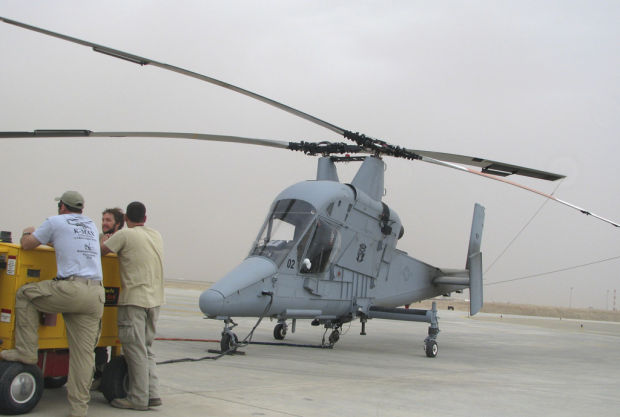
CAMP BASTION, Afghanistan - In January a small group of U.S. Marines at a remote base near the village of Shurakay in northern Helmand province was running low on ammunition after fighting fiercely for days. The road in was too dangerous for a resupply convoy, and there were so many Taliban fighters that a helicopter crew trying to fly in would have been at serious risk.
Still, the Marines soon heard the soft thwack of rotor blades. They looked up as a glimpse into the future of aviation eased into a hover, then gently descended until a pallet of ammunition dangling beneath it touched the ground. The cargo hook released itself and the unmanned K-MAX helicopter rose again, turned and flew off.
The K-MAX, which is the only drone cargo helicopter in the U.S. military's fleet, made two more runs to the embattled outpost, dropping off more supplies each time.
People are also reading…
It wasn't a stunt: Over the past 16 months, two K-MAX helicopters that were sent to Afghanistan as an experiment have delivered 3.2 millions of pounds of cargo across Helmand and flown more than 1,000 missions.
That's reduced the number of supply convoys needed on the province's bomb-infested roads, eased the workload and risk for helicopter and Osprey crews, saved money and provided real-world proof that drones are practical for much more than surveillance and missile strikes.
The combat-zone test was supposed to last just six months, but in March the Marine Corps extended it indefinitely.
In the fast-growing world of unmanned aircraft, the K-MAX's success is a significant step toward what's expected to be a host of new military and civilian roles for cargo drones, said Peter Singer, the director of the 21st Century Defense Initiative at the Brookings Institution research center and the author of "Wired for War: The Robotics Revolution and Conflict in the 21st Century."
"Everyone has framed discussion of drones as being about surveillance ... but they won't be only that," he said.
Last year, Congress ordered the Federal Aviation Administration to open the airways to the commercial use of drones by 2015.
The FAA foresees that there will be 10,000 commercial drones flying by 2020.
Predicted uses include carrying cargo, lifting construction materials into place, undertaking rescue missions in remote mountains or stormy seas, evacuating the wounded from battlefields and even, some experts half-joke, delivering pizza.
US Toll in Afghanistan
2,083
Deaths
18,462
Wounded
Latest identifications
The following Marines were assigned to 2nd Marine Special Operations Battalion, Camp Lejeune, N.C.
• Staff Sgt. Eric D. Christian, 39, of Warwick, N.Y.
• Cpl. David M. Sonka, 23, of Parker, Colo.
The following three airmen were assigned to the 93rd Air Refueling Squadron, Fairchild Air Force Base, Wash.
• Tech Sgt. Herman Mackey III, 30, of Bakersfield, Calif.
• Capt. Victoria A. Pinckney, 27, of Palmdale, Calif.
• Capt. Mark T. Voss, 27, of Colorado Springs, Colo.
Source: Department of Defense


