

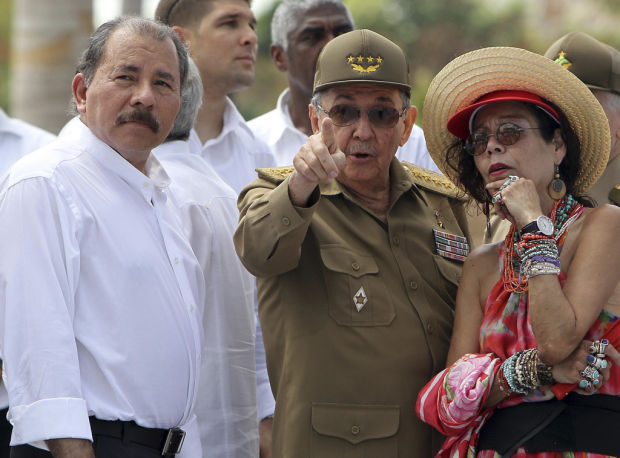
HAVANA - Cuba celebrated the 60th anniversary of the onset of its revolution Friday, with the aging Communist leader who took part in the initial failed uprising vowing to focus the future on younger generations that have been slow to come to power.
Wearing a military uniform, President Raúl Castro spoke to a crowd of thousands outside a military barracks still pockmarked with bullet holes from the 1953 assault that is considered the beginning of the rebellion.
Castro was just 22 when he followed his older brother Fidel's lead in a seemingly suicidal attack on the Moncada barracks in the eastern city of Santiago, along with more than 100 other, mostly youthful, rebels opposed to strongman Fulgencio Batista.
"The years have passed, but this continues to be a revolution of young people, as we were on July 26, 1953," Castro said.
People are also reading…
The Moncada raid was a disaster for the rebels, and many were tortured and killed. But it helped make Fidel Castro the focus of opposition to Batista, whom he overthrew six years later after surviving prison and exile, making him a hero for revolutionaries around the globe.
Yet the youthful insurgents of 1953 and 1959, many now in their 80s, still hold key positions of power in Cuba. While Raúl Castro has led a series of economic and political reforms, young leaders are just now beginning to emerge.
Earlier this year, Miguel Diaz-Canel, 53, was named vice president and became the first person not of the revolutionary generation to hold the No. 2 spot.
At Friday's ceremony, a giant banner hanging from the barracks with an image of Fidel Castro raising a triumphant fist was the only sign of the retired leader. A near-fatal intestinal illness forced him from office seven years ago, and he rarely appears in public these days.
In speeches, allied leaders recalled Moncada as an act that inspired rebellion, both armed and political, across the Americas in the decades that followed.
"The history of Latin America can best be understood if we mark a before and an after the assault on the Moncada barracks," said Ecuadorean Foreign Minister Ricardo Patino.
"Fundamentally this was a revolution of dignity, of self-esteem for Latin Americans," said Uruguayan President Jose Mujica, who joined a leftist guerrilla group in his own country in the 1960s and was imprisoned for more than a decade. "It seeded us with dreams. It filled us with (the spirit of Don) Quixote."
The July 26 holiday is sometimes used to make major announcements or address current affairs, but Castro hardly strayed from the past tense in a speech almost entirely focused on history.
He did not mention a shipment of Cuban weaponry recently seized in Panama on its way to North Korea. Nor did he address the ongoing saga of National Security Agency leaker Edward Snowden and his quest for asylum beyond the reach of U.S. law.
And there was no new word about the future of Castro's reforms, which have seen changes such as the legalization of home and car sales, relaxed restrictions on foreign travel and limited openings for independent small businesses and cooperatives.
Meanwhile, allies including Venezuela's Nicolas Maduro, Bolivia's Evo Morales and Nicaragua's Daniel Ortega praised Havana and bashed capitalism and the United States, railing against "imperialism" and the 51-year-old U.S. embargo against Cuba.


