

BEIRUT - The billionaire businessman chosen by Hezbollah and its allies as Lebanon's prime minister called for a unity government Tuesday, a sign that the Iranian-backed militant group does not want to push its growing power too far and risk isolation abroad and an escalation of sectarian tensions at home.
In Washington, Secretary of State Hillary Rodham Clinton warned that formation of a government dominated by Hezbollah would mean changes in U.S. relations with Lebanon. The militant group and its allies ousted the government backed by Washington two weeks ago when they walked out of the Cabinet.
"A Hezbollah-controlled government would clearly have an impact on our bilateral relationship with Lebanon," Clinton said.
The United States deems Hezbollah a terrorist organization and has imposed sanctions against the group and its members.
People are also reading…
The ascendancy of Hezbollah is a setback to the United States, which has provided Lebanon with $720 million in military aid since 2006 and has tried in vain to move the country firmly into a Western sphere and end the influence of Iran and Syria.
Hezbollah's opponents maintain having an Iranian proxy in control of Lebanon's government would be disastrous and lead to international isolation. The militant group has its own arsenal and is the country's most powerful military force.
Seeking to calm sectarian tensions, Prime Minister-designate Najib Mikati called for a unity government.
"My hand is extended to all Lebanese, Muslims and Christians, in order to build and not to destroy," said Mikati, whose moderate credentials and Harvard education make it difficult for opponents to cast him off as a pro-Hezbollah figure with a militant agenda.
In an interview Tuesday night on local television, Mikati said he is committed to democracy and dialogue.
"I am not in a confrontation with the West," he told the private LBC station. "We are looking to build good relations with the West."
He also rejected the notion that he is a Hezbollah candidate or that the government will be an Iranian proxy.
"Why these accusations and all this furor ahead of time? Why the prejudgments?" he said.
Hezbollah leader Sheik Hassan Nasrallah echoed those sentiments. "We do not seek power and we do not seek to govern. Our minds and hearts are somewhere else," Nasrallah said Tuesday in a televised speech. "While you go to sleep, we go to train (against Israel)."
A telecoms tycoon and former prime minister, Mikati, a 55-year-old Sunni, is seen as a neutral figure in Lebanese politics. He is a friend of Syrian President Bashar Assad and also enjoys close ties with U.S. ally Saudi Arabia.
His nomination does not alter Lebanon's power-sharing system, in which the prime minister must be a Sunni, the parliament speaker a Shiite and the president must be a Christian Maronite. Each faith makes up about a third of Lebanon's population of 4 million.
But the very fact that Hezbollah, a group known as much for its ties to Shiite Iran as for its hostility to Israel, chose him and secured enough lawmakers' votes to make him prime minister is enormously significant. It underscores Iran's growing influence in the region at a time when Washington's is waning.
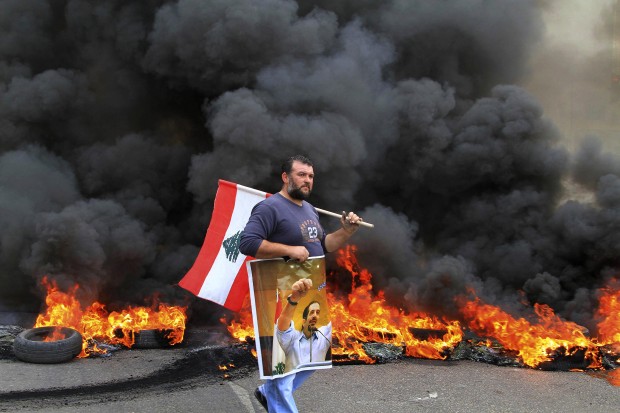
Thousands of Mikati's fellow Sunnis poured into the streets across the country, burning tires, throwing rocks and accusing Hezbollah of a coup d'etat.


