

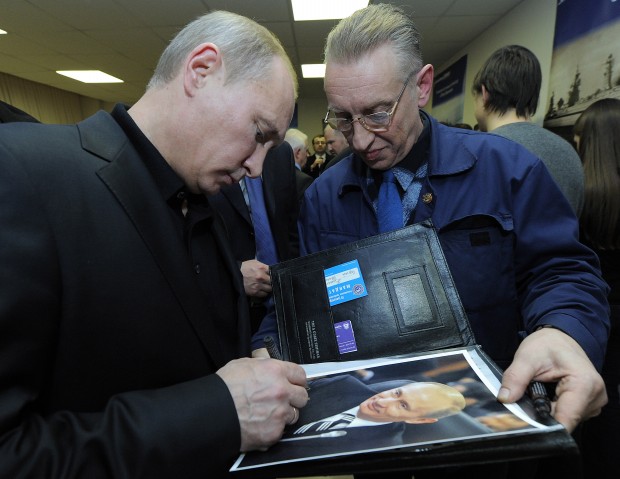
MOSCOW - When Russian leader Vladimir Putin climbed into the martial-arts ring in the Olimpiysky Palace in downtown Moscow recently to congratulate a Russian wrestler who had convincingly beaten his American opponent, he was greeted by boos.
Some in the crowd, which consisted mostly of wealthy and middle-class Russians, also shouted "Go away!"
The prime minister's news service later hurried to explain that the audience last week was booing not Putin but American fighter Jeff Monson.
In October, President Dmitry Medvedev, who is leading Putin's United Russia party into parliamentary elections today, suffered a similar public-relations scramble after a visit to the Journalism Department at Moscow State University.
When his security detail prevented many students from meeting with the president, department members said they organized a subbotnik, the Soviet-era term for a (compulsory) volunteer day, during which they thoroughly washed the auditorium to eradicate the traces of Medvedev's visit.
People are also reading…
The presidential news service later insisted that Medvedev had just rented an auditorium to meet with young people, and not with the students themselves.
The tandem leaders may find comfort in the knowledge that voters are increasingly fed up with other politicians, too, with apathy and frustration widespread.
Last month, the independent Levada Center polling organization reported that Putin's and Medvedev's popularity ratings had slipped to 67 percent and 62 percent, respectively, the lowest showing in years for both.
Only 53 percent of respondents said they intended to vote for United Russia in today's election, raising the specter that it will lose its two-thirds majority in the parliament's lower house, the State Duma. If the polls are borne out and United Russia drops from its current 315 seats to a projected 253 in the 450-seat house, the party would still have a majority but an insufficient one to adopt some laws and introduce constitutional changes.
But opposition movements aren't faring any better. The only truly liberal opposition force on the ballot, the Yabloko party, gets a mere 1 percent and will certainly not reach the 7 percent needed to enter parliament.
A liberal opposition protest against United Russia's monopoly on power last weekend in downtown Moscow attracted only a few hundred people.
"People are just tired of the same faces on all sides of the political spectrum of the country, of the same propaganda and the same promises that no longer mean anything to them," said Boris Dubin, senior researcher with Levada. "About 60 percent of the population believes that Russia needs a change, but they just lack direction, and they don't see a force that can outline a convincing plan aimed to take the country on a road of real reforms."
Polls indicate that 41 percent of Russians believe the country is moving in the wrong direction and that 53 percent think that the coming elections won't change their lives for the better.


