

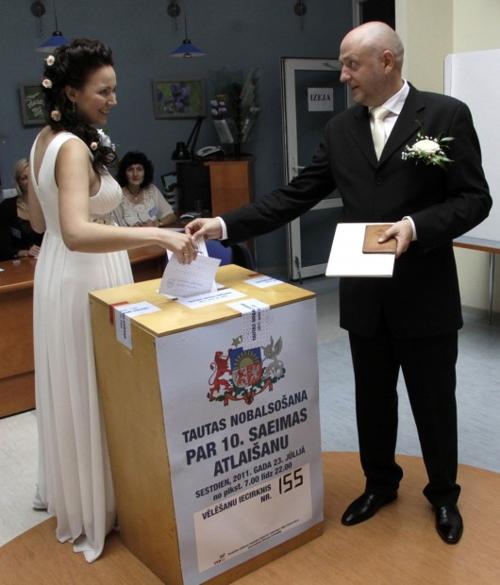
RIGA, Latvia - Latvians voted to sack their Parliament in a historic referendum Saturday as the recession-weary country attempts to dismantle the culture of graft between politics and business.
With some 73 percent of ballots counted, 94.7 percent of voters supported the legislature's dissolution, according to Central Election Commission data, setting the stage for a snap parliamentary election in September.
Only a simple majority was needed to sack Parliament, regardless of voter turnout. Commission data showed that fewer than 45 percent of registered voters participated.
It was the first such referendum since the Baltic country of 2.2 million people broke away from the Soviet Union 20 years ago.
Prime Minister Valdis Dombrovskis said he voted for sacking the legislature, the Saeima, since a new election would be an "opportunity to ensure that forces supporting the rule-of-law would have a majority" in a new legislature.
People are also reading…
The referendum was called for in May when former President Valdis Zatlers used his presidential power to dissolve Parliament - a decision that must be supported by a majority of voters. Zatlers was angered that lawmakers had blocked an anti-corruption probe involving top legislators and businessmen.
The next week, Zatlers lost his re-election bid when legislators - who elect the president every four years - opted for challenger Andris Berzins, a millionaire lawmaker.
Many Latvians share Zatlers' concerns that wealthy businessmen-politicians - known as oligarchs - have too much influence in politics through their personal and business links with lawmakers, or by getting into Parliament themselves.
Inara Slucka said on Saturday she would vote for sacking the legislature. "It's a new opportunity to change the situation, to do something about corruption," she said.
Pensioner Andres Apsitis said he would vote against the dissolution since new elections would mean spending money the country doesn't have.
Latvia is emerging from a deep recession that in three years cut nearly one-fourth of economic output.
In December 2008 the European Union and the International Monetary Fund stepped in to rescue the country from bankruptcy, but the aid did little to alleviate discontent as the government slashed spending and raised taxes.
Unemployment reached nearly 25 percent, and tens of thousands left the country to find work in Sweden, Britain and Ireland.


