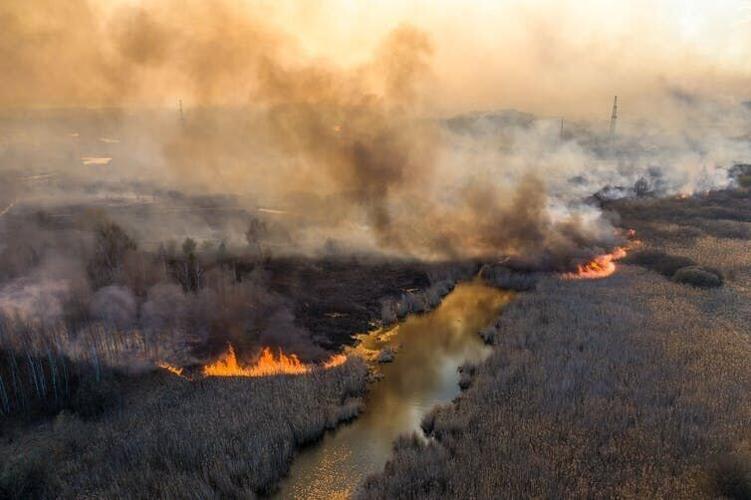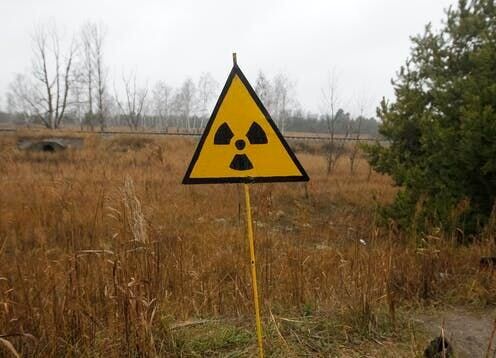
Much of the region around Chernobyl has been untouched by people since the nuclear disaster in 1986. Pavlo Gonchar/SOPA Images/LightRocket via Getty Images
The site of the Chernobyl Nuclear Power Plant in northern Ukraine has been surrounded for more than three decades by a 1,000-square-mile (2,600-square-kilometer) exclusion zone that keeps people out. On April 26, 1986, Chernobyl’s reactor number four melted down as a result of human error, releasing vast quantities of radioactive particles and gases into the surrounding landscape – 400 times more radioactivity to the environment than the atomic bomb dropped on Hiroshima. Put in place to contain the radioactive contaminants, the exclusion zone also protects the region from human disturbance.
Apart from a handful of industrial areas, most of the exclusion zone is completely isolated from human activity and appears almost normal. In some areas, where radiation levels have dropped over time, plants and animals have returned in significant numbers.
People are also reading…

A fox near the Chernobyl Nuclear Power Plant. T. A. Mousseau, 2019, CC BY-ND
Some scientists have suggested the zone has become an Eden for wildlife, while others are skeptical of that possibility. Looks can be deceiving, at least in areas of high radioactivity, where bird, mammal and insect population sizes and diversity are significantly lower than in the “clean” parts of the exclusion zone.
I’ve spent more than 20 years working in Ukraine, as well as in Belarus and Fukushima, Japan, largely focused on the effects of radiation. I have been asked many times over the past days why Russian forces entered northern Ukraine via this atomic wasteland, and what the environmental consequences of military activity in the zone might be.
As of the beginning of March 2022, Russian forces controlled the Chernobyl facility.
Why invade via Chernobyl?
In hindsight, the strategic benefits of basing military operations in the Chernobyl exclusion zone seem obvious. It is a large, unpopulated area connected by a paved highway straight to the Ukrainian capital, with few obstacles or human developments along the way. The Chernobyl zone abuts Belarus and is thus immune from attack from Ukrainian forces from the north. The reactor site’s industrial area is, in effect, a large parking lot suitable for staging an invading army’s thousands of vehicles.
The power plant site also houses the main electrical grid switching network for the entire region. It’s possible to turn the lights off in Kyiv from here, even though the power plant itself has not generated any electricity since 2000, when the last of Chernobyl’s four reactors was shut down. Such control over the power supply likely has strategic importance, although Kyiv’s electrical needs could probably also be supplied via other nodes on the Ukrainian national power grid.
The reactor site likely offers considerable protection from aerial attack, given the improbability that Ukrainian or other forces would risk combat on a site containing more than 5.3 million pounds (2.4 million kilograms) of radioactive spent nuclear fuel. This is the highly radioactive material produced by a nuclear reactor during normal operations. A direct hit on the power plant’s spent fuel pools or dry cask storage facilities could release substantially more radioactive material into the environment than the original meltdown and explosions in 1986 and thus cause an environmental disaster of global proportions.
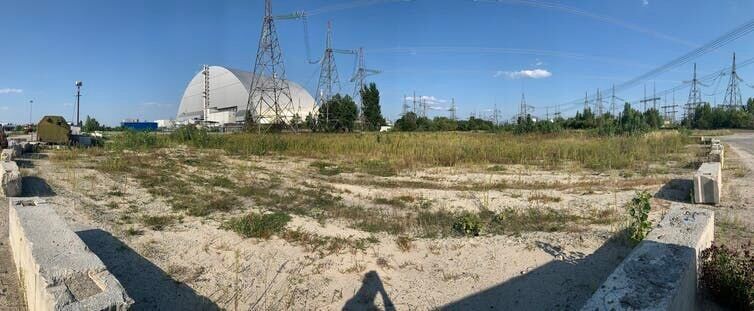
View of the power plant site from a distance, with the containment shield structure in place over the destroyed reactor. T.A. Mousseau, CC BY-ND
Environmental risks on the ground in Chernobyl
The Chernobyl exclusion zone is among the most radioactively contaminated regions on the planet. Thousands of acres surrounding the reactor site have ambient radiation dose rates exceeding typical background levels by thousands of times. In parts of the so-called Red Forest near the power plant it’s possible to receive a dangerous radiation dose in just a few days of exposure.
Radiation monitoring stations across the Chernobyl zone recorded the first obvious environmental impact of the invasion. Sensors put in place by the Ukrainian Chernobyl EcoCenter in case of accidents or forest fires showed dramatic jumps in radiation levels along major roads and next to the reactor facilities starting after 9 p.m on Feb. 24, 2022. That’s when Russian invaders reached the area from neighboring Belarus.
Because the rise in radiation levels was most obvious in the immediate vicinity of the reactor buildings, there was concern that the containment structures had been damaged, although Russian authorities have denied this possibility. The sensor network abruptly stopped reporting early on Feb. 25 and did not restart until March 1, 2022, so the full magnitude of disturbance to the region from the troop movements is unclear.
If, in fact, it was dust stirred up by vehicles and not damage to any containment facilities that caused the rise in radiation readings, and assuming the increase lasted for just a few hours, it’s not likely to be of long-term concern, as the dust will settle again once troops move through.
But the Russian soldiers, as well as the Ukrainian power plant workers who have been held hostage, undoubtedly inhaled some of the blowing dust. Researchers know the dirt in the Chernobyl exclusion zone can contain radionuclides including cesium-137, strontium-90, several isotopes of plutonium and uranium, and americium-241. Even at very low levels, they’re all toxic, carcinogenic or both if inhaled.

Forest fires, like this one in 2020 in the Chernobyl exclusion zone, can release radioactive particles that had been trapped in the burning materials. Volodymyr Shuvayev/AFP via Getty Images
Possible impacts further afield
Perhaps the greater environmental threat to the region stems from the potential release to the atmosphere of radionuclides stored in soil and plants should a forest fire ignite.
Such fires have recently increased in frequency, size and intensity, likely because of climate change, and these fires have released radioactive materials back into the air and and dispersed them far and wide. Radioactive fallout from forest fires may well represent the greatest threat from the Chernobyl site to human populations downwind of the region as well as the wildlife within the exclusion zone.
Currently the zone is home to massive amounts of dead trees and debris that could act as fuel for a fire. Even in the absence of combat, military activity – like thousands of troops transiting, eating, smoking and building campfires to stay warm – increases the risk of forest fires.
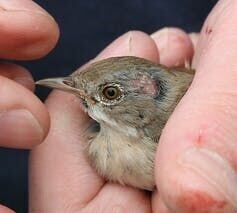
A bird from Chernobyl with a tumor on its head. T. A. Mousseau, 2009, CC BY-ND
It’s hard to predict the effects of radioactive fallout on people, but the consequences to flora and fauna have been well documented. Chronic exposure to even relatively low levels of radionuclides has been linked to a wide variety of health consequences in wildlife, including genetic mutations, tumors, eye cataracts, sterility and neurological impairment, along with reductions in population sizes and biodiversity in areas of high contamination.
There is no “safe” level when it comes to ionizing radiation. The hazards to life are in direct proportion to the level of exposure. Should the ongoing conflict escalate and damage the radiation confinement facilities at Chernobyl, or at any of the 15 nuclear reactors at four other sites across Ukraine, the magnitude of harm to the environment would be catastrophic.
[Get fascinating science, health and technology news. Sign up for The Conversation’s weekly science newsletter.]
Timothy A. Mousseau receives funding from the Samuel Freeman Charitable Trust.
This article is republished from The Conversation under a Creative Commons license.
Gallery: Sports world lets Ukrainian colors fly

A video screen displays the Ukrainian flag, during the English League Cup final soccer match between Chelsea and Liverpool at Wembley stadium in London, Feb. 27, 2022. (AP Photo/Alastair Grant)

Everton players hold Ukrainian flags before the English Premier League soccer match between Everton and Manchester City at Goodison Park in Liverpool, England, Saturday, Feb. 26, 2022. (AP Photo/Jon Super)

Lazio's players enter the pitch wearing T-shirts with the colors of the Ukraine's flag during their warm up ahead of the Serie A soccer match between Lazio and Napoli at Rome's Olympic stadium, Sunday, Feb. 27, 2022. (AP Photo/Gregorio Borgia)

Teams take a minute of silence in support of Ukraine ahead of a German Bundesliga soccer match between Eintracht Frankfurt and Bayern Munich in Frankfurt, Germany, Saturday, Feb. 26, 2022. (AP Photo/Michael Probst)

Bronze medal winner Ilia Burov, of the Russian Olympic Committee, left, hugs silver medal winner Ukraine's Oleksandr Abramenko as they celebrate after the men's aerials finals at the 2022 Winter Olympics, Wednesday, Feb. 16, 2022, in Zhangjiakou, China. (AP Photo/Gregory Bull)

A Seattle Sounders supporter holds a sign that reads "Stop Wars" during a moment of silence for victims of the war in Ukraine, before the start of an MLS soccer match between the Sounders and Nashville SC, Sunday, Feb. 27, 2022, in Seattle. (AP Photo/Ted S. Warren)

Fans hold a Ukraine national flag next to a Polish flag during a semifinal tennis match between Russia's Andrey Rublev and Poland's Hubert Hurkacz at the Dubai Duty Free Tennis Championship in Dubai, United Arab Emirates, Feb. 25, 2022. (AP Photo/Kamran Jebreili)

An electronic screen displays a message from the Six Nations Rugby in support of Ukraine, ahead of the rugby union match between Ireland and Italy at the Aviva Stadium in Dublin, Ireland, Sunday, Feb. 27, 2022. (AP Photo/Peter Morrison)

A Liverpool fan holds a sign in the Ukrainian colors with the initials of "You'll Never Walk Alone", the Liverpool anthem sung by the fans every game, during the English League Cup final soccer match between Chelsea and Liverpool at Wembley stadium in London, Feb. 27, 2022. (AP Photo/Alastair Grant)

The colors of Ukraine are displayed on a video screen at the German Indoor Championships in Athletics in the Arena Leipzig, Germany, Feb. 26, 2022. (Martin Schutt/dpa via AP)

Ukraine's flag is displayed on a giant screen prior to the start of the Serie A soccer match between Lazio and Napoli at Rome's Olympic stadium, Sunday, Feb. 27, 2022. (AP Photo/Gregorio Borgia)

Maryland forward Pavlo Dziuba, front right, who was born in Kyiv, Ukraine, is draped in a flag of Ukraine prior to an NCAA college basketball game against Ohio State, Sunday, Feb. 27, 2022, in College Park, Md. (AP Photo/Julio Cortez)

A fan waves the flag of Ukraine during the first intermission of an NHL hockey game between the Ottawa Senators and the Montreal Canadiens on Saturday, Feb. 26, 2022 in Ottawa, Ontario. (Justin Tang/The Canadian Press via AP)

The words "No War" are written on the shoes of Maryland forward Pavlo Dziuba, who was born in Kyiv, Ukraine, as he stands for the United States national anthem prior to an NCAA college basketball game against Ohio State, Feb. 27, 2022, in College Park, Md. (AP Photo/Julio Cortez)

A screen shows support to Ukraine before the English Premier League soccer match between Everton and Manchester City at Goodison Park in Liverpool, England, Feb. 26, 2022. (AP Photo/Jon Super)

Red Star fans form an image of a gravestones in yellow and blue colors before a Serbian National soccer league derby match between Red Star and Partizan in Belgrade, Serbia, Sunday, Feb. 27, 2022. (AP Photo/Darko Vojinovic)

Soccer fans observe a moment of silence in support of Ukraine before an MLS soccer match between the Los Angeles Galaxy and the New York City FC Sunday, Feb. 27, 2022, in Carson, Calif. (AP Photo/Jae C. Hong)

At the start of the match, the players of both teams hold a Ukrainian flag with the inscription "Stop War. We against war." prior the Bundesliga soccer match between Greuther Fuerth and 1. FC Cologne in Fuerth, Germany, Feb. 26, 2022. (Daniel Karmann/dpa via AP)

Spectators hold banners that reads 'Peace' ahead of an Italian Cup semifinal, first leg, soccer match between AC Milan and Inter Milan at the San Siro stadium, in Milan, Italy, March 1, 2022. (AP Photo/Antonio Calanni)