KYIV, Ukraine — Bound for the battlefield, sounding harried and anxious, the Russian soldier placed a hasty phone call — to a Ukrainian military hotline.
"They say you can help me surrender voluntarily, is that right?" asked the serviceman, explaining that he was soon to be deployed near the southern Ukrainian city of Kherson.
"When Ukrainian soldiers come, do I just kneel down, or what? Do you promise not to film me while this is happening?"
In fluent Russian, the hotline operator calmly assured him he'd be given detailed instructions on how to safely lay down his weapon and turn himself in.
"When you get to the front lines, just call us right away," she said.
People are also reading…
At a crucial juncture in an extraordinarily bloody war, Ukraine's military is focused on one task: removing Russian soldiers from the battlefield. But faced with a foe whose ranks are known to be riddled with unwilling fighters, Ukrainian military strategists realized there might be more than one means to that end.
With that, the "I Want to Live" outreach was born, aimed at providing invading forces with step-by-step information on how to abandon the ranks. Initially run by Ukrainian police, the program has had a ramped-up, military-operated version in place since mid-September.
On Russian-language social media, Ukrainians have spread the word about the program's website, intended as a portal for the surrender-curious or their loved ones. It has attracted more than 13.3 million visits — 7.6 million of those from Russian territory, organizers said.
Russian soldiers also provide personal data through a chatbot on the encrypted messaging app Telegram — information Ukrainian authorities use to winnow down those who are serious about turning themselves in. The chatbot, together with the hotline, has drawn nearly 10,000 contacts, according to organizers.

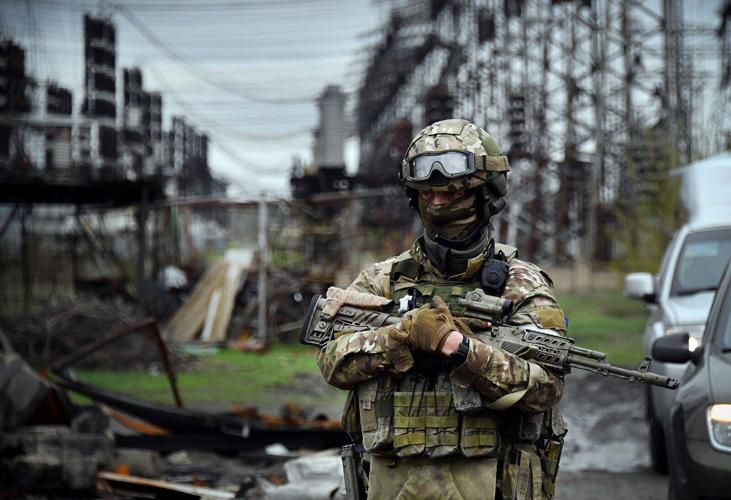
In this picture taken on April 13, 2022, a Russian soldier stands guard at the Luhansk power plant in the town of Shchastya. Note: This picture was taken during a trip organized by the Russian military. (Alexander Nemenov/AFP via Getty Images/TNS)
Citing security reasons, Ukrainian officials declined to disclose how many surrenders have been brokered via the program. But hotline operators field calls around the clock from Russians who are soon to be mobilized, are in the midst of being deployed or are already on the battlefield. Callers might be jittery or stoic, defensive or remorseful, coolly businesslike or floridly emotional — sometimes all of those in a single conversation.
"So, this is not fake?" one Russian soldier asked.
"It is not fake," the Ukrainian operator replied.
The 10-member hotline team, all active-duty service personnel with backgrounds in psychology, is tasked with providing callers with clear, concise instructions, while being alert to signs that the outreach might be a "probe" by Russian intelligence, meant to elicit information about Ukrainian methods and intentions.
However tense the backdrop, those dealing directly with would-be surrenderers try to "calm them down," said Vitaly Matvienko, a junior lieutenant who serves as spokesman for the program, which is run by the department for prisoners of war.
"Hi, I'm listening," goes a typically low-key operator salutation in an audio sampling of recent calls provided by the Ukrainian military. In the recordings made public, callers' voices are distorted to shield their identities.

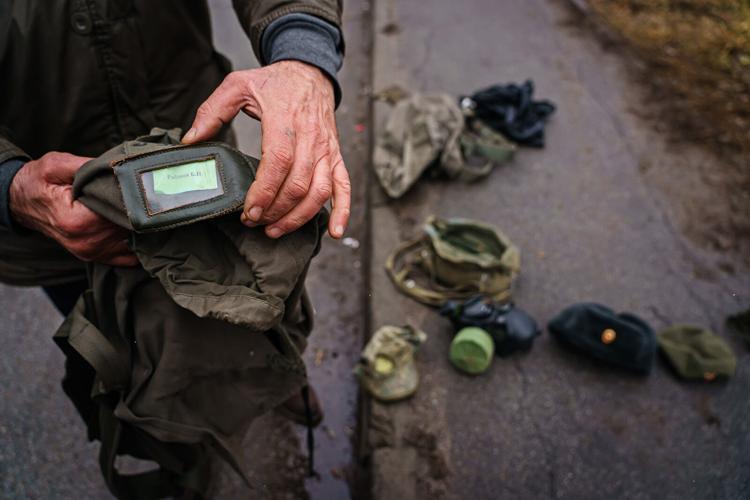
A Ukrainian soldier displays military items collected from Russian forces in Sytnyaky, Ukraine, Thursday, March 3, 2022. (Marcus Yam/Los Angeles Times/TNS)
Hotline operators initially worked out of military headquarters in the Ukrainian capital, Kyiv, but were later moved to a secret location because they are now seen as a high-profile potential target, Matvienko said. The military refused to make any operators available for interviews but said they are male and female, a range of ages and all able to chat easily in colloquial Russian.
When it comes to surrenders in the field, both sides are aware that the moment carries enormous risk for all involved, he said.
"In general, it's a very dangerous process," said Matvienko. But strict protocols, clearly laid out in advance, improve the odds of everyone staying alive.
Russians who want to turn themselves in are told to wave a white cloth, remove the magazines from their guns, point the barrels to the ground and eschew body armor and helmets. They are assured that in the event they want to be sent home in a prisoner swap, their paperwork will reflect that they were captured, not that they gave up voluntarily.
If it's a bring-your-own-tank surrender, which happens not infrequently, the turret is to be turned in the opposite direction. If it's a group surrender — also a fairly common occurrence, with a Russian squad often fearing retribution from commanders but agreeing to act jointly and surreptitiously — the highest-ranking soldier must identify himself.

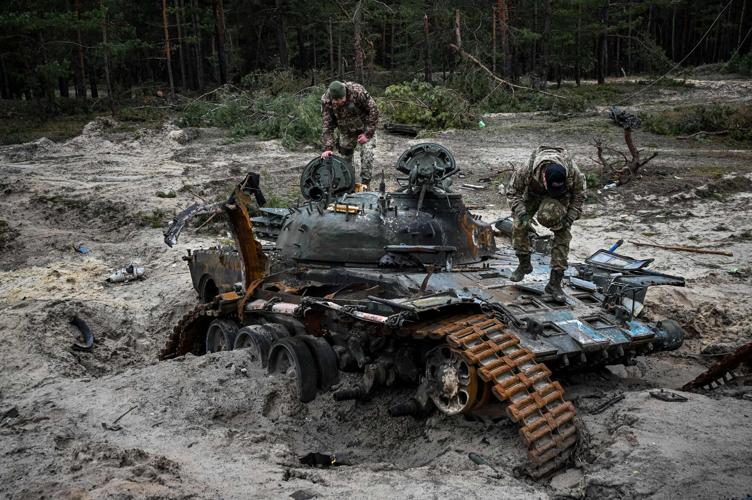
Ukrainian servicemen inspect a destroyed Russian tank near Kivsharivka village in a suburb of Kupiansk, Kharkiv region on Dec. 15, 2022, amid the Russian invasion of Ukraine. (Sergey Bobok/AFP/Getty Images/TNS)
If a surrendering soldier runs out of options for separating himself from his unit, the hotline offers help.
"We can coordinate with special units that will extract you safe and sound," one operator told a worried caller.
Like so much in this conflict, the "I Want to Live" program employs both high-tech methods and simple communication tools.
Russians facing deployment can communicate with the Ukrainian side using the Telegram chatbot, and before leaving for the front, they're urged to procure and hide a basic flip phone — not a smartphone — and use that to call the hotline.
Ukrainians say they've heard from Russian soldiers already on the battlefield who learned of the hotline by word-of-mouth or from a scrawled-on slip of paper passed from hand to hand.
In Russia's battle to subdue Ukraine, now in its second year, one of Moscow's greatest advantages is the sheer number of troops it can throw into the fight, Western military analysts say — which is why Ukraine is willing to try novel tactics to reduce those numbers.

In addition to the 190,000 Russian soldiers who took part in the initial multipronged invasion that began in February 2022, Russian President Vladimir Putin last year ordered the mobilization of 300,000 more, many of whom are now in Ukraine. And another major mobilization is expected as Russia seeks to mount a spring offensive.
But despite a more than 2-to-1 Russian advantage in its standing military, Moscow's faltering performance has been blamed on troop quality, which has deteriorated as the war goes on. Western military observers consistently cite poor morale, substandard training and shambolic supply practices as key factors in a string of Russian battlefield routs last autumn.
"In order to snatch a victory of sorts from the jaws of defeat, Putin must now rely on the overwhelming numbers provided by mass mobilization," analyst Peter Dickinson wrote in a report last month for the Atlantic Council. "This is a tried and tested Russian tactic, but it also carries considerable risks."
Deploying thousands of untrained soldiers "to fight against battle-hardened and highly motivated Ukrainian troops could result in the kind of carnage that breaks armies," he wrote.

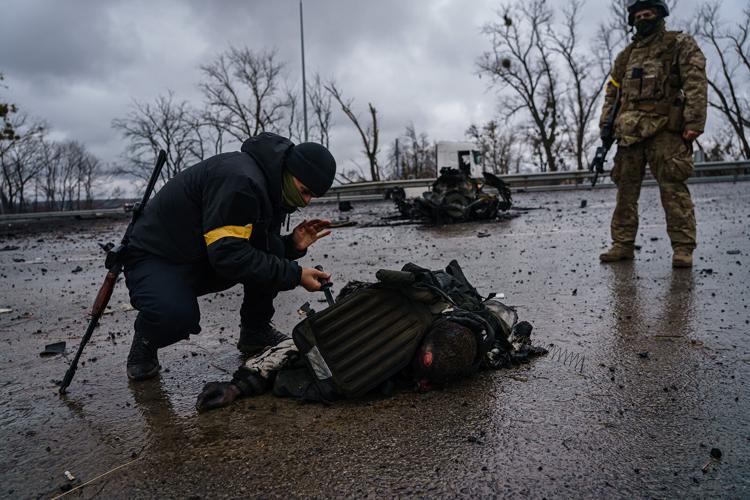
GRAPHIC CONTENT: Ukrainian soldiers salvage equipment off a body of a dead Russian soldier after a Russian vehicle was violently destroyed Ukrainian forces in battle along the main road near Sytnyaky, Ukraine, Thursday, March 3, 2022. (Marcus Yam/Los Angeles Times/TNS)
At the start of the invasion, some Russian troops apparently believed they would be welcomed by Ukrainians as liberators. But fierce military resistance, coupled with widespread shows of disdain and defiance from civilians, soon disabused them of that notion.
Last autumn's mobilization by Putin prompted a huge exodus of fighting-age men from Russia, with hundreds of thousands settling in Turkey, Georgia, Kazakhstan and other nearby countries to avoid being conscripted.
Western analysts say it has become more widely known within Russia that Moscow's commanders have scant regard for the lives and welfare of their own troops.
January and February saw an uptick in Russian-language social media postings about harrowing field conditions and chaotic leadership — accounts widely echoed in months of intercepted calls home from deployed Russian troops.
In mid-February, a British military intelligence assessment said Russian forces were suffering what appeared to be the highest casualty rates since the early weeks of the war — many occurring near the hotly contested town of Bakhmut. While Ukraine has suffered heavy attrition as well, Russia lost exceptionally large numbers of troops and armored vehicles in a failed attempt last month to storm the Ukrainian-held eastern town of Vuhledar — an apparently bungled opening volley in a much-vaunted Russian spring offensive.
Ukrainian officials hope that such setbacks will serve a dual purpose: inflicting a costly defeat, and prompting Russian soldiers to recognize the sometimes suicidal role they are expected to play in human-wave attacks on fortified Ukrainian positions, which have been a recurring feature of recent fighting.
"With their own eyes, they see they are nothing more than cannon fodder," Matvienko said. "They see one of their comrades being ordered to walk into a minefield to find a path, and he gets blown up, and another is told to go next, and he's blown up too, and on it goes."
Episodes like this, he said, can galvanize a desperate sense of self-preservation.
"They realize this is real and not some war movie," he said. "And the thought has to occur to them: 'How do I save myself?'"
One caller, sounding angry and despairing, used an expletive to describe the prospect of sudden death in battle.
"A single mortar shell, and it's done," he said. "Who needs this war?"
___
Photos: In Ukraine, searing images capture a year of war

Natali Sevriukova is overcome with emotion as she stands outside her destroyed apartment building following a rocket attack in Kyiv, Ukraine, Friday, Feb. 25, 2022. (AP Photo/Emilio Morenatti)

Ukrainians crowd under a destroyed bridge as they try to flee by crossing the Irpin River on the outskirts of Kyiv, Ukraine, Saturday, March 5, 2022. (AP Photo/Emilio Morenatti)

Stanislav says goodbye to his 2-year-old son, David, and wife, Anna, after they boarded a train that will take them to Lviv, from the station in Kyiv, Ukraine, Thursday, March 3. 2022. Stanislav stayed to fight as his family sought refuge in a neighboring country. (AP Photo/Emilio Morenatti)

A child in a stroller is lifted across an improvised path as people flee Irpin, on the outskirts of Kyiv, Ukraine, Wednesday, March 9, 2022. (AP Photo/Felipe Dana)

Ukrainian emergency personnel and police officers evacuate injured pregnant woman Iryna Kalinina, 32, from a maternity hospital that was damaged by a Russian airstrike in Mariupol, Ukraine, March 9, 2022. "Kill me now!" she screamed, as they struggled to save her life at another hospital even closer to the frontline. The baby was born dead, and a half-hour later, Iryna died too. (AP Photo/Evgeniy Maloletka)

A man runs after recovering items from a burning shop following a Russian attack in Kharkiv, Ukraine, Friday, March 25, 2022. (AP Photo/Felipe Dana)

An elderly woman is assisted while crossing the Irpin River on an improvised path under a bridge that was destroyed by Ukrainian troops designed to slow any Russian military advance, while fleeing the town of Irpin, Ukraine, March 5, 2022. (AP Photo/Vadim Ghirda)

Bodies are placed into a mass grave on the outskirts of Mariupol, Ukraine, Wednesday, March 9, 2022. (AP Photo/Evgeniy Maloletka)
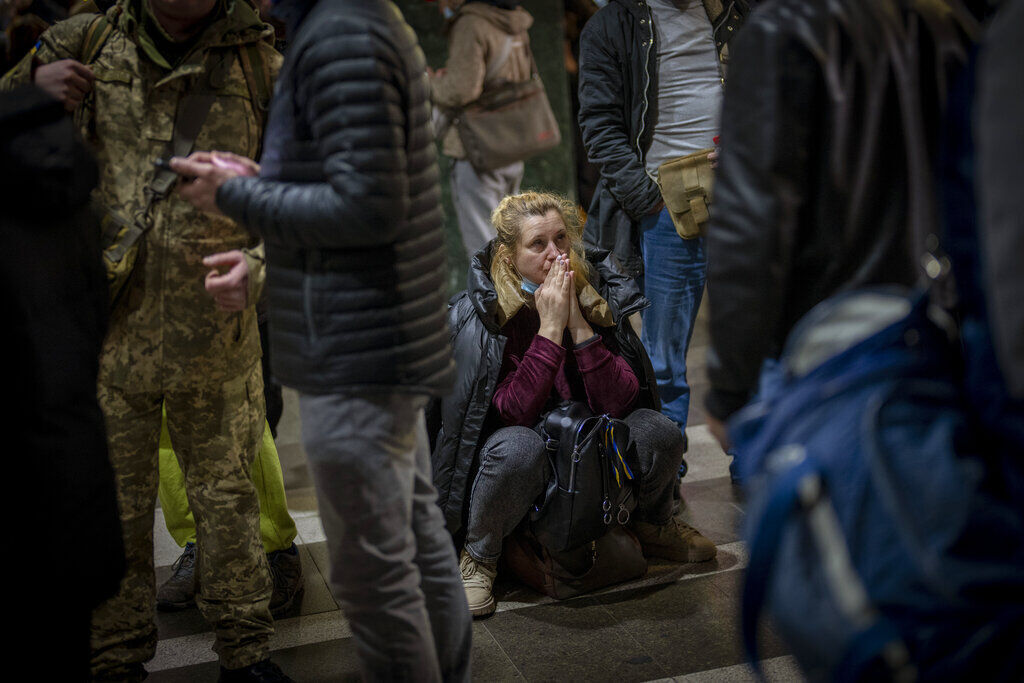
A woman reacts as she waits for a train trying to leave Kyiv, Ukraine, Thursday, Feb. 24, 2022. (AP Photo/Emilio Morenatti)

Cadets practice with gas masks during a lesson in a bomb shelter on the first day of school at a cadet lyceum in Kyiv, Ukraine, on Sept. 1, 2022. (AP Photo/Efrem Lukatsky)

Armored vehicles destroyed during the fighting between Ukrainian and Russian armed forces lie on a bank of the frozen Siverskiy Donets River in the recently-liberated village of Bogorodychne, Ukraine, Friday, Jan. 13, 2023. (AP Photo/Evgeniy Maloletka)

An explosion erupts from an apartment building at 110 Mytropolytska St., after a Russian army tank fired on it in Mariupol, Ukraine, Friday, March 11, 2022. On the seventh floor of the building, two elderly women Lydya and Nataliya were stuck in their apartment because they couldn't make it down to the shelter, and were killed in the explosion. The two heavily burned bodies were buried by neighbors in front of the building. (AP Photo/Evgeniy Maloletka)

Destroyed Russian tanks sit on a main road after battles near Brovary, north of Kyiv, Ukraine, Thursday, March 10, 2022. (AP Photo/Felipe Dana)

Ira Gavriluk holds her cat as she stands near the bodies of her husband and brother who were killed in Bucha, on the outskirts of Kyiv, Ukraine, Monday, April 4, 2022. (AP Photo/Rodrigo Abd)

Ludmila, left, says goodbye to her granddaughter, Kristina, who, with her son, Yaric, departs by train from Odesa, southern Ukraine, on Tuesday, March 22, 2022. (AP Photo/Petros Giannakouris)

The body of a man with his hands tied behind his back lies on the ground in Bucha, Ukraine, Sunday, April 3, 2022. (AP Photo/Vadim Ghirda)

A man and child ride a bicycle as bodies of civilians lie in the street in the formerly Russian-occupied Kyiv suburb of Bucha, Ukraine, Saturday, April 2, 2022. (AP Photo/Vadim Ghirda)

Children look out of the window of an unheated Lviv-bound train, in Kyiv, Ukraine, Thursday, March 3, 2022. (AP Photo/Vadim Ghirda)

A civilian wears a Vladimir Putin mask as a spoof, while a Ukrainian soldier stands atop a destroyed Russian tank in Bucha, Ukraine, outside of Kyiv, on April 7, 2022. (AP Photo/Rodrigo Abd)

Nina Shevchenko mourns over the body of her 15-year-old son, Artem Shevchenko, who was killed in a Russian attack on Kharkiv, Ukraine, Friday, April 15, 2022. (AP Photo/Felipe Dana)

The body of an elderly woman lies inside a house in Bucha, outskirts of Kyiv, Ukraine, Tuesday, April 5, 2022. (AP Photo/Felipe Dana)

Elderly men lie in beds at a hospice in Chasiv Yar city, Donetsk district, Ukraine, Monday, April 18, 2022. At least 35 men and women, some in wheelchairs and most of them with mobility issues, were helped by volunteers to flee from the region that has been under attack in the last few weeks. They are being transported to Khmelnytskyi, in western Ukraine. (AP Photo/Petros Giannakouris)

Ukrainian soldiers carry the coffin of Volodymyr Losev, 38, during his funeral in Zorya Truda in the Odesa region of Ukraine, Monday, May 16, 2022. The 38-year-old Ukrainian volunteer soldier was killed on May 7 when the military vehicle he was driving ran over a mine in eastern Ukraine. (AP Photo/Francisco Seco)

Nila Zelinska holds her granddaughter's doll found in her destroyed house in Potashnya on the outskirts of Kyiv, Ukraine, Tuesday, May 31, 2022. Zelinska had just returned to her hometown after escaping war to find out she is homeless. (AP Photo/Natacha Pisarenko)

Volodymyr, 66, injured from a strike, sits on a chair in his damaged apartment in Kramatorsk, Donetsk region, eastern Ukraine, Thursday, July 7, 2022. (AP Photo/Nariman El-Mofty)

Relatives and friends pay their last respects to Liza, a 4-year-old girl killed in a Russian attack, during a mourning ceremony in an Orthodox church in Vinnytsia, Ukraine, Sunday, July 17, 2022. Wearing a blue denim jacket with flowers, Liza was among 23 people killed, including two boys aged 7 and 8, in a missile strike three days earlier in Vinnytsia. Her mother, Iryna Dmytrieva, was among the scores injured. (AP Photo/Efrem Lukatsky)

Anastasia Ohrimenko, 26, is comforted by relatives as she cries next to the coffin of her husband, Yury Styglyuk, a Ukrainian serviceman who died in combat on Aug. 24, in Maryinka, Donetsk, during his funeral in Bucha, Ukraine, Wednesday, Aug. 31, 2022. (AP Photo/Emilio Morenatti)

Ukrainian soldiers fire artillery towards Russian positions near Bakhmut, Donetsk region, Ukraine, Sunday, Nov. 20, 2022. (AP Photo/LIBKOS)

A woman warms her dog in her coat in Kivsharivka, Ukraine, Sunday, Oct. 16, 2022. Residents in Kivsharivka have been living without gas, electricity or running water for around three weeks. (AP Photo/Francisco Seco)

Ukrainian family members reunite for the first time since Russian troops withdrew from the Kherson region in the village of Tsentralne, southern Ukraine, on Nov. 13, 2022. (AP Photo/Bernat Armangue)

A resident wounded after a Russian attack lies inside an ambulance before being taken to a hospital in Kherson, southern Ukraine, Thursday, Nov. 24, 2022. (AP Photo/Bernat Armangue)

A woman transporting the coffin holding the body of her son, a soldier who was killed in fighting with Russians, sits in a boat crossing the Siverskyi Donets River near Staryi Saltiv, Kharkiv region on Wednesday Jan. 4, 2023. (AP Photo/Erik Marmor)

A woman walks with a flashlight during a power outage in Kyiv, Ukraine, Wednesday, Dec. 14, 2022. (AP Photo/Felipe Dana)
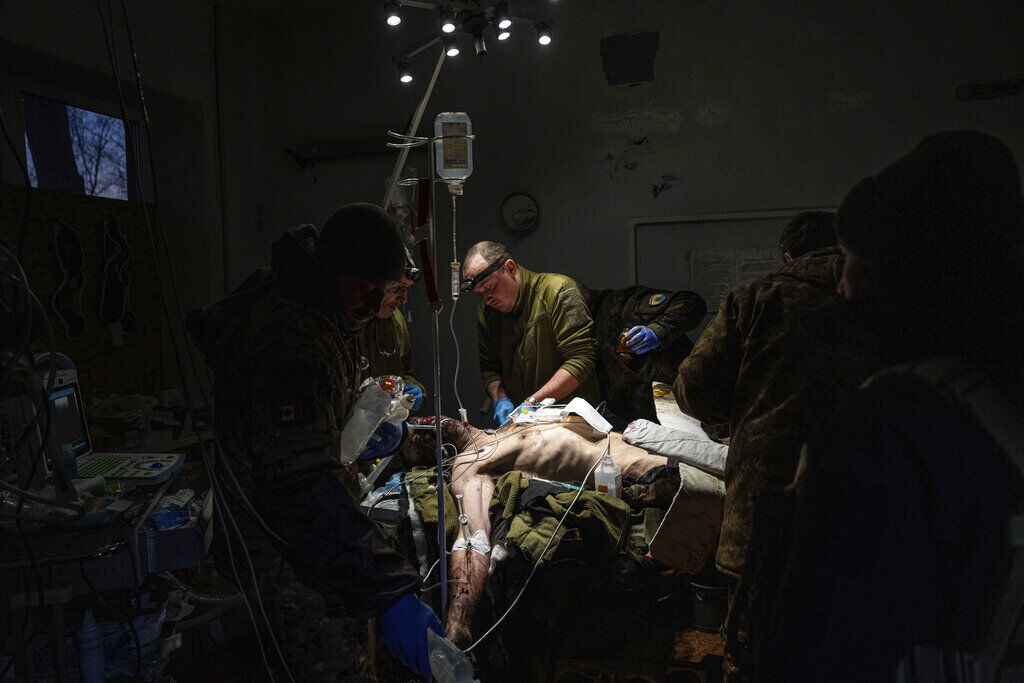
Ukrainian military doctors treat an injured comrade who was evacuated from the battlefield at the hospital in Donetsk region, Ukraine, Monday, Jan. 9, 2023. The serviceman did not survive. (AP Photo/Evgeniy Maloletka)

The body of a woman lies under rubble after a Russian rocket hit a multistory building leaving many people under debris in the southeastern city of Dnipro, Ukraine, Saturday, Jan. 14, 2023. (AP Photo/Evgeniy Maloletka)

Emergency workers clear the rubble after a Russian rocket hit a multistory building leaving many people under debris in the southeastern city of Dnipro, Ukraine, Saturday, Jan. 14, 2023. (AP Photo/Evgeniy Maloletka)

Relatives mourn over the body of Oleksiy Zavadskyi, a Ukrainian serviceman who died in combat on Jan. 15 in Bakhmut, during his funeral in Bucha, Ukraine, on Thursday, Jan. 19, 2023. (AP Photo/Daniel Cole)

Ambulance paramedic Oleksandr Konovalov performs CPR on a girl injured by shelling in a residential area, next to her father, left, after arriving at the city hospital in Mariupol, eastern Ukraine, Sunday, Feb. 27, 2022. The girl did not survive. (AP Photo/Evgeniy Maloletka)

Residents prepare tea in a basement being used as a bomb shelter in Irpin, on the outskirts of Kyiv, Ukraine, Sunday, March 13, 2022. (AP Photo/Felipe Dana)

A woman takes shelter in a basement with no electricity in Irpin, on the outskirts of Kyiv, Ukraine, Sunday, March 13, 2022. (AP Photo/Felipe Dana)