
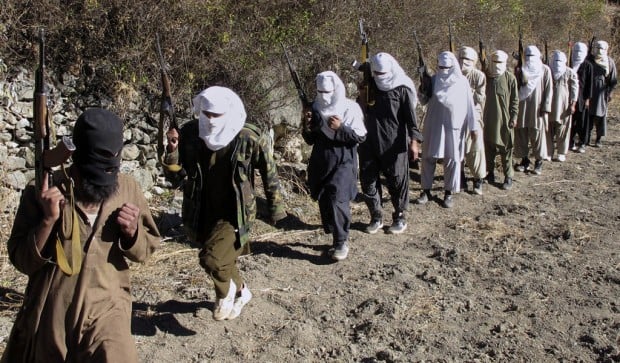
Editor's note: Associated Press reporter, photographer and videographer Ishtiaq Mahsud spent six days with fighters from the Pakistani Taliban close to the Afghan border. His account of their travels through South Waziristan offers a look at an area that the Pakistani military claimed had been brought under control after an army offensive two years ago.
SOUTH WAZIRISTAN, Pakistan - For 15 hours, we walked with Taliban fighters through territory supposedly controlled by the Pakistani army and frequently pounded by U.S. drone strikes. Avoiding roads and towns, we easily evaded soldiers and were shown recruits drilling with weapons, militant positions and - from a distance - a compound used by foreign fighters.
The rare trip to South Waziristan revealed the resilience of militants in the northwestern tribal areas, some of whom are also battling American soldiers across the frontier in Afghanistan. It also demonstrated that the insurgents, who once ruled much of South Waziristan from permanent bases with many hundreds of fighters, are now largely a guerrilla force there.
People are also reading…
The Pakistani Taliban had invited three Pakistani journalists to meet its leader, Hakimullah Mehsud, at a time when splits have appeared in the movement. But Mehsud canceled, with his aides saying he was called into urgent meetings with a delegation of Afghan Taliban elders who had arrived from across the border.
The trip began in the capital of North Waziristan, Miran Shah, where the Pakistan army has yet to launch an offensive despite requests from Washington. Militants, including al-Qaida and Afghan Taliban factions, are in firmer control in this region than in South Waziristan. Extremists from other countries and other areas of Pakistan were visible on the streets of the town.
We then drove to the boundary with the south and began our journey on foot, accompanied by four fighters.
South Waziristan was once home to about 500,000 people, but its towns and villages are now mostly empty. The population was told to flee ahead of a major Pakistani army offensive in 2009. The army has declared victory, but most locals haven't returned. They do not believe official statements that their homeland is safe.
In one abandoned village, three men were living in a single room in a ruined house. They said they couldn't leave because they had no money and two of them were blind since birth. Their sole possessions were a dirty mat and some blackened cooking pots. One, 30-year-old Mafiq, said the Taliban gave them monthly rations and sometimes cooked food.
At night, we slept in empty houses. Once we feasted on goat with about 40 fighters in a forest encampment.
The Pakistani military remains in South Waziristan in force, but its men are often targeted in ambushes.
On the main roads there were army posts, vital for supplying the 30,000 soldiers in the region. But it was easy to travel without being spotted or pursued so long as our group stayed off them.
After 15 hours hiking, our group came to a semipermanent forward position used to attack troops traveling on a main road below. About 30 fighters were armed with rocket launchers, sniper rifles and artillery. Through binoculars, Mehsud pointed out what appeared to be an anti-aircraft gun on a nearby ridge that he said belonged to the Taliban.
As we chatted, the army fired mortars at the position, one round landing about 50 yards from it.
At one point on the trip, the militants showed us young recruits - they called them trainee suicide bombers - exercising on a flat piece of land in a deserted village surrounded by mountains. Wearing masks, they staged the mock capture of a man wearing the uniform of a Pakistani soldier.
"We will jump in the fire without any hesitation on the orders of our commander," they shouted in unison at the end.