

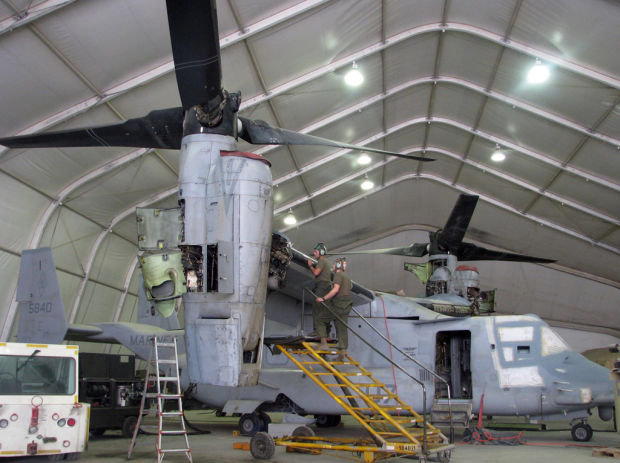
CAMP BASTION, Afghanistan - Almost four years after the MV-22 Osprey arrived in Afghanistan, trailing a reputation as dangerous and hard to maintain, the U.S. Marines Corps finally has had an opportunity to test the controversial hybrid aircraft in real war conditions. The reviews are startlingly positive.
"This is an ugly duckling that turned into a swan," said Richard Whittle, the author of "The Dream Machine: The Untold History of the Notorious V-22 Osprey" and a senior scholar at the Wilson Center, a research center in Washington. "It is still probably more expensive than it should be, and more expensive to operate. But I think many people are still laboring under the impression that it is dangerous to fly, when it now has probably the best safety record of any rotorcraft that the military flies."
The odd aircraft, which takes off and lands like a helicopter but rotates its engines forward to fly like an airplane, had a star-crossed development period that took more than two decades and included huge cost overruns and crashes that claimed 30 lives.
People are also reading…
Its deployment to Iraq's Anbar province from 2007 to 2009, where as combat waned it was used mainly to transport people and cargo, won it criticism from the Government Accountability Office over maintenance and performance issues.
In Afghanistan, however, the Marines have been able to use it more widely, flying it for everything from freight to hundreds of assaults, where it's carried loads of Marines into or out of landing zones, often under intense fire. It's twice as fast as the helicopter it replaces, the CH-46, it has substantially greater range, and can carry more cargo and more than twice as many troops. The Marines are learning how to maintain it in a harsh environment.
The MV-22 Ospreys here now are dusty, stained and smudged from hot exhaust, and at least five have returned to base with bullet holes, including - twice - the one flown by Lt. Col. Douglas C. Sanders, the commander of the Marine unit that's flying the Osprey in Afghanistan, Marine Medium Tiltrotor Squadron 264.
The various redundant systems work in the real world, said Maj. Matthew McSorley, a pilot and the operations officer for the squadron, who was hit by a different kind of fire while flying a mission on Valentine's Day: a massive bolt of lightning. "It was one of those days where the airplane itself just totally wins over your heart," he said. "It bounced right back, and I flew it all the way back, and within a week I was flying the same plane again."
Still, the Osprey is expensive - $122.5 million each, according to Sen. John McCain, R-Ariz., a persistent critic - and it isn't cheap to maintain.
The local angle
Nineteen Marines were killed in April 2000 when an MV-22 Osprey crashed at the Marana airport. The aircraft went down during a training exercise at Marana Northwest Regional Airport, 11700 W. Avra Valley Road.
US Toll in Afghanistan
2,085
Deaths
18,480
Wounded
Source: Department of Defense


