

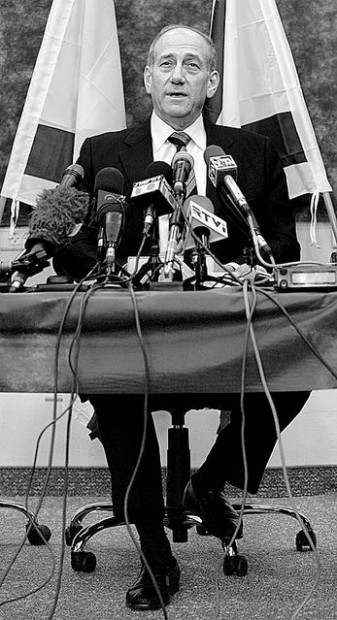
JERUSALEM — Ariel Sharon's heir-apparent, Ehud Olmert, scored a 71 percent approval rating after his first week as acting prime minister — defying predictions that Sharon's new Kadima Party would disintegrate after his massive stroke.
Olmert pulled off the delicate task of not appearing overeager to replace his ailing boss, while reassuring Israel and the world that he can carry out Sharon's agenda of drawing the country's final borders, with or without a deal with the Palestinians.
Two polls published Friday indicated support for Kadima keeps growing and Olmert is the overwhelming favorite to become prime minister in a March 28 general election. In the surveys, Kadima won 42 and 43 seats, respectively, in the 120-member parliament, meaning it would form the next government.
The results appeared to be a testament to Olmert's deft handling of the transition at a time of uncertainty. They also signaled continued backing in Israel for a unilateral separation from the Palestinians by unloading much of the West Bank. Sharon withdrew from the Gaza Strip and four West Bank Jewish settlements last summer.
People are also reading…
"He is going to be prime minister after the election, unless something incredible happens," said political scientist Abraham Diskin. "This first week was crucial and he passed (the test)."
Olmert's performance won rare unanimous praise for both style and content.
Widely perceived as abrasive and arrogant, the 60-year-old Olmert appeared genuinely shaken by his mentor's sudden departure from the political scene. In presiding over two Cabinet meetings since Sharon's Jan. 4 stroke, Olmert spoke in a somber voice and sat in his regular seat at the Cabinet table, next to Sharon's oversized chair.
Olmert stayed clear of Sharon's deserted office, but kept in close touch with the prime minister's advisers. One newspaper reported that in a rare display of emotion, Olmert hugged and comforted the prime minister's distraught driver.
Once a popular guest on TV and radio talk shows, Olmert has not given any interviews. Other than the Cabinet meetings, he appeared in public only once, for a brief economic news conference in his role as finance minister, meant to steady a jittery stock market.
In his party, he moved quickly to prevent infighting that could have damaged the electoral prospects of Kadima, the party Sharon formed after quitting Likud in November.


