

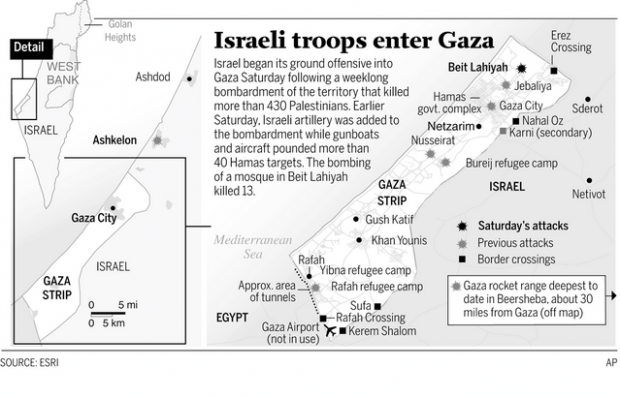
GAZA CITY, Gaza Strip — Thousands of Israeli troops backed by columns of tanks and helicopter gunships launched a ground offensive in Gaza Saturday night, with officials saying they expected a lengthy fight in the densely populated territory after eight days of punishing airstrikes failed to halt rocket attacks on Israel.
The incursion set off fierce clashes with Palestinian militants, and Gaza's Hamas rulers vowed the coastal strip would be a "graveyard" for Israeli forces.
"This will not be easy and it will not be short," Israeli Defense Minister Ehud Barak said on national television about two hours after ground troops moved in.
The night sky over Gaza was lit by the flash of bullets and balls of fire from tank shells. Sounds of explosions were heard across Gaza City, the territory's biggest city, and high-rise buildings shook from the bigger booms.
People are also reading…
Troops with camouflage face paint marched single file into Gaza. As the ground troops moved in, Israel kept pounding the area with airstrikes. F-16 warplanes hit three targets within a few minutes, including a main Hamas security compound.
Witnesses in Gaza said that in the first phase, Israeli ground forces had moved several hundred yards inside Gaza. Israeli security officials said initial clashes with militants took place in open fields and soldiers did not immediately move into Gaza's crowded cities, where warfare would likely get much deadlier.
"We have many, many targets," Israeli army spokeswoman Maj. Avital Leibovich told CNN. "To my estimation, it will be a lengthy operation."
Israeli leaders said the operation, meant to quell militant rocket and mortar fire on southern Israel, would not end quickly, but that the objective was not to reoccupy Gaza or topple Hamas. The depth and intensity will depend in part on parallel diplomatic efforts that so far haven't yielded a truce proposal acceptable to Israel, the officials said.
In the airborne phase of Israel's onslaught, militants were not deterred from bombarding southern Israel with more than 400 rockets — including dozens that extended deeper into Israel than ever before. They fired six rockets into Israel in the first few hours after the ground push began, the military said.
One rocket scored a direct hit on a house in the southern city of Ashkelon earlier Saturday and another struck a bomb shelter there, leaving its above-ground entrance scarred by shrapnel and blasting a parked bus.
"I don't want to disillusion anybody and residents of the south will go through difficult days," Barak said. "We do not seek war but we will not abandon our citizens to the ongoing Hamas attacks."
Israel called up tens of thousands of reservists in the event Palestinian militants in the West Bank or Hezbollah guerrillas in Lebanon decide to exploit the broad offensive in Gaza to launch attacks against Israel on other fronts.
The military said the country's north was on high alert in case Hezbollah guerrillas decided to use their vast stockpiles of missiles against Israel. Israel and Hezbollah fought a 34-day war in the summer of 2006.
White House spokesman Gordon Johndroe said U.S. officials have been in regular contact with the Israelis as well as officials from countries in the region and Europe.
"We continue to make clear to them our concerns for civilians, as well as the humanitarian situation," Johndroe said.
The U.N. Security Council scheduled emergency consultations Saturday night on the escalation in Gaza. Secretary-General Ban Ki-moon has urged key world leaders to intensify efforts to achieve an immediate truce, including international monitors to enforce a truce and possibly to protect Palestinian civilians.
Israel's bruising air campaign against Gaza over the past eight days began days after a six-month truce expired. Gaza health officials say the air war has killed more than 480 Palestinians in an attempt to halt Hamas rocket attacks that were reaching farther into Israel than ever before. Four Israelis have been killed by rockets.
Israel is taking a risk by wading into intense urban warfare in densely populated Gaza that could exact a much higher toll on both sides and among civilians.
This sort of urban warfare has not gone well in past campaigns where Israel sent ground forces into Arab population centers in the Palestinian territories or in Lebanon wars in 1982 and 2006. Israeli forces have either gotten bogged down or sustained heavy casualties, without quelling violent groups or halting attacks for good.
The decision to expand the operation, while continuing to batter Gaza from the air and sea, was taken after Hamas refused to stop attacking Israel, government officials said. They spoke on condition of anonymity because discussions leading up to wartime decisions are confidential.
Before the ground incursion began, heavy Israeli artillery fire hit east of Gaza City, in locations where the military said Hamas fighters were deployed. The artillery shells were apparently intended to detonate Hamas explosive devices and mines planted along the border area before troops marched in.
Hamas remained defiant as the ground war began.
"You entered like rats," Hamas spokesman Ismail Radwan told Israeli soldiers in a statement on Hamas' Al Aqsa TV, broadcast shortly after the start of the invasion. "Your entry to Gaza won't be easy. Gaza will be a graveyard for you, God willing," he said.
"Gaza will not be paved with flowers for you. It will be paved with fire and hell," Hamas warned Israeli forces.
A text message sent by Hamas' military wing, Izzedine al-Qassam, said "the Zionists started approaching the trap which our fighters prepared for them." Hamas said it also broadcast a Hebrew message on Israeli military radio frequencies promising to kill and kidnap the Israeli soldiers.
"Be prepared for a unique surprise, you will be either killed or kidnapped and will suffer mental illness from the horrors we will show you," the message said.
Hamas has also threatened to resume suicide attacks inside Israel.
Hamas has long prepared for Israel's invasion, digging tunnels and rigging some areas with explosives. At the start of the offensive, Israeli artillery hit some of the border areas, apparently to detonate hidden explosives.
Before the ground invasion, defense officials said about 10,000 Israeli soldiers had massed along the border in recent days.
Israel initially held off on a ground offensive, apparently in part because of concern about casualties among Israeli troops and because of fears of getting bogged down in Gaza.
Israeli Prime Minister Ehud Olmert said his government decided to mount a land operation despite the risk it posed to thousands of soldiers.
An inner Cabinet of top ministers met with leading security officials for four hours Saturday before deciding to authorize the ground invasion.
The immediate aim of the ground operations was to take control of sites militants use as rocket-launching pads, the military said. It said large numbers of troops were taking part but did not give specifics.
Israeli airstrikes intensified just as the ground operation was getting under way, and 28 Palestinians were killed. Palestinian health officials said civilians were among the dead, including a woman, her son and her father who died after a shell hit their house.
One raid hit a mosque in the northern Gaza town of Beit Lahiya, killing 13 people and wounding 33, according to a Palestinian health official. One of the wounded worshippers, Salah Mustafa, told Al-Jazeera TV from a hospital that the mosque was packed. "It was unbelievably awful," he said, struggling to catch his breath.


