

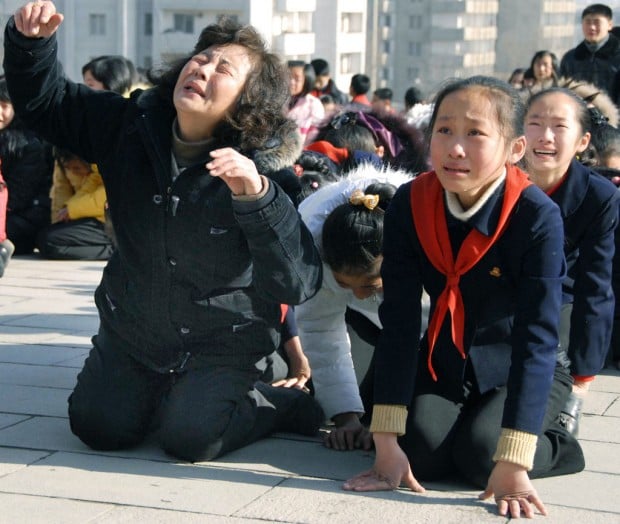
BEIJING - The scenes of mass grief coming from North Korea - people falling to the ground weeping and cries of anguish amid somber crowds - look forced.
More than theatrical, the mass mourning over the death of dictator Kim Jong Il is being driven by a mix of forces. Loss and fear of an uncertain future - the same emotions that many feel at the death of a loved one - become contagious in crowds. Added to that are the perils of crossing a police state. Self-interest is at work, too, as many North Koreans work for the ruling Workers' Party, the military and state companies and institutions.
When Kim's father, North Korean founder Kim Il Sung, died in 1994, the mourning proved infectious to Kim Yeong-nam, who defected to South Korea in 1998 and now runs an art troupe of fellow defectors.
No relation to the country's leaders, Kim said fellow university students in Sinuiju city near the Chinese border wailed spontaneously at news of the death. In the days that followed, Kim found the solemn music and eulogies at staged events at public statues made him cry, even though he did not like the country's founder.
People are also reading…
"They play songs and do everything they can to create a somber mood," Kim said.
Poor and largely isolated from outside information, North Koreans grieve in an atmosphere that is part family mourning, part coercion. The pressures to be part of a group that are present in all societies exert an especially strong force when the costs for resisting them are harsh. Its rigid controls on ordinary life make North Korea different in intensity, but hardly an exception.
Millions of Egyptians thronged Cairo's streets, crushing scores to death, for the funeral of President Gamal Abdel Nasser in 1970 even as his authoritarian repression left the country unstable. Palestinian communities erupt in cries of anguish and rage in response to deadly Israeli raids. Much of Britain, and the world, swelled in grief after Princess Diana's death in a car crash in 1997, though her life had been tabloid fodder for years.
It's the bandwagon effect: a powerful urge to belong to a group that impels people to behave in ways they might not ordinarily.
"Mourning, like laughter, is contagious in a social network," said Scott Atran, an American anthropologist who studies the psychology of groups at France's National Center for Scientific Research. Smoking and obesity, among other traits, he said, are often tied to the influence of a person's social mix.
"People usually believe they are slightly exceptional to the norm. But if they want to be part of the group, they overexaggerate and go toward the extreme of what they think the norm is," Atran said.


