

LONDON - Archaeologists searching for the grave of King Richard III say they have found bones that are consistent with the 15th-century monarch's physical abnormality and of a man who died in battle.
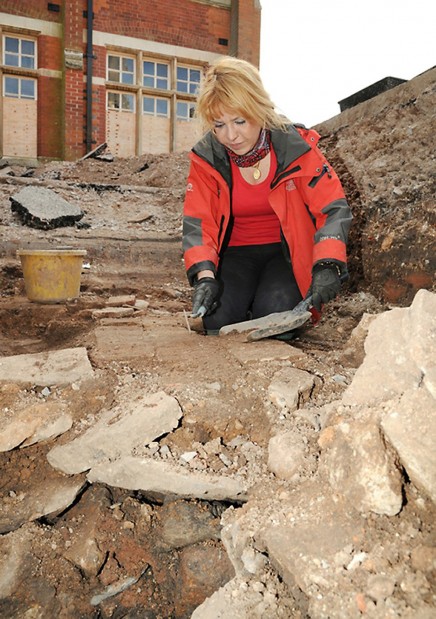
A team from the University of Leicester said Wednesday that the bones were beneath the site of the Grey Friars Church in Leicester, central England, where contemporary accounts say Richard was buried after his death in the Battle of Bosworth Field in 1485.
Richard Buckley, co-director of the university's Archaeological Services, said the bones are a "prime candidate" to be Richard's. The remains are now being examined, and the team hopes that DNA can be recovered to aid identification.
"We are not saying today that we have found King Richard III," Richard Taylor, the university's director of corporate affairs, told a news conference. "(But) this skeleton certainly has characteristics that warrant extensive, further detailed examination."
People are also reading…
William Shakespeare, writing more than a century after Richard's death, described the king as "deform'd, unfinished," a monster with a deformed conscience who murdered his nephews in the Tower of London in order to gain the throne.
The murder charge is a matter of historical dispute. The official royal website says the young princes "disappeared" while under Richard's protection.
Taylor said the skeleton displayed spinal abnormalities consistent with contemporary accounts of Richard's appearance.
"We believe that the individual would have had severe scoliosis, which is a form of spinal curvature. This would have made his right shoulder appear visibly higher than his left shoulder," Taylor said.
He said the skeleton was apparently of a man and in good condition. There were signs of trauma to the skull shortly before death, perhaps from a bladed instrument, and a barbed metal arrowhead was found between vertebrae of the upper back.
Professor Lin Foxhall, head of the university's School of Archaeology and Ancient History, agreed that the skeleton is consistent with some contemporary accounts of Richard but "does not fit the exaggerated picture painted by later, Tudor sources, which portrayed him as a wicked hunchback."
"The individual we have discovered was plainly strong and active despite his disability," Foxhall said. "Indeed it seems likely that he died in battle."
Richard, the last English king to die in battle, was buried "without any pompe or solemne funeral" by the Franciscan monks of Grey Friars.
There is a record that King Henry VII, the victor at Bosworth Field, commissioned a memorial for Richard's grave - in the eastern portion of the Grey Friars Church - about 1495.
Although the records pointed to a grave in Leicester, 100 miles north of London, the church was suppressed in 1538 after King Henry VIII abolished the monasteries and its location was long forgotten.


