

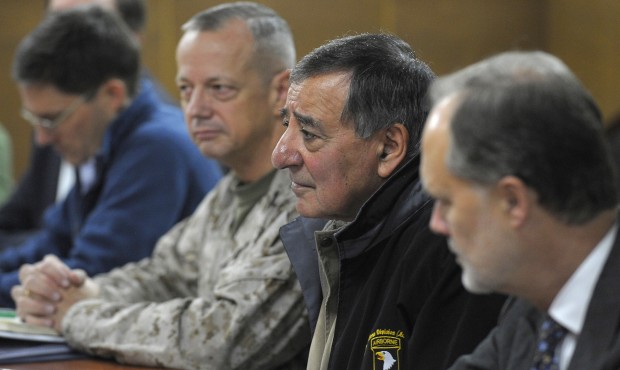
NEAR MARJAH, Afghanistan - U.S. Marines seized key positions in the Taliban sanctuary of Marjah on Saturday, as thousands of coalition troops picked their way through a dense tangle of homemade bombs to consolidate their hold on a swath of desert and farm territory surrounding the southern Afghan city.
U.S. and Afghan commanders reported only scattered resistance from Taliban fighters, who boasted that they were holding off the massive coalition assault despite evidence that they were retreating instead - most likely to fight another day.
Western military officials said some insurgents had fled the town before the offensive, and that others appeared to have fallen back to parts of the town not yet secured by the Marines. At least 20 insurgents were killed in the fighting, military commanders said.
Two members of NATO's International Security Assistance Force were killed on the first full day of the offensive, meant to establish security and governance in what had been a particularly chaotic corner of Helmand province. Their nationalities were not immediately disclosed.
People are also reading…
Three U.S. service members were killed in an explosion elsewhere in the south Saturday, the military reported.
The Marines, who pushed into the Helmand River Valley seven months ago, had described Marjah as the last main Taliban stronghold in their theater of operations.
The offensive is the first major operation involving U.S. forces since President Obama decided late last year to deploy an additional 30,000 troops to Afghani-stan in a bid to turn the tide of the war before an expected American drawdown next year.
About 5,000 Marines are spearheading the Marjah offensive, but a total of about 15,000 coalition forces are involved in combat and support roles, including British troops and U.S. Army units that pushed in from the northeast, linking up with the Marines to encircle the town.
The offensive began with the thunder of helicopters filling the dark sky. More than 60 choppers took part in what British Maj. Gen. Nick Carter, the commander of NATO forces in southern Afghanistan, described as a "successful insertion" by air of thousands of coalition and Afghan troops into the town, as well as surrounding farmlands.
The ground advance into the main population center was slower, delayed by the painstaking task of clearing away one of the thickest layers of homemade bombs that Western commanders had yet encountered.
Such bombs, planted by insurgents on roads, in culverts and in open terrain, are the No. 1 killer of Western troops in Afghanistan. Throughout the day, the boom of detonations echoed through the streets as bomb-disposal teams disabled one device after another.
Several thousand civilians have fled, even amid the fighting. The North Atlantic Treaty Organization had urged noncombatants to stay in their homes once the battle began rather than risk their safety on the roads, but some families braved roadside bombs and Taliban checkpoints to get clear.
"Our home and orchards were destroyed in the last offensive, and we are worried that they might be destroyed again," said Marjah farmer Abdul Hadi, who took shelter with his family in the provincial capital of Lashkar Gah. But he supported the offensive, saying locals wanted the foreign and Afghan forces to stay in place to keep the Taliban from returning and terrorizing townspeople.
"Marjah was on fire, and we want it pulled from the flames," he said.
The commander of Afghan forces, Gen. Sher Mohammad Zazai, said his troops had helped uncover Taliban weapons caches throughout the day, seizing arms including heavy machine guns and rocket-propelled grenades, and carried out house searches that cultural sensitivities dictate be done by Afghan troops.
President Hamid Karzai, who gave his approval to the offensive only hours before its start, issued a statement calling on the assault force to exercise "absolute caution to avoid harming civilians."
US Toll in Afghanistan
• Deaths: 898
• Wounded: 4,922
SOURCE: Department of Defense.


