Yanava "Navi" Hawkins grew up on Northland Avenue, a place of resonance for anyone familiar with Buffalo’s baseball history.
More than 60 years ago, Luke Easter used to live on the same street, a monumental guy whose one-of-a-kind house – a place of storybook detail, brought out in bright colors – still leads old-timers to recall when the legendary slugger made the Hamlin Park area his home.
Yet Hawkins is only 27. She was born decades after Easter, who died in 1979, became famous for hitting long-distance rockets. The first African American to play for the Bisons in the 20th century, he was a well-loved presence in neighborhoods around the old Offermann Stadium – a ballplayer who remains a bigger-than-life reminder of an era when the game was revered in the city.

For Lum Smith, a historian with deep knowledge of the African-American experience in Buffalo, the meaning of those feats of hitting the ball over the scoreboard will always transcend
That time, as Hawkins knows too well, is long gone. She started playing softball as an 8-year-old when her parents brought her to a youth league at Shoshone Park. Hawkins became a catcher, a role she loved because “you see the whole field,” but she also noticed one thing as she grew into youth leagues and travel ball:
People are also reading…
“I did not see a lot of players who looked like me,” said Hawkins, who is African American.
Her mission is changing that dynamic – a task at the heart of an ongoing three-week baseball and softball clinic at the Johnnie B. Wiley Amateur Athletics Sports Pavilion. Organizers hope the effort, ignited by Major League Baseball's Play Ball initiative, will eventually lead to organized league play within MLB's Reviving Baseball in Inner Cities program.
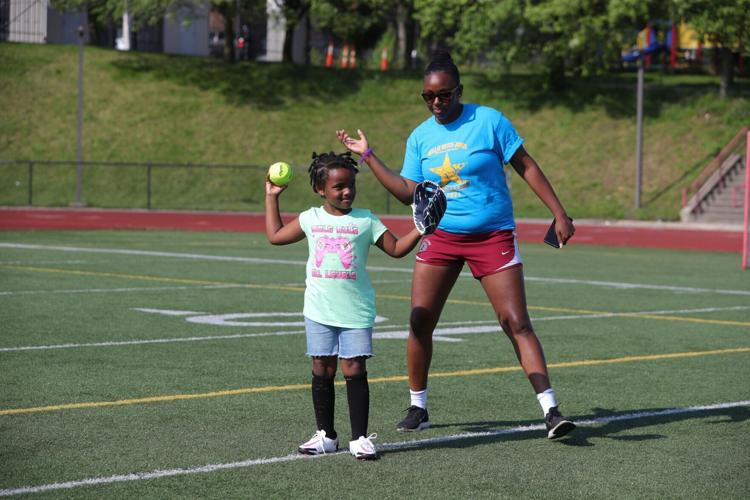
Thursday, Hawkins stood maybe five or six yards from 5-year-old Monroe McDonald, who was learning to throw a softball. Monroe’s early throws were all arm, legs locked in place. Hawkins gently explained how to pull the ball back, then step and throw – until that routine, bit by bit, was fluid motion for the child.
“You should see how much she’s improved in two days,” said Hawkins, a City Honors School graduate who played a year of softball at the University at Buffalo before founding a club team on campus.

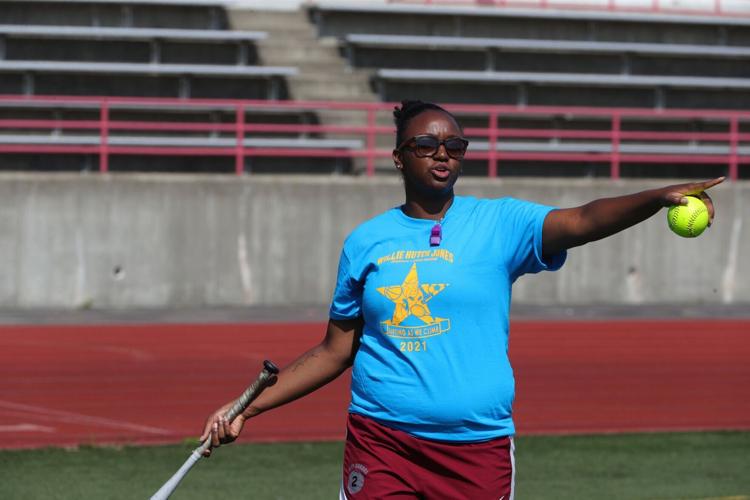
Yanava "Navi" Hawkins led a girls' softball camp as part of new Major League Baseball commitment to the game at the Johnnie B. Wiley Pavilion in Buffalo.
The dream is that the camp is only the beginning for an initiative channeled through the Willie Hutch Jones Educational and Sports Programs, with the Buffalo Bisons as conduit to the MLB. Both Charlie Wilson, a lawyer and youth baseball umpire, and David James, the MLB national vice president for baseball and softball development, said the timing had an emotional connection to the two-year stay of the Toronto Blue Jays in Buffalo.
Wilson grew up near the long-vanished Offermann, at the corner of Michigan Avenue and East Ferry Street. He remembers when pickup baseball was routinely played on parks, vacant lots and playgrounds in nearby neighborhoods – a bond with the game that vanished long ago. He felt the wave of sheer civic emotion evoked by big-league ball at Sahlen Field, and he contrasts childhood memories of warm community with ascending violence and grief in the same neighborhoods.
If healing involves a sweeping tapestry of selfless concern, he sees youth baseball and softball as a potential gateway.
“This is just incredibly important in helping to develop good citizens right now,” Wilson said.
Who is the one person with whom you most wish you could watch a major league game in Buffalo?
Earlier this year, he wrote to Major League Baseball to inquire about Buffalo and RBI. Mike Buczkowski, director of baseball operations for Bisons executives Bob and Mindy Rich, said the letter helped touch off a collaboration that brought a roomful of officials last month to the Wiley Pavilion. James, as the main guest, said Buffalo "has been on the radar" for big-league youth programs for a long time.
Representatives of many agencies, foundations and "The Seasons of Buffalo Baseball," a new book about the game's deep heritage in the city, discussed potential scholarships, mentoring and ways of building or restoring fields, as well as eventually bringing more full-blown youth leagues to diamonds where the game has been absent for too long.
James spoke of how youth baseball and softball competition nationally seems increasingly built around expensive travel ball or all-star play, skipping past far too many neighborhoods where entire summers go by and kids simply have no chance to play. Buczkowski hopes to offer new activities at Sahlen Field, within the Play Ball effort, that might provide children with a lifetime connection – the dream of such Buffalo baseball stalwarts as the Rev. Kenny Simmons, a tireless champion for years of city baseball.
As for James, he described the character lessons of the sport, the way you learn how popping up or striking out is hardly a disaster – and how lasting success is really measured by the well-being of the team.

Yanava "Navi" Hawkins works with 5-year-old Monroe McDonald in a softball camp at Johnnie B. Wiley Stadium.
That truth, he said, is best taught in one way:
“Just play games,” James said, a goal he and Wilson share.
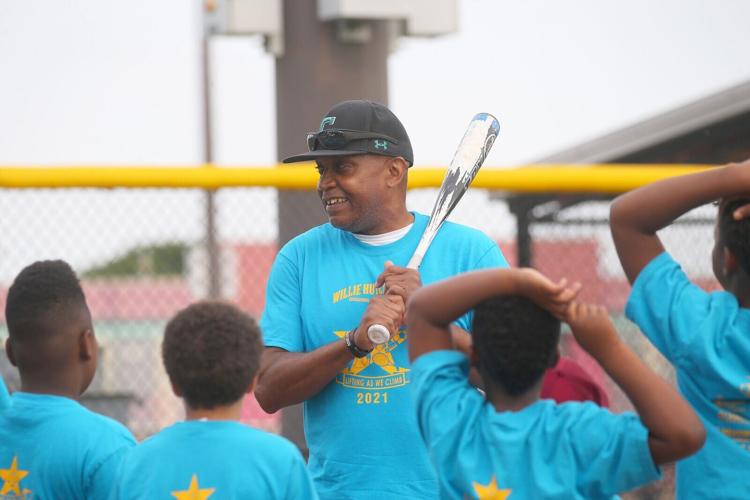
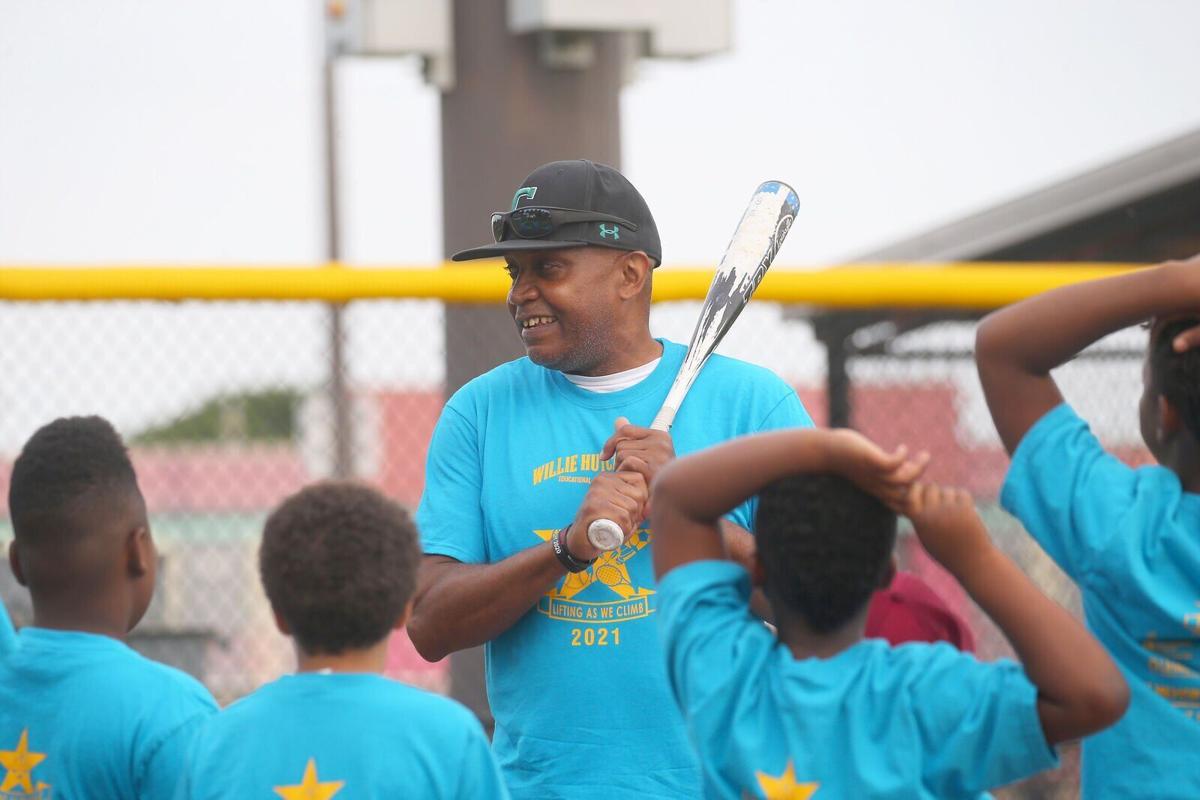
The first small step began last week at Wiley, where Hawkins coordinated several coaches working with the girls while T.J. Blackmon, a retired firefighter, did the same for the boys. Before Blackmon played college ball at Coastal Carolina, he was a major part of a 1986 sectional baseball title by City Honors – a triumph the school achieved again this year.
Blackmon remembers playing pickup baseball until the sun went down at McCarthy Park, a place where he dreams of reigniting that passion. It was his grandfather, Pharoah Horne, who gave Blackmon his first glove and often brought him to Bisons games at the old War Memorial Stadium, whose cement bones are now towering boundaries at Wiley.
Those gentle memories – of snaring foul balls at the Rockpile, or playing sandlot ball all day – remain as precious for Blackmon as his high points in organized baseball.
"What you want to do,” he said of children, “is just get ’em on the field.”
He watched Wednesday as his friends and assistants, Vernon Duncan and Jerry Falgiano, had some kids play the field while awaiting their chance to hit off a tee. Three days into the camp, children who had rarely played the game were catching on. You saw their sunrise moments, such as when 11-year-old Rico Gore abruptly realized catching the ball revolves entirely around how you drop or raise your glove.
A group of adults waited patiently, including Barbara Wynn – Rico and Monroe's grandmother – who recalled finding balls in the weeds and then playing childhood pickup at Martin Luther King Jr. Park, in an era when girls had few organized options. She and her daughter-in-law, Ashley McDonald, shared the feelings of Linda Donalson, whose 8-year-old son Ayden was in Blackmon's group.

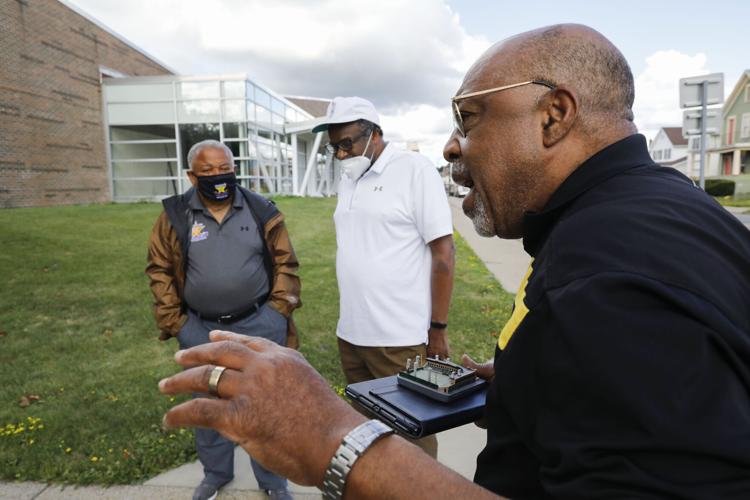
From left, Vernon Duncan, Gilbert Hargrave and Charlie Wilson reminisce about growing up in the neighborhood surrounding Offermann Stadium, before the ballpark was demolished in 1962; Wilson is holding a small replica of the old ballpark, which once stood on a site now occupied by Buffalo Academy for Visual and Performing Arts.
“I played sports when I was young, and you learn structure and you learn to get along with your teammates and why following the rules helps your team," Donalson said. "All of that transfers when you come home.”
Wilson's immediate goal is seeing a new, well-maintained girls' softball field built in the city, a vision close to Hawkins' heart. She and her assistants – Alison Mierzwa, Katelyn Atzl and Gabby Miletsky – led the children through detailed fielding drills. The focus was building fundamental self-belief, which Hawkins said can have far-reaching consequence.
Today is Jackie Robinson Day, a commemoration that resonates beyond baseball.
“Being an athlete changed my life,” she said. During her teen years, she remembers how her devotion to softball provided clear direction. It reinforced her schoolwork, her sleep habits, often her choice of friends. She contemplated how several girls at Wiley were even younger than she was when she picked up the game, and she saw a touch of herself in their passion.
While little Monroe said her favorite part of camp was “whacking the ball,” Hawkins was especially thrilled at the progress the child made, playing catch. They started at maybe four or five yards apart. Before long Monroe was snagging the ball when Hawkins threw it, then returning it with confidence.
The 5-year-old abruptly asked to stretch the distance. “You’re sure this is OK?” Hawkins said, backing up a few steps, but Monroe was thinking only of business. Arm raised, stepping forward, her next throw matched the whole point of the camp: She launched a rocket.