

Mike Desmond has been breaking news for a lifetime, so it’s ironic that I recently broke some news to him about the biggest story of his career.
Desmond is the Buffalo radio reporter who got the video of Martin Gugino being pushed over by the police in front of City Hall — a shot seen round the world.
Turns out Desmond and Gugino are classmates — Canisius High School, Class of 1962 — which Desmond said was news to him.
“I didn’t realize that,” he told me. “God, I’ll have to go look.”
He couldn’t at that moment, as we spoke by phone last week, because he was at the offices of WBFO, where he’s worked since 1988, when its call letters were still WEBR.
“I just don’t remember him,” Desmond said. “I’ll have to go look in my directory. He must not have been in my section. When I was in school, the classes were very rigid. I sat in the same class for four years with basically the same group of guys. The other classes may well have been the same way.”
People are also reading…
Desmond has been covering news for more than 50 years. He worked on typewriters when he broke into the biz — and shot that video by cellphone in a sort of sorcery he once could scarcely have imagined. He’s an old reporter who’s learned new tricks.
“You learn to adapt,” he said. “Otherwise you sit home and pluck your rose bushes.”
In golf, shooting your age is a nearly unattainable goal. It means that if you’re 75, you can shoot 75 strokes or lower on a regulation course. The percentage of golfers who can do that is .0000089%, or fewer than nine per million.
Desmond is more like one in a million. He doesn’t golf, but he did shoot his age — multiplied by a million — with that video. He is 75, and it’s been viewed more than 82 million times.
“We have some young reporters here who are amazed by that,” Desmond said. “But it just so happens I was in the right place at the right time with exactly the right angle.”
This sort of nonchalance is a Desmond trait. I’ve known him since 1975. We sat next to each other for a couple of years when we were reporters at the Courier-Express. Our intertwined family histories go back to before either of us was born. Joe Desmond, his uncle, was the godfather of my sister Sheila. That’s how things often go in Buffalo.
When Desmond started at the Courier-Express, in the early 1970s, he worked an afternoon/night shift known as general assignment. Today, at WBFO, he works a shift that begins at 2 in the afternoon, Sunday through Thursday.
“Roughly the same hours I had at the Courier,” he said, “covering roughly the same things.”
That included, on June 4, covering the protests that wound through downtown streets and led to Niagara Square. The 8 p.m. curfew was nearing when Desmond took his position on the steps of City Hall.
Here, from his perspective, is how he got the images that are now instantly recognizable the world over:
“A few minutes after 8, this line of cops came up. They were wearing helmets and carrying clubs — they call them batons these days, very European — and they formed up and started to advance. Clearly they were trying to sweep everybody out.”
Most of the protesters had gone by this time. By then, Desmond thinks, maybe the reporters outnumbered the demonstrators. Then, when he saw Gugino begin to approach a police officer, Desmond began recording the scene.
“The video was rolling when this incident occurred between the police and this guy in the blue shirt. That’s the way I thought of him. And I just kept the camera rolling as he tumbled over and you could see the blood starting to come out of his head. At that point one of the cops kind of came at me with the same thing, to push me back on the steps and keep me moving.”
You can see the camera jostle at this point of the video.
“So I took the hint and walked a wide curve over to the Niagara Square side of the street and I was trying to get images of the two medics who showed up and were treating the man, who I now know is Martin Gugino.”
Desmond didn’t know then if he’d fully captured the incident. He had set up the shot by looking through the phone’s video screen, but then watched with his own eyes as the event unfolded — looking above the phone as he tried to hold it steady.
“I’m standing on the steps of City Hall,” he said, “and I wanted to make sure I didn’t lose my own footing.”
That’s why Desmond wasn’t sure what he had until he got back to the office. A fellow reporter, Ryan Zunner, took Desmond’s company cellphone to upload the 49-second video while Desmond went online to see if there was a news release from the city about the incident.
“I saw the statement about an unidentified man who had tripped and fallen,” Desmond said. And that’s when Zunner showed him the video on a computer screen.
“We just kind of shook our heads,” Desmond said. “And I thought, ‘There’s going to be a problem.’ ”
When WBFO posted the video on its website, it went viral almost immediately. Desmond said he didn’t get home until 7 a.m. and got almost no sleep as his personal cellphone filled with voicemails and texts.
“I knew it was a big story,” he said, “when I heard from my nephew in Berlin.”
That afternoon, Brianna Keilar interviewed Desmond on CNN as the network showed his video for an umpteenth time.
“It’s so hard to watch, Mike,” Keilar said. “It’s so important that you got this video. I just — I don’t know what would have happened if you weren’t there to capture it. That honestly just makes us realize that so often there isn’t a Mike Desmond there to capture it.”
The temptation is to say this is Desmond’s 15 minutes, but better make that 30. “I had my 15 minutes of fame once before,” he said.
That was in the late 1970s, at the Courier-Express, when his multipart series on hazardous waste gained national attention and landed him an interview on the "Today" show, in New York. He keeps the newspaper page proofs rolled up in a closet at home.
Andy Warhol is the one who popularized the notion of 15 minutes of fame. That was in 1968 — which, as it happens, is the year Desmond began his career at the Lockport Union-Sun & Journal.
His next stop was The Buffalo Evening News, but he was there for only a few months. (He says he was a green reporter who got caught up on the wrong side of a power struggle among editors.) He landed at the Utica Observer-Dispatch — and then at the Courier-Express.
When the Courier closed, in 1982, Desmond had stints at Channel 2 and Business First and on the unemployment line before catching on at the radio station now known as WBFO, Buffalo’s NPR affiliate.
“When I moved into radio, it was radio,” he said. “Now we’ve moved onto the web and Twitter and all these other things. We have the endless need that the web must be fed.”
Desmond’s video fed the web for days. President Trump got in on it, suggesting with no evidence that Gugino is a member of a violent protest movement, when he is actually part of a nonviolent peace movement.
“I did wonder where the president got his information from,” Desmond said. “He’s entitled to his point of view. And the public has differing points of view on his point of view.”
The news that the reporter who shot the video, and the protester at the center of it, are high school classmates is likely to lead to conspiracy theories, maybe even from the president once again.
“Oh, I know,” Desmond said. “That’s the world we live in.”
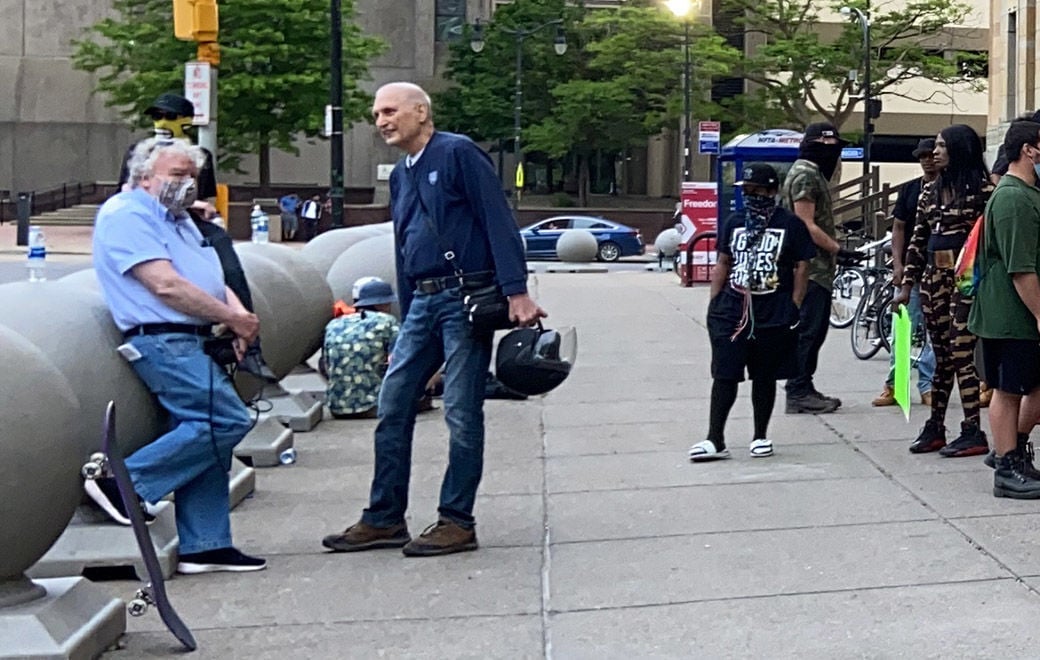
A Buffalo News photo taken before the incident shows Desmond and Gugino chatting in the way old friends might. Desmond says they caught each other’s notice that night simply because they were the only septuagenarians on the scene. He figures Gugino did not remember him, either, or else he probably would have mentioned it.
“If I remember right, we were saying, ‘It’s a nice day for a protest,’ as opposed to some of the protests in winter around here,” Desmond said. “I think we talked about how young the protesters are, at least from our perspective. But I didn’t know what his name was.”
Now he does. And now he knows their Canisius connection, too. The school reports that the Class of 1962 had about 170 graduates.
I called Desmond back days after our first conversation to find out if seeing Gugino in an old yearbook might have jogged his memory. Desmond said he couldn’t check his yearbooks because his brother, Stewart, borrowed them years ago and hasn’t returned them. But Desmond said he did find Gugino’s name in an old high school directory.
“I may well have known him at the time,” he said. “But I can honestly say I have no recollection of him.”
And now Desmond will never forget him. They are paired in history, in Buffalo and beyond.
