

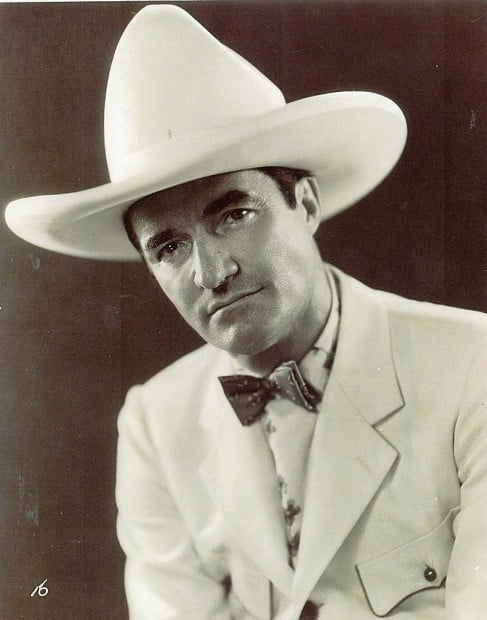
Tom Mix was easily the most popular cowboy of the silent era, but he wasn't the first.
That distinction goes to Gilbert M. Anderson, who, after appearing in "The Great Train Robbery" in 1903, played Bronco Billy in nearly 150 silent Western shorts.
William S. Hart rode onto the scene in 1914, playing the lead role in "The Bargain," a feature-length film that was shot at the Grand Canyon. Hart, a Shakespearean actor who ended up making more than 65 films, prided himself on crafting realistic portraits of life in the Old West. But his approach fell out of favor by the early 1920s.
"Hart's hero had been the Good Bad Man, a hard-drinking, hard-riding, hard-shooting he-man, often an outlaw, often the enemy of law and order, but always true to the moral code of the old frontier," wrote film historian Arthur Knight.
People are also reading…
"After the First World War, Hart's descriptions of the West, although essentially truer than anything that has been done since, came to be dismissed as 'old-fashioned.' Moviegoers, even Westerners, preferred the more romantic version of the West they found in the films of Tom Mix."
Moviegoers couldn't seem to get enough of Mix, who was handsome, flashy and utterly unconcerned with historical accuracy. He also had a publicist that made up wild tales about his past - a collection of lies that only added to his allure.
The irony is that Mix, unlike Hart, was a real cowboy whose skill in the saddle was unrivaled among his movie counterparts.
He made many of his more than 300 films in the Prescott area, where he won the 1909 national rodeo championship. He was well-known in Prescott as a trick roper and rider, not to mention an insufferable show-off.
Prescott historian Lester "Budge" Ruffner reported that local kids were forever trying to imitate the tricks performed by Mix, resulting in lots of "broken bones and worse."
Ruffner said that mothers became so angry with the movie star that they threatened to hold an old-fashioned lynching party if they ever got their hands on him.
Just how popular was Mix? Well, consider that he earned a reported $6 million in the 1920s, a time when movie tickets cost a nickel.
He lost most of his fortune in the 1929 stock market crash, and his career did not survive the advent of sound.
Mix retired in 1935, with just nine talkies to his credit.
On Oct. 12, 1940, he was killed when he crashed his 1937 Cord 812 Phaeton on the highway south of Florence.
Witnesses said he was going at least 80 mph when he approached a construction zone. He crashed through the barricades and into a wash. The impact sent a suitcase full of money and jewels flying forward. It crushed his skull and broke his neck.
A memorial marks the site on Arizona 79. Inscribed on the plaque: "In memory of Tom Mix whose spirit left his body on this spot and whose characterization and portrayals in life served to better fix memories of the old West in the minds of living men."