

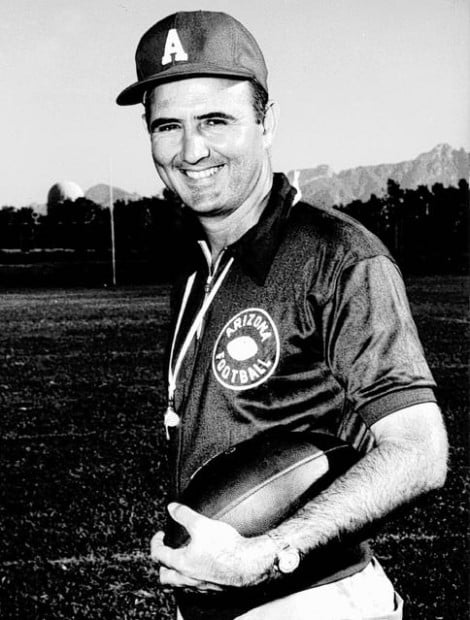
A few days after Thanksgiving 1966, Arizona Wildcats defensive line coach Ron Marciniak took his suitcase to the football offices underneath Arizona Stadium.
He planned to get an expense check, drive to the airport and fly to Pennsylvania for a few days of recruiting.
After eight seasons on Jim LaRue's staff, Marciniak was eager to add reinforcements to a program that in 1967 would play Ohio State and Missouri.
Marciniak did not get to the airport that day, but he did need his suitcase.
"We all got fired that morning,'' he was saying Wednesday. "Coach LaRue came back from a meeting with the vice president and said the trips were off. He had been made to resign.''
LaRue and his four-man staff sat alone in his office for what seemed like forever.
People are also reading…
"It was a shock,'' says Marciniak, 78, who is retired and lives in Plano, Texas, after a 22-year career as an NFL scout. "Jim was somber but typically respectful. He didn't holler or criticize the president or the athletic director. We just sat there, looking at the floor, no conversation.
"After about 20 minutes, he said, 'Gentlemen, I need to call my wife. Let me know how I can assist you in looking for work.' He was dignified and professional. In all my years at Arizona and with Jim, I learned a lot about football, but I learned more about dignity and character."
Marciniak is in Tucson this week to help honor LaRue for his contributions to amateur football. On Friday, the Southern Arizona chapter of the National Football Foundation and College Hall of Fame will pay tribute to LaRue in a noon banquet at the Tucson Convention Center.
From 1959 to 1966, LaRue's record at Arizona was 41-37-2. That does not matter now any more than his brilliant 15-1-1 streak in the early '60s does. What endures is the way LaRue conducted himself and what he meant to those he coached.
"Coach LaRue was a man of character, and whenever I see him, my heart lights up,'' says former Sahuaro High School football coach Howard Breinig, who was part of LaRue's first UA team and later a team captain. "I've admired him forever; I'm a better person because of going through his program."
LaRue earned $16,500 in his final year as Arizona's football coach. He had three teenage children and lived modestly, he remembers, in a middle class neighborhood near Speedway and Swan.
Even though he was a mathematics graduate of Duke and earned a master's degree at Maryland, newly unemployed LaRue did not have time to wait for a preferred career position. He quickly found a job selling insurance in Tucson and, to make himself a better insurance salesman, took Spanish classes at night.
Now, 41 years later, he can chuckle at the memories.
"After a few months selling insurance, we packed our car and drove to Carbondale, Ill.,'' he says. "I coached the freshman football team at Southern Illinois, and I was fine with it. I needed to support my family. It was a good time."
The best part of Jim LaRue's life story is that he triumphed over that one lousy day — Nov. 28, 1966, when he was fired by the UA — and did not let it define him.
He went on to coach at Utah, Wake Forest and with the Buffalo Bills.
Remember that epic 1986 Super Bowl won by Ditka's Bears? Walter Payton, the Fridge and Jim McMahon? Jim LaRue was in the middle of a 16-year run as the Bears' secondary coach.
"The UA treated me well," he says. "We moved back here in the mid-1990s, so you must know how much I enjoy the people of Tucson. I was never bitter. Coaching isn't a secure profession, and I knew that from the beginning.''
LaRue grew up in Clinton, Okla., the son of a small-town attorney who was, he says, a farmer at heart. His mother was ill and confined to a wheelchair for much of her adult life.
As a teenager, before and after school, Jim took over the family's washing, ironing and cooking duties. Marciniak believes that industrious upbringing led to LaRue's career successes.
"As a coach, at Arizona, we didn't have the best of anything,'' he says. "Our equipment was below average. Our facilities weren't very good. I had to paint all the walls white so that we could use them for our film work. We couldn't afford screens to use with our projectors.
"But Jim was a grinder. He didn't complain. At Arizona, I learned many great lessons dealing with a crisis, because we had many of them as a football program. Jim never let it get him down.''
At Arizona, LaRue was universally known as "Gentleman Jim.'' In 1966, use of the word "gentleman'' before a football coach's name was often interpreted as a sign of weakness.
In 2008, we know that it was one of Jim LaRue's many strengths.


