


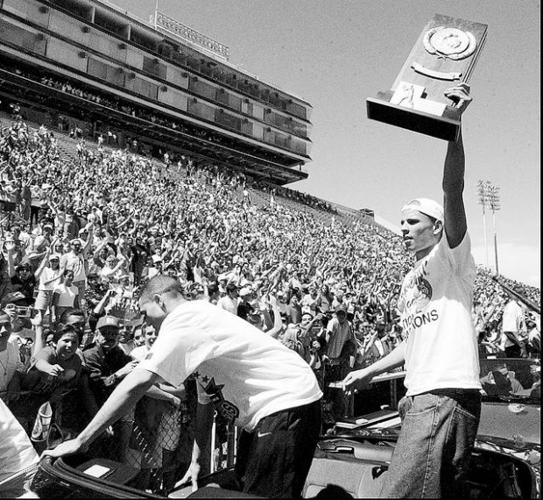
This is the way the fairy tale reads:
In 1997, a year before Arizona was supposed to be ready for a national title run, the Wildcats beat three No. 1 seeds to win the NCAA championship and make a name for themselves.
That Final Four was played in the basketball heartland of Indianapolis, the hometown of a future high school All-American named Jason Gardner.
The Wildcats intrigued Gardner, who signed and eventually helped lead them to another Final Four, and the recruiting floodgates opened from there.
Gardner actually followed a rich recruiting class that also was lured by the 1997 title. It included Richard Jefferson, Luke Walton and Michael Wright.
The Wildcats later attracted elite talents such as Andre Iguodala, Hassan Adams, Salim Stoudamire and Mustafa Shakur.
People are also reading…
Arizona has won or shared four Pac-10 titles since 1997, reached five Sweet 16s, four Elite Eights and one Final Four.
All of that happened, yes. But it didn't happen just because of that magical championship run.
Those in and around the Arizona basketball program, including Gardner, will tell you it was happening anyway. The rocket was launched years earlier.
"I don't really think the championship had anything to do with it," Gardner said of his commitment to the UA. "There were just a lot of good point guards there, like Damon (Stoudamire), and the guards get up and down the floor."
Outside the program, except for the uninitiated few, the same was true. The UA had already reached the 1988 and 1994 Final Fours. It had already won or tied for seven Pac-10 titles since coach Lute Olson took over in 1983.
Financial evidence says the program had already made it, too. The Wildcats were selling out McKale Center for more than a decade, they had led the Pac-10 in attendance every year since 1985 and, while UA officials acknowledge a slight bump in licensing money from souvenirs after the title, they had all but maxed out their television revenue.
"It would be hard to argue that (television) increased," said John Perrin, the UA's associate to the athletic director for finance. "We have gotten as many as we're going to get. The teams that are highly competitive are going to get on there, even if they don't win the national championship. TV stations don't call you and tell you they want you on because you won the national championship."
Thanks to that exposure and to most knowledgeable fans around the country, Arizona's 1997 win was an upset of note in the office tourney pool, but not a complete shocker. Then again, some fans may have only remembered the Wildcats' first-round NCAA tournament exits. For them, the UA's national title did open their eyes.
ESPN analyst Jay Bilas, who played for Duke's 1986 national runner-up, said he remembered how his team was not fully appreciated until the Blue Devils won the 1991 and 1992 titles, then lost in the 1994 title game.
He scoffed at the notion that Roy Williams, who took Kansas to four Final Fours, was not completely respected until he won the national title with North Carolina in 2005.
This spring, it was Billy Donovan, another coach Bilas likes, who won his first title at Florida.
"It validates everything you've done," Bilas said. "It's kind of like an uneducated man's validation. Smart people shouldn't need that.
"I've been saying for years that Billy Donovan was one of the elite coaches. You couldn't get anybody to listen, but now they do, of course. Same thing was true for Coach Olson."
That validation is really the only difference UA assistant coach Miles Simon sees at Arizona since he was the 1997 Final Four MVP.
"I think winning a national championship for any school puts you at even more of an elite status," Simon said. "It puts you on another level.''
No question it helped eventually put Olson into the Basketball Hall of Fame, too. But it didn't right away: Olson was nominated but not selected, even after the Wildcats reached their fourth Final Four in 2001.
It was only after Olson did one of his best coaching jobs, putting a young team wrecked by the talent exodus of 2001, into the 2002 Sweet 16, that he was finally honored.
Today, to Olson, the lasting effect of 1997 was not the Hall of Fame, not the new offices built at McKale Center after the title, and not the new practice courts under construction.
It simply was the added leverage he had with today's recruits.
"At least the championship has gotten us in the door on kids that maybe, prior to the championship, we'd have trouble'' recruiting, Olson said. "Once you've won the title, you become one of the options that they're considering.
"That's the good news. The bad news is the competition we face for those players is at the very elite level — Duke, Carolina, Texas, Florida, Michigan State, Ohio State, Illinois."
Or, as longtime UA associate head coach Jim Rosborough puts it bluntly: "You still have to bust your butt to get kids. It opens doors, but kids aren't just falling to get in here."
It is also more critical than ever that elite programs get those elite prospects to stay on top of the competition. Since 1997, Arizona has won the Pac-10 title outright only three times, in part because the league is more balanced from top to bottom.
Deep NCAA tournament runs from teams such as George Mason, which reached the 2006 Final Four, suggest the national level of talent also is rising.
"You look at the NCAA tournament over the last couple of years and the competition has been better from round one right through," Olson said. "There are more good players, and the coaching has improved on all levels of competition in Division I. It's a case now where everyone is good enough, that if you don't come out ready to play, you're going to lose, whether it's at home or on the road."
Worse, the elevated expectations that accompany a national title make those bad losses taste even worse. The Washington State win over the UA at McKale in 2005? The Wildcats' slip from the Top 25 polls and the race to just keep their 20-win streak alive last season?
No longer acceptable. Yet, in a way, that's a good sign, a sign of the progress Arizona has made since well before its 1997 national championship.
"Going 20-13, for 99 percent of the country, that's as good as they can expect," UA assistant coach Josh Pastner said. But "some people said it was an off year for us. That's why we're considered an elite program."
King of the Cats
Men's basketball consistently creates more net profit for Arizona's athletic department than any other sport. Official figures obtained from UA, however, show that basketball revenue did not rise in 1997.


