

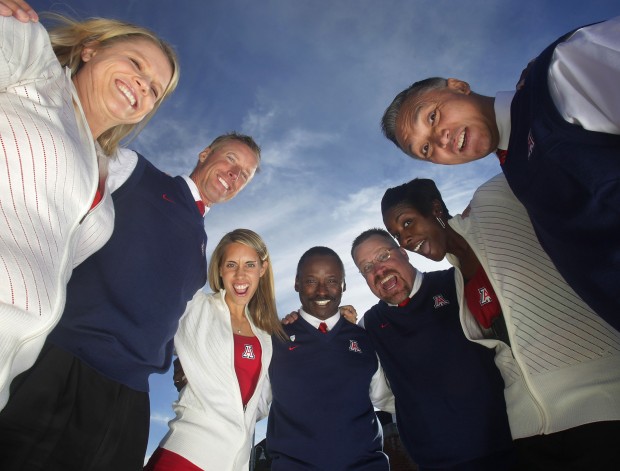
In an isolated corridor at McKale Center, Fred Harvey requires an economical 14 steps to survey his track and field kingdom.
James Li, who coaches America's leading middle distance runner and an undefeated NCAA cross country champion, is so close, 5 yards from Harvey's door, that you can almost hear his conversations through the cinder-block walls.
Craig Carter, voted the nation's top assistant track coach of 2011 by the U.S. Track & Field and Cross Country Coaches Association, a man who coaches the NCAA shot put champion as well as the reigning USA shot put champion, is 10 paces from Harvey's front door.
Sheldon Blockburger, who coaches the nation's top women's high jumper, a two-time NCAA decathlon champion and the USA's No. 3 pole-vaulter, is another 4 yards distant.
The territory shared by Arizona's track and cross country staff is so modest that there's almost no room to puff out a chest or to allow for an ear-to-ear grin.
People are also reading…
There is little space for a record book, much of it that required re-writing in 2011.
In '11, Harvey was selected the Pac-12's Coach of the Year not only for men's track and field, but for women's track and field, too.
"It was one of those perfect-storm type seasons," he says. "You see all the hard work, all of the labor, come to fruition."
For that excellence, Harvey and his staff are No. 1 on the Star's 2011 list of the Top 100 sports figures in Tucson.
It was such a good year that it actually moved Harvey to tears.
After the Wildcats finished an unprecedented No. 2 in both the Pac-12 men's and women's track championships - the UA women's team had finished second only once, in 1992, and the men's team had never finished that high - Harvey stood on the infield at Drachman Stadium and let the tears flow.
Several weeks later in Des Moines, Iowa, at the NCAA championships, the Wildcats finished No. 5 in women's finals and No. 7 in the men's competition. Only once, in 1989, had UA men's and women's track teams been simultaneous top-10 finishers.
"Fred has done an excellent job of recruiting quality coaches and, in turn, helping them recruit quality athletes," said former UA track coach Dave Murray, who coached the Wildcats to a combined 12 top-10 track finishes, men and women, from 1984-2001.
"They've really got it going."
Oregon is the standard by which Pac-12 track and field/cross country programs are measured and in 2011, the Wildcats and the Ducks were neck-and-neck.
According to the U.S. Department of Education, Oregon spent $1,084,473 on track/cross country in 2010-11. Arizona spent $615,260.
The Wildcats did more with less.
Harvey's staff includes Li, Blockburger, Carter, distance running coach Erin Dawson, sprints coach Francesca Green and director of operations Dawn Boxley. That's seven full-time people.
By comparison, Oregon's website lists 11 coaches, two directors of operations, and a director of track and field ventures.
The Ducks and Wildcats both use the maxiumum number of NCAA scholarships: 12.6 for men and 18 for women. Because of the small population base in Southern Arizona, Harvey rarely is able to deploy skilled walk-ons, or partial scholarship athletes, which is an edge UCLA, USC, Stanford, Cal and the Ducks enjoy.
Harvey has virtually no depth, yet the Wildcats compete at the highest level, judiciously spreading out scholarships to Carter's throws athletes, Li's distance runners, Blockburger's jumpers and Harvey's sprinters.
"Arizona has to be very selective," says Murray. "You need your top scholarship people to score points for you on a national basis. You can't afford to be wrong in your evaluation process because you're not going to nickel-and-dime people with sixth- and eighth-place points the way Oregon and USC can."
In 2011, the Wildcats were dead-on accurate in their recruiting evaluations.
Junior high jumper Brigetta Barrett won the NCAA championship and the USA title.
Freshman distance runner Lawi Lalang was second in the NCAA 5,000 meters and an undefeated NCAA cross country champion.
Junior shot putter Julie Labonte won the NCAA shot put championship.
Junior distance runner Jen Bergman was third in the NCAA 10,000 meters and a first-team All-American in cross country.
Junior high jumper Nick Ross won the Pac-12 and was third in the NCAA. Junior distance runner Stephen Sambu was third in the NCAA 10,000 meters. And on and on.
In addition, Li coaches Bernard Lagat, an Olympic silver medalist at 5,000 meters. Carter coaches Jill Camarena-Williams, who in 2011 became the first American women's shot putter ever to win a medal at the World Championships.
And Blockburger coaches two-time UA national decathlon champion Jake Arnold, an ex-Wildcat who is a contender for the 2012 London Olympics, former Arizona NCAA high jump champion Liz Patterson, and ex-Wildcat Nick Mossberg, who was third at the USA championships in 2011.
"Coaching the post-grads and elite athletes, like Bernard Lagat, helps our recruiting and our image," says Harvey. "Our standards and expectations are high."
Li came to Arizona from Washington State. Blockburger had been a successful mid-level coach at Cal-Poly. Carter had coached at Utah State. Dawson was at NAU.
All have been in demand. In recent months, Carter declined a job opportunity at home-state BYU, and Dawson, who is a recruiting dynamo, turned down a chance to coach at Stanford.
"We don't think 2011 was a fluke," says Harvey. "We think we'll get better. Our expectations are higher than ever."
Contact him at 573-4362 or ghansen@azstarnet.com


