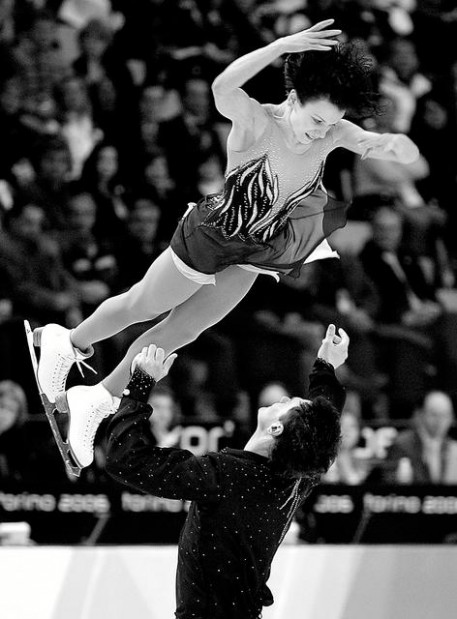
TURIN, Italy — Ask the Russians why they have so dominated pairs figure skating for the last four decades and they will smile and say the answer is self-explanatory.
The Russians are so good because … they are Russians. As if it's just genetically encoded in a certain amount of the population there to be able to do throw jumps, death spirals and side-by-side double axels.
The more realistic explanation, though, is that strong competition within their own country and the best coaching have kept the Russians on top. They've won every Olympic gold medal from 1964 to 2002 (though the 2002 gold was shared with Canadians Jamie Sale and David Pelletier.) And in the World Championships, Russians have won 32 of the last 41 pairs titles.
One thing is the same from the legendary duo of Ludmilla and Oleg Protopopov, who began the Russian dominance in pairs with the 1964 Olympic gold, to current favorites Tatiana Totmianina and Maxim Marinin, who go for the Olympic title tonight. The Russians are on the cutting edge, so to speak, of peak pairs performance.
People are also reading…
Thus, it may seem a bit odd that when it comes to the throw triple axel, the Russians don't do it. The first pair to land that skill in competition was the U.S. duo of John Baldwin and Rena Inoue (an American by way of Japan, for which she competed in two previous Winter Olympics.)
Baldwin and Inoue successfully did the throw triple axel last month in the free skate at the U.S. Figure Skating Championships. Then they became the first skaters to land it in international competition Saturday night in the short program.
Americans, incidentally, have never won an Olympic gold in pairs. And they've taken the World Championships title just twice.
Baldwin and Inoue are in sixth place going into tonight's free skate. Their short-program score of 61.27 has them three points away from the third-place pair, Russia's Maria Petrova and Alexei Tikhonov.
The American duo plans to attempt another throw triple axel in the free skate.
As for why they've worked so hard to accomplish it, Inoue said, "I wanted to do something special, something no one else could do."
Inoue explained the element from her perspective: "Technique-wise, it's the same (as most jumps): the guy has to throw the girl right. But it's more complicated because he takes off backward and I have to take off forward. It takes more timing. Just keep working hard, and you'll get it someday."
At nationals last month, Baldwin talked about the difficulty of learning and refining the throw triple axel, saying, "We had a few hard falls."
"We" is the pronoun all pairs skaters use, because it's a team effort, but … only one person actually hit the ice, and that was Inoue. Such is the nature of the event. The women skaters in pairs must have a large amount of trust and courage. But some things frighten even them, including the throw triple axel.
"Most girls are scared to do jumps when thrown forward," Marinin said. "Tatiana is one of those girls, so we have never tried it."
Totmianina has reason to be a bit wary on the ice. In October 2004, she was knocked unconscious and suffered a concussion when she fell during an overhead lift at the Smart Ones Skate America competition in Pittsburgh. Totmianina said back then she didn't really remember what happened as she fell.
"I can tell you that even after that fall, I never thought I would stop skating," she said after Saturday's short program.
Likely, the only thing that could stop "Tot and Max" from taking the gold would be an outstanding performance from their compatriots Petrova and Tikhonov or the Chinese duo of Zhang Dan and Zhang Hao in second place.
Totmianina and Marinin lead the pack with 68.64 points. They've won the last two world championships, but Marinin admitted he was nervous at the Olympic short program.
"I tried to avoid looking at other skaters skating, but I couldn't do it," he said. "I was feeling that the others were skating better and better. The atmosphere was rising inside the rink. That was a stone from my shoulder when we finished our program."

 Lloyd to get clarity on Arizona basketball future this week | Greg Hansen