

After the New York Giants swept the Cleveland Indians in the 1954 World Series, baseball's power teams scheduled 18 spring training games between one another in March of '55. Giants in Phoenix. Indians in Tucson. Not much in between.
There was no speedy Interstate 10 then, and no whining, either. There was, instead, baseball uninterrupted.
Baseball's best teams of the moment (the Yankees and Dodgers would soon interrupt the 1955 Cactus League bliss) traveled Highway 89 between Tucson and Phoenix over and over and over for the entire month of March. If you wore an Indians uniform, you made every trip because, until 1962, Cleveland's minor-leaguers trained in Daytona Beach, Fla.
The mayor of Phoenix scheduled a parade down Central Avenue (ballplayers rode two to a convertible) to welcome the Giants. In Tucson, the "Keep Cleveland in Tucson" project had raised enough money to build the Indians a new locker room and three training fields in an attempt to keep them away from a would-be landlord from Daytona Beach.
People are also reading…
No one could have suspected it, but by March 1955, Tucson had already been witness to the two greatest teams that would ultimately stage spring training in this humble, backwater oasis. That's No. 1 and No. 2 of what will be 88 total spring training teams when the Diamondbacks and Rockies make their exit this year.
Unthinkably, the Indians roster for their first Tucson spring training, 1947, overflowed with six future Hall of Famers: Joe Gordon, Al Lopez, Lou Boudreau, Larry Doby, Bob Feller and Bob Lemon.
There was so much talent on display that Tris Speaker and Rogers Hornsby, Hall of Famers with more than 6,000 hits between them, showed up at old Randolph Park to hold a hitting camp.
"I don't know whether to ask them for batting tips or autographs," said Boudreau, then Cleveland's 29-year-old player-manager, who would be the 1948 American League MVP.
Given that launch point, the '48 Indians became the best baseball team to train in Tucson. Here's one man's look at the top five:
1. Cleveland Indians, 1948: The Tribe was an offensive juggernaut, scoring 840 runs, the most of any Cleveland team until 1996. They went 97-58, beat the Boston Braves in a six-game World Series and boasted a Big Three pitching staff that included Lemon, 20-14, Feller, 19-14, and Gene Bearden, 20-7.
Gordon, an All-Star second baseman who had been traded by the Yankees a year earlier, had his career season with 32 homers and 124 RBIs. It was also Doby's first full year in the big leagues. The American League's first African-American baseball player hit .301, and protected All-Star third baseman Ken Keltner, who hit 31 homers, in the lineup.
2. Cleveland Indians, 1954: Until the 1998 New York Yankees won 114 games and the 2001 Seattle Mariners won 116 in longer seasons, the Indians' 111-43 team of '54 was baseball's most prolific winner. They were so good that they beat the 103-51 Yankees by eight games.
Unfortunately, they were swept 4-0 by the Giants in the World Series.
Incredibly, Cleveland's starting rotation of All-Star Mike Garcia and Hall of Famers Feller, Lemon and Early Wynn went a composite 78-29. First and third baseman Al Rosen and second baseman Bobby Avila started in the All-Star Game. Avila had a career year, batting .341. He finished third in MVP voting.
3. Arizona Diamondbacks, 2001: Arizona teams of 1999 and 2002 won more games than the 92-70 D-backs of 2001, but none could match the overall dynamics of the '01 World Champions, who overcame a September slump (10-11) to squeeze into a division title by two games over the Giants.
The D-backs had the most imposing 1-2 punch in the last quarter-century of pitching: Randy Johnson went 21-6 with a 2.49 ERA and 372 strikeouts to win the Cy Young Award. Curt Schilling was 22-6. No other starter won more than 11 games, and left fielder Luis Gonzalez was the only position player in the All-Star Game.
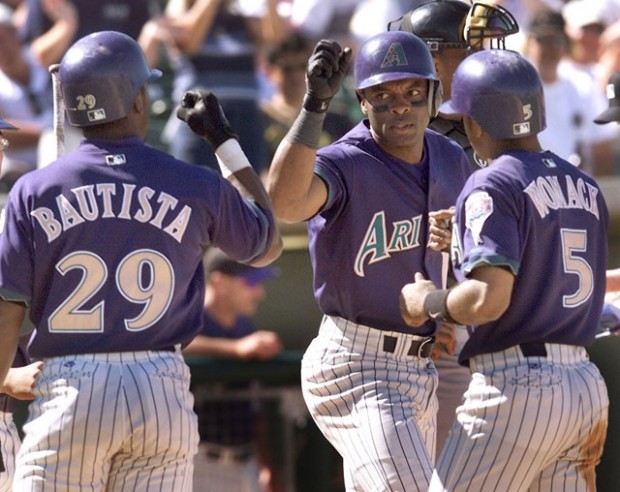
Unimaginably, Gonzalez hit 57 home runs. He had never hit more than 31 and never again hit more than 28. A bunch of clutch hitters, including Mark Grace, Tony Womack and Reggie Sanders, enabled the D-backs to stun the Yankees in an epic seven-game World Series.
4. Chicago White Sox, 2005: In first place for all 161 days of the regular season, the White Sox limited opponents to 645 runs, the franchise's fewest since 1972. All-Star pitchers Mark Buehrle and Jon Garland were terrific, 34-18 overall. The surprise star was closer Dustin Hermanson, who saved 34 games. He had only 56 when his career ended a season later.
First baseman Paul Konerko, with 40 homers and 100 RBIs, and left fielder Scott Podsednik, with 56 stolen bases, were the key parts of an otherwise no-name offense that swept the Astros in the World Series.
5. Colorado Rockies, 1995: The year began with a strike, forcing an abbreviated schedule. But the Rockies soon became the most entertaining team in baseball. They hit a major-league high 200 home runs as they introduced the Blake Street Bombers - Dante Bichette, Andres Galarraga, Larry Walker and Vinny Castilla - to baseball.
That foursome combined for 119 homers as the Rockies, in just their third year of existence, reached the National League playoffs before losing in the division series. Colorado scored 5.45 runs per game, most in baseball.
The Rockies didn't reach the postseason again until 2007, when they made a startling run to the World Series. But the '07 Rockies, swept by the Red Sox, couldn't match the '95 club, which drew a major-league high 3,390,337 at the gate and established the Coors Field reputation as a home run paradise.
Contact columnist Greg Hansen at ghansen@azstarnet.com or 573-4362.


