

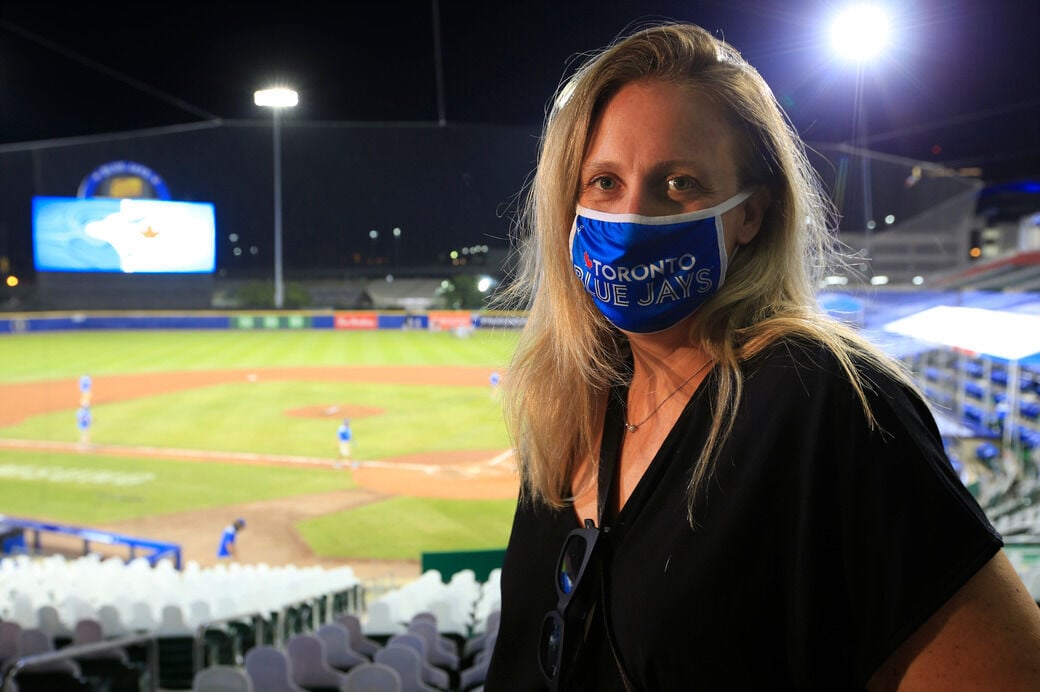
The transformation of Sahlen Field was a frenetic project done in just more than two weeks to turn the Buffalo Bisons' longtime Triple-A home into a facility capable of hosting Major League Baseball.
Marnie Starkman, the Toronto Blue Jays' senior vice president of marketing and business operations, has been one of the key people on the project and discussed its details on a Zoom call with The Buffalo News and Toronto media this week.
After splitting two games with the Miami Marlins, the Jays begin a three-game series Friday against the Tampa Bay Rays.
Here are some of Starkman's thoughts on numerous aspects of the move to Sahlen Field, lightly edited for clarity:
Q. What went into the decision to replace the infield, because it was not initially in the plan?
People are also reading…
A: The (Blue Jays') depth squad was here and Pat Skunda heads our grounds crew in (Dunedin) Florida and he's used to dealing with grass. Once he got here, he felt that the lip between the dirt and the field was just too deep. ... When we looked at it and talked to a few other teams who had laid down grass fairly quickly, it just seemed like the best decision. We replaced the infield, we replaced behind home plate and down the lines and 20 feet out to the outfield. You will see on the broadcast a little bit of coloration difference, but the guys have done an amazing job of smoothing that out.
Q. As far as the visiting side being in the parking lot behind right field, was that something MLB provided guidelines for or did you take that on internally?
A: We worked with MLB. The two clubhouses really couldn't fit two teams. When we got here and looked at it, I think the home clubhouse might have fit 15 players socially distanced if we were lucky and the visiting was maybe 10 guys. We have our coaches now in the entire (Bisons) clubhouse. Once we realized space was an issue, MLB had that plan for what a big clubhouse would look like because they were dealing with the "Field of Dreams Game" (which was postponed Thursday in Dyersville, Iowa) and that really helped us. Those plans, to be honest, were done when Buffalo was an option a while ago. We knew from the get-go the Bisons owned that parking lot and that's where we were going to build that visiting compound.
Q. What was used and trucked from Toronto and brought to Buffalo?
A: We brought a lot from back home – four full Campbell moving trucks. And that was sort of our purpose because I think one of the objectives we definitely got (from GM Ross Atkins and manager Charlie Montoyo) was to make this feel as close to home as you can. It's not going to look like home exactly, but anything you can do to make it look like home. We packed up our entire home weight room. We packed up our entire visiting weight room. All of the clubhouse chairs are from home. ... All of our training tables, anything in the training room.
Q. What was the biggest challenge?
A: There was no Major League Baseball infrastructure here. It's not a knock on it. It's just a Triple-A facility. Lighting was a big one. Field. Major league facilities in general. That was the first hurdle. The second was general space. The third one was space in a pandemic with a manual that keeps getting added to. The fourth one was time, because you're trying to build this in a pandemic as well.
Q. How many workers were needed to get this going?
A: Brian Blew (the Blue Jays' senior VP of facilities) had been here setting up the depth squad. I came here a couple days before the final decision was made with about five staff members and now we're up to about 25. We had five different plans running. Toronto we were prepared for obviously. Dunedin we were most prepared for because we had made the decision on the lighting, but it became more and more clear that we just weren't sending our guys to Dunedin. Buffalo we really had been working on and that's been a little bit of a misconception. We just weren't comfortable pressing go on the financial commitments right away because it was lighting and big builds.
We had plans in PNC Park (Pittsburgh) and Camden Yards (Baltimore). At PNC, in left field there's a big restaurant there and we were going to use that for our clubhouse space and use the concourse to build. And then Baltimore we were going to use the first-base concourse side.
Q. Can you go over what was subpar about the lighting and what you did to it to bring it up to speed?
A: We're working with Musco Lighting, who Major League Baseball works with on all their levels and readings. There's an outfield reading and an infield reading. The stadium was not to par. It's not only player safety. It's broadcast as well. We replaced every bulb on the existing towers they have. ... That got the levels up to two-thirds of where they needed to be. The two additional Musco lighting trucks are what they used in Williamsport (for MLB's Little League Classic) and for NCAA events. They go up each night and support the additional lighting levels. They do a reading that gets sent to MLB to make sure they're up to standards.
Q. Did you consider an alternate location for the bullpens, moving them so they are not on the field?
A: We did. There was really nowhere to move them. We walked it. We looked, tried to figure out if we could reconstruct them anywhere. A big portion of the highway is behind the left-field side and it became clear with the (right-field) compound there wasn't anywhere where we felt we could build them. ... The one thing we did do is there's no way there's enough space for guys to sit socially distant. We created the padded stairway so guys in the bullpen can sit in auxiliary tents in the stands and do their work up top (in the concourse) so we take the guys off the field.
Q. Was there anything you weren't anticipating at the start that caught you by surprise? Anything beside the grass?
A: A ton of things come up as you do this. The grass was just a choice. ... Another big one was air conditioning in the (Blue Jays') clubhouse. Because we used the hallways to create a larger clubhouse, we added an HVAC system and air in there so there's proper circulation. The stairs to the field, you're figuring out how you're doing that with netting and safety. ... We built a weight room on the concourse, but that area still has winds. We've gone through every day finding something new and we'll continue to do that.
Q. Do you have a sense what the cost has been?
A: You can see it required significant resources. To give you a running total, I don't have that. ... A significant commitment here. We feel some of the stuff here will be left for our Triple-A team. The Bisons have been so great to work with. To brand all of this space, the painting, the carpeting, the field, the lighting. All that stuff is going to be left. ... A lot of the work we've done will be beneficial for the guys who show up next year.
Q. What will be most beneficial investment for the Bisons moving forward?
A: The field is the biggest one. We're working through a plan to leave with the Bisons on just how to ensure it's maintained so that they can work through the fall to maintain it now that it's in. ... It's the biggest investment and will be one that will help us in the long run.


