

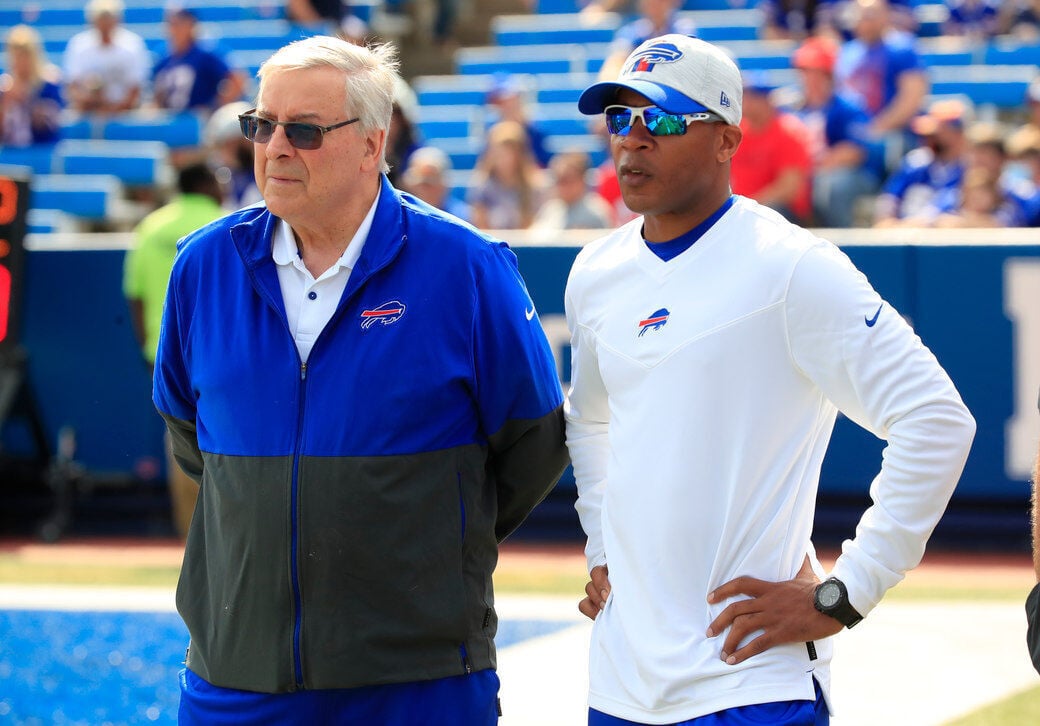
MOBILE, Ala. – The Buffalo Bills have been scouting this year’s draft prospects on the field since the college football season began in September.
For the past week at the Senior Bowl, the Bills began the process of getting to know the prospects – face to face – off the field.
It might not exactly be half the battle in scouting, but it’s a significant part of getting draft picks right.
“It’s a big part of it, at least for us,” Terrance Gray, the Bills' assistant director of player personnel, said after Wednesday’s practices in Mobile. “When you draft them, they come into your building and you’re adding them to your culture. So it is a big part of what we do, sitting down in one-on-one interaction. It’s not always all football. We want to get to know the individual, their background, what makes them tick, what motivates them. Obviously, you get to some football elements. You try to find out their football IQ, how well they understand the game.”
People are also reading…
The Senior Bowl and the East-West Shrine Bowl in Las Vegas last week were the first chances for NFL scouts to speak with draft prospects.
“The hardest part is drilling down and figuring out the person,” Senior Bowl executive director Jim Nagy said. “Seeing them in the hotel, seeing them interact with their teammates. How do they learn? How attentive are they? All those intangible qualities, these scouts get to see.
"You get the person wrong more than you get the player wrong," Nagy said. "The longer you scout figuring out the player and the tape is the easy part. It's really figuring out what is this player going to be with a lot more time on their hands, a lot less structure, and a lot more money."
The good news for Gray, the Bills and the rest of the NFL scouting community is the drafting process is almost back to normal this year. Last year’s draft was conducted amid a slew of restrictions prompted by the Covid pandemic.
“I would say because of the Covid environment nothing is completely back to normal, but we’re able to do our job to the full capacity,” Gray said. “I think the biggest difference between this draft cycle and last draft cycle is the access to players. We’re back on campuses, we’re back at practices, we have full access to games, no matter what conference it is. All of the conferences – from Division I to NAIA – everyone was back playing football.”
In the 2020 season, NFL area scouts could not go to college campuses during the season. They couldn’t watch practices or talk in person with college coaches. The pandemic last year caused the cancellation of the NFL scouting combine, where the top 330 or so prospects are tested and evaluated every February. Instead, all the testing was held at pro-day workouts on campus, a less standardized process, and each NFL team was limited to 10 representatives in attendance. That effectively excluded most assistant coaches.
There weren’t any dinners with draftees, either at pro-day workouts or at the team facilities. Normally each team is allowed to bring in 30 draft prospects to its facility for interviews. Instead, all interviews were done via videoconference.
The combine is back on this year, set for March 1-7 in Indianapolis. The 30 private visits for each team are back on, barring any unexpected change in NFL protocols.
“It was a huge adjustment last year,” Gray said. “You had to really brainstorm and adjust and get a new game plan for how you wanted to attack that draft class. ... Our whole theme last year was adapt and adjust, from coaching to personnel. Our focus was we want to have a good draft. Let’s not get distracted by what we can’t do. Let’s make the most out of what we can do. It was all about priorities and being organized and having a strategic plan. I felt our staff did a great job of executing the plan we laid out. It was a challenge, but we made it work.”
At the Senior Bowl, there is a set schedule for interviews.
“Every player has a time slot,” Gray said. “They will meet with every team in the convention center. It’s called their formal interview process. They give you 16 minutes with each kid.”
Of course, the game itself sets the Senior Bowl apart from the combine, where testing and workouts are done in T-shirts and shorts. Last year there were 106 players from the Senior Bowl drafted. In 2020 the number was 93. The Bills drafted five Senior Bowl players last year – Carlos Basham, Spencer Brown, Marquez Stevenson, Damar Hamlin and Jack Anderson. There were six future Bills in the game in 2018 – Josh Allen, Taron Johnson, Wyatt Teller, Harrison Phillips, Siran Neal and Levi Wallace.
“It’s the best of the best all in one setting,” Gray said. “This is a great opportunity for those guys and a great litmus test. Some of those guys who come out of smaller schools can be dominant within that conference. You look at a Spencer Brown, who hadn’t even played in 2020. ... Being able to see those guys compete in this setting against guys from Alabama, Auburn. It's kind of a sink or swim for them. Some of those guys – Darius Leonard, Quinn Meinerz, Kyle Dugger, you see guys that rise to the occasion.”
Brown was selected in the third round from Northern Iowa. Leonard, the Colts’ Pro Bowl linebacker, came from South Carolina State. Meinerz was a third-round pick of Denver last year from Division III Wisconsin-Whitewater. Dugger starred at Division II Lenoir-Rhyne before going to New England in 2020.
“You see it go the other way, too,” Gray said, “where the moment was probably a little too big for some guys. It’s really good to see it live in person.”
It’s not just about getting a better handle on small-school guys. Maybe a receiver from a power conference faced mostly mediocre cornerbacks in a given season. How does he do against tougher competition?
“Absolutely,” Gray said. “Why not a Spencer Brown? You might say this tackle from the Big 12 is rated high and he’s pretty good. But you watch them against common competition and say Spencer Brown is just as good or even better.”
Gray was hired by General Manager Brandon Beane in May 2017 as director of college scouting after spending the previous 11 years in the Vikings organization. At the same time, Lake Dawson was hired from Cleveland to be assistant director of college scouting. Dawson had 22 years of NFL experience before joining the Bills. Gray was promoted last May and still oversees all of college scouting.
The Bills have five area college scouts. Pete Harris scouts the Northeast, Mike Szabo the Southeast, Brian Fisher the Midwest, A.J. Highsmith the Southwest and Tyler Pratt the West Coast. Keith Jennings is the Bills scout for BLESTO, the 12-team national scouting service.
Dennis Hickey is a national scout who came to the Bills in 2017 after serving as general manager of the Dolphins. Doug Majeski, who joined the Bills’ scouting staff full time in 1989, is a senior college scout who mostly handles a select number of schools in the Northeast and on the West Coast.
Gray says having such a veteran group has helped navigate the scouting challenges the past couple of years.
“I was an area scout before I took the director of college scouting when I came here in 2017,” Gray said. “Anyone who knows the actual day to day of scouting, you’ve got to be a self-starter, you’ve got to be motivated, you’re really working independently. To have guys with that amount of experience is a great benefit.
“Dennis Hickey is a former GM,” Gray said. “Lake was a vice president. Szabo could be a director. Brian Fisher’s experienced. Doug Majeski is a former director. It makes my job a lot easier. But beyond that, it’s great to be able to bounce ideas off guys – little check points in our process. I always tell our guys if you see something you think we can do better or that I may have missed along the way, let me know. ... Whether it’s coverage of schools, how many looks we get on a kid, the small school process, there’s so many layers to what we do. Having that degree of experience in our room is beneficial.”
The Bills divide all the college prospects into tiers over the summer.
Tier 1 prospects get at least two looks per area scout, at least one look per national scout, and the Bills’ top personnel executives (Beane, Gray, etc.) check them out.
Tier II prospects, who might have peaked at the college level, are seen by at least one area scout and one national scout.
“We set those tiers at the beginning of the fall scouting season and things change,” Gray said. “Some guys play above expectations. Some guys play below their expectations and may have been graded too high going into the fall. That tier system gives us a baseline to start each scouting cycle. It’s fluid through the last game.”
For the scouts, the Senior Bowl begins an intensive 12-week process of creating a draft board.
“Obviously, we’re disappointed with the finish of our season, but we like where we are and we have to stick to our fundamentals – how we got here,” Gray said. “It’s always been a focal point each year, not feeling like we’ve arrived as an organization and just continue to stick to the fundamentals of our draft process and our player acquisition and field the most competitive team we can possibly field to reach our ultimate goal, which is to bring a Super Bowl to the City of Buffalo.”


