


Offseason? What offseason?
The Bills Mailbag knows of no such thing. As always, you have plenty of questions, and hopefully, I have sufficient answers, so let’s jump right into it.
Sam Ruggiero asks: I’ve recently been seeing on social media suggestions of the possibility the Bills might be interested in picking up the extremely versatile running back/receiver Cordarrelle Patterson. That would be a huge fit to get over the Kansas City hump! Would this be a possibility and can the Bills fit him into their tight salary range?
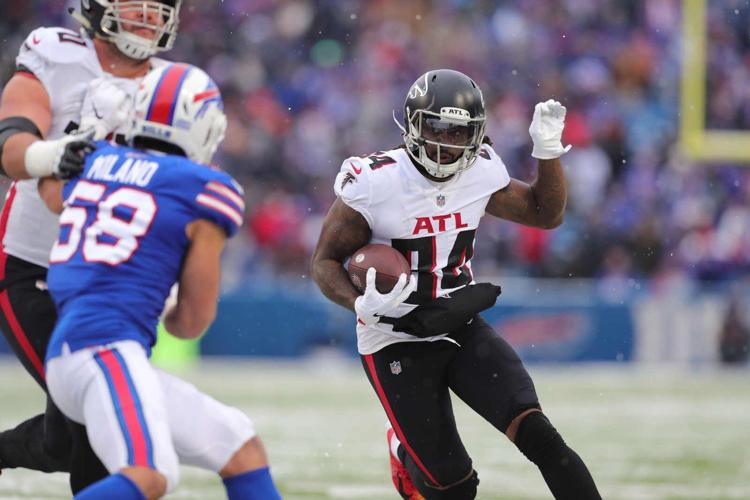
Jay: Patterson signed a one-year, $3 million contract with the Falcons for the 2021 season. After putting up 1,166 yards from scrimmage as a running back/receiver, he’s likely earned a deal worth more than that for 2022, especially when considering his ability as a kick returner. He has eight career touchdowns in that role. Patterson is a (much) more accomplished version of Isaiah McKenzie. It would no doubt be intriguing to add him to the offense, but the price tag is the likely holdup.
People are also reading…
Tony Falzone asks: Sony Michel, Jamison Crowder and Christian Kirk are all free agents for 2022. Is it possible that any of these players could be on the Bills' radar? I think Sony Michel would be a great complement for Devin Singletary and create a nice one-two punch. Jamison Crowder would be a great fit as well. Your thoughts?
Jay: It wouldn’t be a surprise if all of them were on the Bills’ radar, although in the case of Crowder and Kirk, it would seemingly mean the end of Cole Beasley’s time in Buffalo. Crowder is strictly a slot receiver, and wouldn’t be a fit if Beasley were still here. Kirk is coming off the best season of his career and likewise did most of his work from the slot, finishing with 77 catches for 984 yards and five touchdowns. At only 25, he figures to sign a big, long-term deal that could price out the Bills.
As for Michel, the Bills could be in the market for another running back given that Matt Breida and Taiwan Jones are impending unrestricted free agents. Michel, however, is likely to want the chance to be a No. 1 back somewhere. At worst, he’d want to be part of a two-man rotation. Any interest the Bills would have in him would first have to take into consideration how they view Zack Moss and Devin Singletary.
Ed Helinski asks: Need you to gaze into your crystal ball for the following: In terms of numbers, how many players do you think the Bills will turn over on their 53-man roster? Might that number be more than or less than 12 players? Reference points are the Kansas City playoff loss to the 2022 season opener.
Jay: Given your set number, I’ll take the over. We could be looking at significant change along the offensive and defensive lines, at wide receiver and at cornerback. There are also potential changes coming at backup quarterback, running back and at depth linebacker. Whereas the 2021 offseason focused on retaining their own, I wouldn’t be surprised to see the Bills decide this year that they need to change things up a bit.
Jim Bove asks: With the life expectancy of a stadium being 50-plus years, the Bills could have numerous owners during this period. Would lack of a dome in a cold-weather city be the linchpin for a new owner to relocate out of Buffalo? Four new stadiums have opened since 2015 and they are all domed. In 2021, New York took in $0.00 in mobile sports betting revenue. Now, New York's share of mobile sports betting revenue could be as high as $500 million or more yearly. With that windfall, do you think the state could fully fund a new, state-of-the art stadium and take the burden off Erie County taxpayers?
Jay: It could, but why are we gifting Terry and Kim Pegula with a new stadium? I’d much prefer to let the billionaires use their own money – which Erie County residents add to with ticket purchases – and pay their fair share. I understand some public money will be used for this project – that just comes with the territory of having an NFL team in a small market. I would never sign up for fully funding the project with all public money, though.
Also, it’s purely speculative to suggest there could be “several” new owners over the next 50 years. The Pegulas have young(er) children, and we know nothing of their potential succession plans. I was “team dome,” but it’s time to accept the team and state don’t favor that option. If the new stadium does indeed feature a design that covers a majority of the seats, that’s at least a step in the right direction.
Bob Clarke asks: I must have been Rip Van Winkled. Since when did the “taxi squad” change over to the “practice squad?” What did the taxi squad originally mean or come from?
Jay: The term dates back to the 1940s. Legendary Cleveland Browns coach Paul Brown had an eye for talent, and at the time, rosters were limited to just 33 players. Brown didn’t want to let some of the players he found simply go to other teams, so he convinced Browns owner Arthur McBride to put them on the payroll of his taxi company, even though they never did any actual work for it. The players were paid by funneling money through the taxi company. Hence, the name “taxi squad” for those “employees” caught on.
The NFL did not officially recognize “taxi squads” until 1965, and from that point there were several different rules put in place regulating how teams could use them. There is no time it officially became known as the “practice squad,” although the collective bargaining agreement between the league and the NFL Players’ Association struck in 1993 created rules similar to what are in place today. Since that time, the practice squad has grown from five players, to the current 14 allowed.
Jeff Miller asks: Some questions about the press box. What time does everybody show up? Do local reporters get a chance to talk with their national counterparts, or is there no time for mingling? When do you start writing articles for the newspaper? Do you have the same TV monitors that we have, with replays and commercials? Is there even time for snacking or, egads, a meal?
John Neeley asks: How do all of you work in the press box so calmly? I sit in Section 226 and infrequently turn around to glance into the press box to see if I recognize any national NFL, ESPN or people I follow on Twitter and while I recognize you’re all at work, the majority of you seem emotionally spent and robotic. It’s a football game, not a lecture on 1950s Soviet agronomy. Surely, the majority of you got into your profession because you once played sports, but are all of you in that area so “professional” and unemotional? Are there ever any physical fights, arguments or food being thrown? Are you separated by seating by seniority, by form of media or by what team you cover?
I’ve had season tickets since 1996 and I realize the press box has only been behind me a short while, but I can only recall two of your cohorts appearing genuinely juiced to be in attendance and experiencing what took place on the field.
Jay: For a 1 p.m. game, I like to be there about 10:30 a.m. That allows time for some breakfast and, said mingling. My first responsibility of the day is to post a blog on the inactive players at 11:30 a.m. When there are players who are questionable for the game and it’s 50-50 as to whether they’ll play, it’s important to watch warmups, as well. That’s also a time we might learn of potential lineup changes, especially along the offensive line. Another thing to focus on is the kickers – particularly what their range is at both ends of the stadium.
The TV broadcast is on in the press box, and we also can view the stadium jumbotron replays from where we sit. Food is plentiful, both before the game and at halftime. I write my observations column as the game goes on, which gets posted as soon as the game ends, then head to the postgame interview room to speak with players and coach Sean McDermott.
As for the lack of emotion, John, you’d be interested to know that they actually make an announcement before the game that cheering of any kind in the press box is strictly prohibited. It’s our work space, and as you can imagine, when you’re going crazy for a good play, we’re trying to document what happened. That wouldn’t be easy if everyone was screaming and cheering. There are some reactions to big plays, and sometimes some cheering – my guess is that’s from team employees – but by and large, everyone is there to work.
I’ve not seen any physical fights or food being thrown – it’s not an elementary school cafeteria, after all – but there have been arguments from time to time. It’s a high-stress environment, particularly when deadlines are tight. Typically, those who cover the Bills are on the left side of the press box, while those who cover the road team are on the right. We all have assigned seats, and sit next to our coworkers. We’re not separated by the type of outlet we work for. I can’t speak for everyone, John, but I’m genuinely thrilled to be able to cover the NFL for a living – even if it might not look like it while the game is going on.
Dennis Priore asks: I look forward to reading your report card article following each Bills game. Please pull back the curtain, when you write it do you: write it by yourself, in consultation with other News writers, refer back to your notes and or look at both teams' stats.
Jay: That’s all me, Dennis. I will once in a while ask my colleagues their opinion on a certain area if I’m struggling to come up with a grade, but that’s rare. I also sit next to Sal Maiorana from the Rochester Democrat & Chronicle. He also does a report card for his publication, so we’ll sometimes compare what we gave, say, the Bills’ passing game, often times just to see if we were thinking the same thing. As for how I come up with the grades, I consult the “game book,” which lists player and team stats and the play by play. As the game is going on, I’ll make notes of certain things I want to highlight in the report card, be it a good stop by a run defender or poor use of a timeout by the coaching staff.
Dan from Hamburg asks: Regarding the 17-game schedule and its implications on bonuses and salary cap, it seems players will achieve milestones that they may not have achieved if the 17th game wasn't added. Can contracts signed before the 17th game, that included bonuses for catches, sacks, yards, etc., be adjusted for the additional game and how will this bonus money affect the 2022 salary cap? Regarding the quality, or should I say lack of quality, of officiating: It appeared to get worse as the season went on. For the playoffs, do you think they should use the eye in the sky for flagrant penalties that are missed or phantom penalties that are not called?
Jay: Those contracts conceivably could be reworked, although it would take both parties agreeing to do so, and from a player’s perspective, why would you ever agree to make an incentive in your contract more difficult to obtain? The more likely outcome is that when new contracts are written, teams become aware milestones that were once used in a 16-game schedule might require some tweaking to account for the extra game. Not to get too far into the weeds on NFL contracts, which is easy to do, but incentives are designated as “likely to be earned” or “not likely to be earned” based on the player or team’s previous-year performance.
Let’s say a running back has a $100,000 incentive for reaching 1,000 rushing yards. If he did that the previous year, it would be an LTBE incentive. If he didn’t, it would be an NLTBE incentive. The difference is, LTBE incentives count against the current year’s salary cap, while NLTBE ones do not. If the running back hit the NLTBE incentive, there would be a $100,000 cap charge the following season. If he didn’t hit the LTBE incentive, there would be a $100,000 cap credit the following year. There are exceptions to those rules, but that’s a basic guideline.
As for the postseason, I’m not in favor of changing the rules from the regular season. I totally get the concern about the officiating – it’s something the NFL needs to address this offseason – but adding another layer to how games are called at this point does not strike me as the solution. Football is a difficult sport to officiate, and there is a degree of subjectivity that comes with penalties like holding and pass interference. Truthfully, every play could be reviewed to look for those types of penalties, and nobody wants that.
Marc Adel asks: Can you explain the rules that govern which team gets the home field in the two conference crossover games every team plays each year based on their respective division finishes? So this year, the Bills played the Chiefs at Arrowhead based on the fact that they each finished first in 2020. So, in 2022 they will play each other again based on their respective first-place finishes in 2021. So why is the game again at Arrowhead? Shouldn't the home field alternate amongst the way it does in the four games they play every three years against the other AFC division on a rotating basis (and the NFC games). Similarly, we played at Nashville in 2019 and 2020 based on similar division finishes in the prior year.
Mike Lazar asks: Why is it the Bills are, again, having to travel to Kansas City for another regular-season game next year? Why isn't it here? I'm not privy to how the scheduling works in that regard.
Jay: Those single games against conference opponents that finished in the same place in their division the year prior go on two-year cycles. For example, the Bills play at the team in the AFC West that finished in the same spot as they did in 2021 and 2022. That means back-to-back road games against the Chiefs. In 2023, the Bills play all of the AFC West teams, so they’ll actually be at Kansas City for a third straight year. Then, in the years 2024 and 2025, the Bills will host the AFC South team that finishes in the same spot as they did in the standings.
Another example: In 2020 and 2021, the Bills hosted the team that finished in the same spot in the AFC North. That ended up being the Steelers. In 2022, the Bills will face all of the AFC North, so Pittsburgh will visit for a third straight year. In 2023 and 2024, the Bills will travel to the AFC North team that finishes in the same spot in the standings the previous season.
Larry Schiro asks: How do we contact the New Jersey Giants to tell them that Brian Daboll is not moving to “this side of the state” as quoted in your article on Jan. 29? They and the Jets haven’t played in New York in several decades. I think it is time to get them to stop using the “New York” geographical area in their names. I don’t think they pay taxes on their income in New York? After all, it was New Jersey who built their stadium.
Jay: Let’s just hope the Giants are regular mailbag readers, Larry. That way they’ll get the message.
Thanks to everyone, as always, for the questions. They can be submitted via email to jskurski@buffnews.com or via Twitter, @JaySkurski.


