HANOVER, N.H. — The Dartmouth men's basketball team voted to unionize Tuesday in an unprecedented step toward forming the first labor union for college athletes and another attack on the NCAA's deteriorating amateur business model.
In an election supervised by the National Labor Relations Board in the school's Human Resources offices, the players voted 13-2 to join Service Employees International Union Local 560, which already represents some Dartmouth workers. Every player on the roster participated.

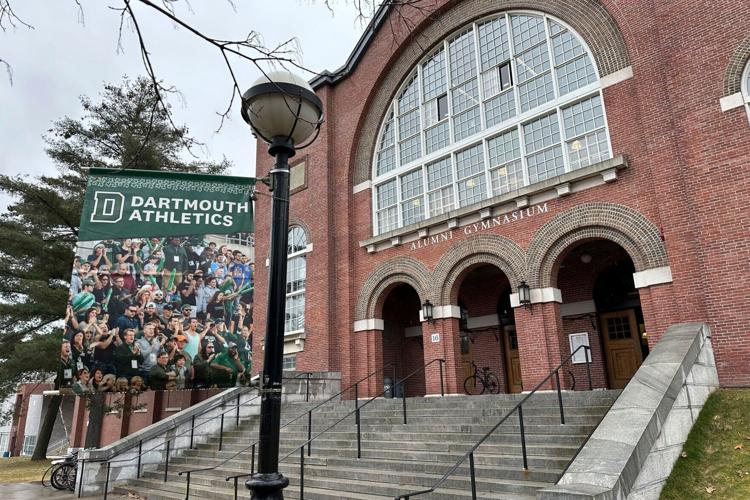
A Dartmouth Athletics banner hangs outside Alumni Gymnasium on the Dartmouth University campus in Hanover, N.H., Tuesday, March 5, 2024. Dartmouth basketball players vote Tuesday on whether to form a union. (AP Photo/Jimmy Golen)
"Today is a big day for our team," players Cade Haskins and Romeo Myrthil said in a statement. “We stuck together all season and won this election. It is self-evident that we, as students, can also be both campus workers and union members. Dartmouth seems to be stuck in the past. It’s time for the age of amateurism to end.”
The school has five business days to file an objection to the NLRB and could also take the matter to federal court. That could delay negotiations over a collective bargaining agreement until long after the current members of the basketball team have graduated.
People are also reading…
Dartmouth pushed back on the decision — again — in a statement, saying it was supportive of the five unions it negotiates with on campus, including SEIU Local 560.

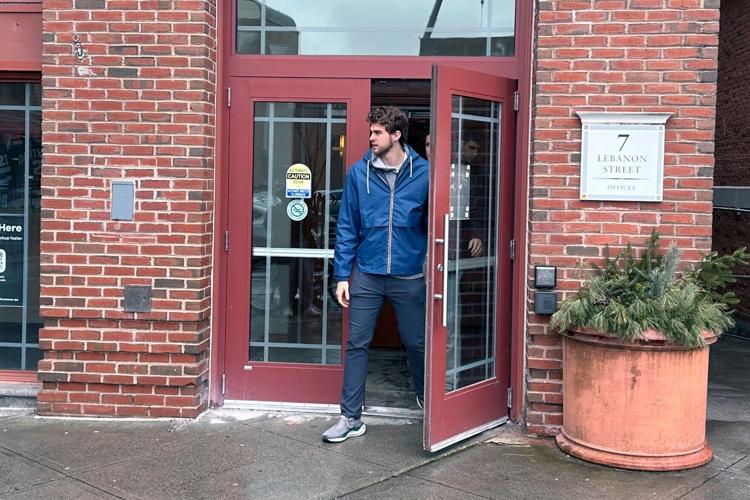
Dartmouth basketball player Cade Haskins leaves after voting in Hanover, N.H., Tuesday, March 5, 2024. Dartmouth basketball players vote Tuesday on whether to form a union.(AP Photo/Jimmy Golen)
“In this isolated circumstance, however, the students on the men’s basketball team are not in any way employed by Dartmouth,” the school said. “For Ivy League students who are varsity athletes, academics are of primary importance, and athletic pursuit is part of the educational experience. Classifying these students as employees simply because they play basketball is as unprecedented as it is inaccurate. We, therefore, do not believe unionization is appropriate.”
Although the NCAA has long maintained that its players are “student-athletes” who were in school primarily to study, college sports has grown into a multibillion-dollar industry that richly rewards coaches and schools while the players remained unpaid amateurs.
Recent court decisions have chipped away at that framework, with players now allowed to profit off their name, image and likeness and earn a still-limited stipend for living expenses beyond the cost of attendance. Last month’s decision by an NLRB that the Big Green players are employees of the school, with the right to form a union, threatens to upend the amateur model.
"We will continue to talk to other athletes at Dartmouth and throughout the Ivy League about forming unions and working together to advocate for athletes’ rights and well-being,” Haskins and Myrthil said.

Dartmouth basketball players Cade Haskins, left, and Romeo Myrthil pose at Dartmouth College in Hanover, N.H., Tuesday, March 5, 2024. Dartmouth basketball players vote Tuesday on whether to form a union.(AP Photo/Jimmy Golen)
A college athletes union would be unprecedented in American sports. A previous attempt to unionize the Northwestern football team failed because the teams Wildcats play in the Big Ten, which includes public schools that aren’t under the jurisdiction of the NLRB.
That’s why one of the NCAA’s biggest threats isn’t coming in one of the big-money football programs like Alabama or Michigan, which are largely indistinguishable from professional sports teams. Instead, it is the academically oriented Ivy League, where players don’t receive athletic scholarships, teams play in sparsely filled gymnasiums and the games are streamed online instead of broadcast on network TV.
Myrthil and Haskins have said they would like to form an Ivy League Players Association that would include athletes from other sports on campus and other schools in the conference. They said they understood that change could come too late to benefit them and their current teammates.
The team includes four seniors, five juniors, three sophomores and three freshman.
“We have teammates here that we all love and support,” Myrthil said after playing at Harvard last month in the Big Green’s first game after the NLRB official’s ruling. “And whoever comes into the Dartmouth family is part of our family. So, we’ll support them as much as we can.”
Mary Kay Henry, the international president of the SEIU, said the players “will go down as one of the greatest basketball teams in all of history.”
“The Ivy League is where the whole scandalous model of nearly free labor in college sports was born and that is where it is going to die,” she said.
___
The Most Unionized Industries in the U.S.
The Most Unionized Industries in the U.S.

Photo Credit: Billion Photos / Shutterstock
After decades of declining power and influence, organized labor in the U.S. is making a comeback.
The COVID-19 pandemic has set off a number of shifts in the labor market that have given workers more power. Labor participation rates fell sharply early in the pandemic and still have not recovered to pre-pandemic levels. The Great Resignation saw millions of workers leave their jobs in search of better pay or working conditions. With the labor market still tight, employers have struggled to recruit and retain employees.
In this context, workers have been organizing at rates not seen in decades. One of the most high-profile examples is the union drive at Starbucks stores across the U.S. over the last year. Around 250 Starbucks locations have voted to unionize since the first Starbucks union formed in Buffalo, NY late in 2021. Employees at other major companies have also attempted unionization, including retail and factory workers at Apple and Amazon. And the trend extends to white collar industries like tech, academia, and media, where unionization has historically been limited.
According to the National Labor Relations Board, 1,522 votes on unionization have taken place so far in 2022. This is the highest number of union elections since 2015 and an increase of more than 50% over 2021.
Union membership has sharply declined in recent decades

The recent uptick in unionization could begin to reverse a decades-long decline in union membership rates. The peak of union membership over the last 50 years was in 1979, when 24.1% of American workers were union members. That figure has since fallen by more than half, with only 10.3% of workers in a union as of 2021. In raw numbers, there are nearly 7 million fewer union members in the U.S. now than there were in the late 1970s.
Recent trends in unionization are significant to bother workers and employers. Unionization and collective bargaining materially affect the compensation and working conditions that workers experience, for better or for worse. In turn, these factors can affect employers’ ability to staff their businesses and the overhead costs they must pay to operate.
The difference between union and nonunion wages has also declined

Compensation is one of the most notable differences between unionized and non-unionized workers, as unions are often able to negotiate for higher wages. And as unions’ influence has declined over time, so too has the gap in compensation between union and non-union employee wages. At the height of unionization in the late 1970s and early 1980s, union members made over 30% more per hour than their non-union counterparts. Today, union members continue to earn more than non-union workers, but the gap between the two is just 11%.
The new growth in union membership is unlikely to return the U.S. to historic levels of unionization, and union representation will continue to be stronger in some industries than others. Certain sectors of the economy have significantly higher rates of union membership than others, including transportation, utilities, public administration, and education. At the highest end, some industries have union membership rates greater than 50%.
The data used in this analysis is from Unionstats.com. Researchers at Smartest Dollar calculated the union membership rate for 247 industries, ranking them from highest to lowest. In the event of a tie, the industry with the greater union coverage rate was ranked higher.
Here are the most unionized industries.
15. Administration of economic programs and space research

Photo Credit: Andrey Armyagov / Shutterstock
- Union membership rate: 25.0%
- Union coverage rate: 28.1%
- Total union membership: 138,656
- Total union coverage: 156,072
- Sector: Public Administration
14. Pulp, paper, and paperboard mills

Photo Credit: Sergey Nemirovsky / Shutterstock
- Union membership rate: 25.1%
- Union coverage rate: 26.1%
- Total union membership: 47,959
- Total union coverage: 49,928
- Sector: Nondurable Goods Manufacturing
13. Administration of environmental quality and housing programs

Photo Credit: Viewfoto studio / Shutterstock
- Union membership rate: 25.2%
- Union coverage rate: 28.8%
- Total union membership: 76,932
- Total union coverage: 88,138
- Sector: Public Administration
12. Natural gas distribution

Photo Credit: Zivica Kerkez / Shutterstock
- Union membership rate: 25.6%
- Union coverage rate: 25.6%
- Total union membership: 29,094
- Total union coverage: 29,094
- Sector: Utilities
11. Administration of human resource programs

Photo Credit: mavo / Shutterstock
- Union membership rate: 26.2%
- Union coverage rate: 29.5%
- Total union membership: 332,403
- Total union coverage: 373,761
- Sector: Public Administration
10. Sewage treatment facilities

Photo Credit: People Image Studio / Shutterstock
- Union membership rate: 26.4%
- Union coverage rate: 28.0%
- Total union membership: 30,428
- Total union coverage: 32,259
- Sector: Utilities
9. Public finance activities

Photo Credit: Feoktistoff / Shutterstock
- Union membership rate: 27.2%
- Union coverage rate: 33.0%
- Total union membership: 90,118
- Total union coverage: 109,429
- Sector: Public Administration
8. Foundries

Photo Credit: DedMityay / Shutterstock
- Union membership rate: 29.5%
- Union coverage rate: 29.5%
- Total union membership: 15,053
- Total union coverage: 15,053
- Sector: Durable Goods Manufacturing
7. Air transportation

Photo Credit: ersin ergin / Shutterstock
- Union membership rate: 38.4%
- Union coverage rate: 40.2%
- Total union membership: 231,414
- Total union coverage: 242,337
- Sector: Transportation & Warehousing
6. Elementary and secondary schools

Photo Credit: Ground Picture / Shutterstock
- Union membership rate: 39.1%
- Union coverage rate: 43.6%
- Total union membership: 3,457,197
- Total union coverage: 3,862,835
- Sector: Educational Services
5. Justice, public order, and safety activities

Photo Credit: LightField Studios / Shutterstock
- Union membership rate: 40.9%
- Union coverage rate: 43.2%
- Total union membership: 1,093,245
- Total union coverage: 1,153,724
- Sector: Public Administration
4. Bus service and urban transit

Photo Credit: LeManna / Shutterstock
- Union membership rate: 42.5%
- Union coverage rate: 43.5%
- Total union membership: 190,016
- Total union coverage: 194,251
- Sector: Transportation & Warehousing
3. Rail transportation

Photo Credit: Ryan DeBerardinis / Shutterstock
- Union membership rate: 54.0%
- Union coverage rate: 56.8%
- Total union membership: 107,632
- Total union coverage: 113,299
- Sector: Transportation & Warehousing
2. Postal Service

Photo Credit: Drazen Zigic / Shutterstock
- Union membership rate: 58.8%
- Union coverage rate: 64.1%
- Total union membership: 369,623
- Total union coverage: 403,417
- Sector: Transportation & Warehousing
1. Labor unions

Photo Credit: Billion Photos / Shutterstock
- Union membership rate: 65.0%
- Union coverage rate: 67.0%
- Total union membership: 52,163
- Total union coverage: 53,821
- Sector: Other Services, Exc. Public Admin.
Jimmy Golen covers sports and the law for The Associated Press.