In the summer of 1975, I drove 270 miles to Vernal, Utah, to watch Mickey Mantle throw out the first pitch at an American Legion baseball tournament. That’s how much I admired Mickey.
My friend and I followed Mantle and his handlers to a bar in the small town near the Utah-Wyoming border. It didn’t take long to realize that my lifelong sports idol was smashed. It was maybe 2 in the afternoon.
Mantle died when he was 63. He literally drank himself to death.
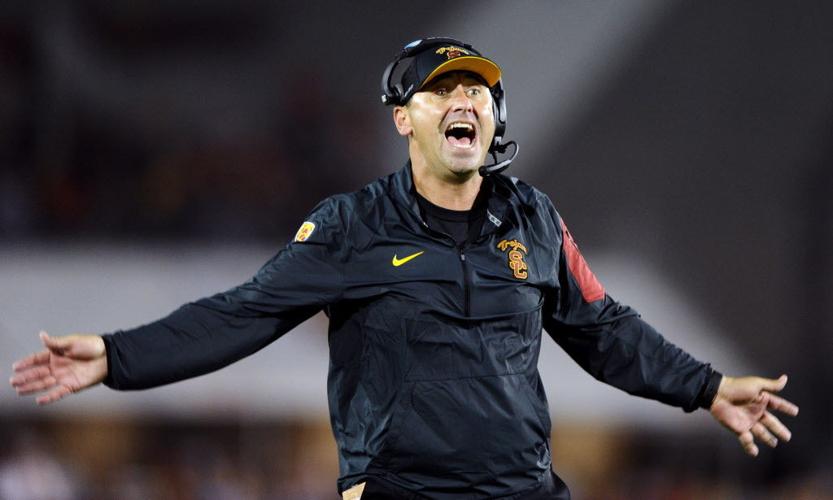
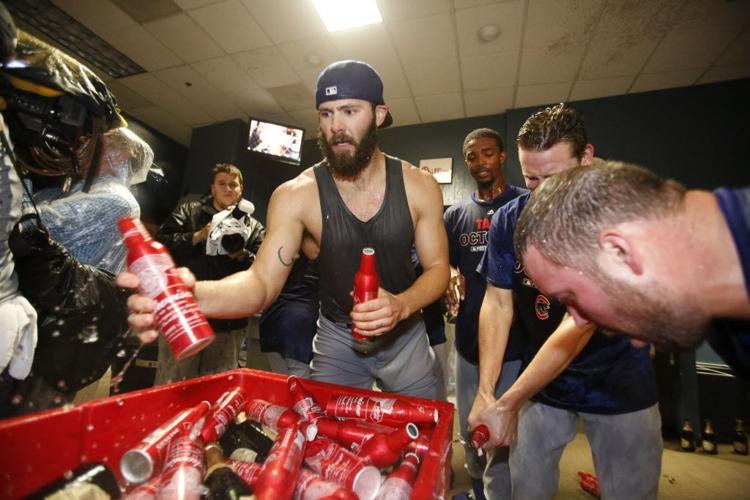
The culture of drinking in sports is an American pastime. Last week was a big one for sports drinking. Jake Arrieta, the Cubs’ star pitcher, was photographed guzzling champagne from a bottle held by his 3-year-old son. In August, USC football coach Steve Sarkisian said he would “explore treatment for alcohol use.” On Sunday, USC placed Sarkisian on leave. Monday, he was fired.
People are also reading…
Get in line, Sark.
In 1995, Michigan football coach Gary Moeller was fired after police said he was intoxicated at a restaurant and punched a patrolman in the chest.
Only 54, Moeller had coached the Wolverines to a 44-13-3 record and two Rose Bowls. He never coached another day in college football, at any level.
In the ’90s, I was sitting on the patio at Bob Dobbs, a popular watering hole near the University of Arizona campus. It was the 55th birthday of Arizona football coach Dick Tomey.
While still wearing his Creative Awards city league baseball uniform, Tomey joined his teammates to celebrate.
Tomey didn’t drink, but he sat with a bunch of us until midnight. Word spread.
A few days later, I picked up the phone and listened as a reader said it was disgraceful for Tomey to be drunk in public. He demanded I write that Tomey seek help or tender his resignation.
Ultimately, those stories got back to Tomey, the teetotaler. He didn’t join his teammates at Bob Dobbs again.
I long ago learned that booze and sports are often inseparable.
As a naïve rookie beat writer for the Tampa Bay Buccaneers, I flew to and from games on the Bucs’ charter flights (an arrangement that wisely ceased during the ’80s).
On the tarmac, at the base of the plane, were three XXL-sized coolers. Two were full of beer. Players loaded up, stuffing their pockets, their flight bags and their large hands with as many 12-ounce cans as possible.
Win or lose, the return flight to Tampa was always Happy Hour at 35,000 feet.
And then we all got in our cars and drove home.
USC last month announced it had removed beer from the football coaches’ offices. Who knew? At least the Trojans can’t be accused of hiding their drinking issues.
When I lived in Corvallis and covered Oregon State’s football team, Beavers coach Craig Fertig would often miss Tuesday practices because he would drive to Portland for a weekly luncheon with OSU boosters. Fertig was all personality; a cigar-smoking, story-telling former USC quarterback who was the life of the party.
In those days, when reporters would regularly stand on the sideline, thoroughly bored by every football practice, the only drama was whether Fertig would make it back from Portland in shape to coach his team.
Fertig went 10-34-1 in four seasons and was fired. He was only 37 and never coached again.
I somehow survived three years on the Pac-10 Skywriters Tour, a 10-day pilgrimage from campus to campus during August training camp that was unofficially a 10-day salute to drinking. Cal and its coaches and sports administrators hosted the sportswriters at the Korbel champagne factory. Oregon staged its party in the backyard of football coach Rich Brooks. One year, a Ducks’ basketball coach wandered in from an adjacent golf course carrying what was left of a six-pack in one hand, his golf clubs in another.
The booze flowed. It was the same at each stop: Washington, Arizona and especially with Pac-10 administrators at the Tournament of Roses house in Pasadena, California.
A lot of us looked forward to any visit to Cal; the sports information office in Berkeley had a refrigerator stocked with beer.
Now there are too many prying eyes to successfully hide drinking in college sports. Sadly, if a coach like Sark wobbled at a boosters’ outing in the years before social media, slurring words and punctuating his language with four-letter bombs, most would’ve laughed it off and lauded the coach for being “down to earth.”
If nothing else, perhaps Sark will serve as a deterrent for those coaches and players to come.
I recently re-read Jim Bouton’s classic baseball narrative “Ball Four.” It is essentially a book about drinking. In it, former Seattle manager Joe Schultz often admonished his team to “pound that Budweiser” to forget that day’s game.
Today, “pounding that Budweiser” gets a sports figure suspended, fired, disgraced or all three.