
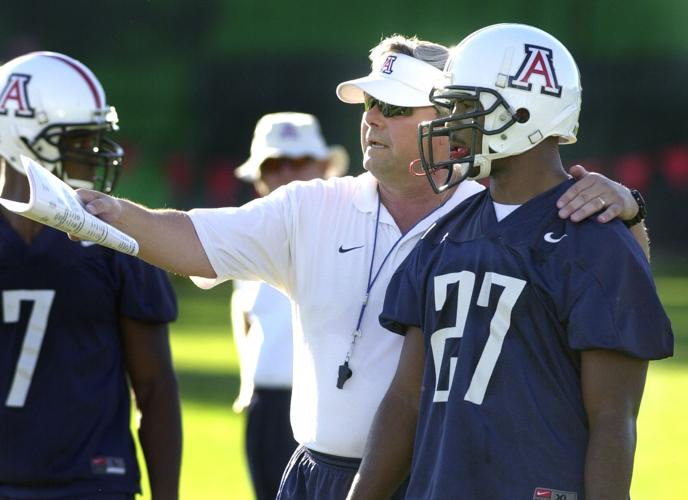

The front door to the Lowell-Stevens football complex was locked Monday afternoon. Even Rich Rodriguez’s daughter, Raquel, had to knock — perhaps in secret code — before she was admitted.
The sacred Territorial Cup is on display on the third floor, where it would take James Bond to (a) find it or (b) steal it.
“It’s usually kept on the third floor where it’s more secure,” RichRod said.
The spy vs. spy business of college sports, stealing signals, encouraging deception and uncovering secrets, isn’t new. It’s as old as a Pop McKale catcher’s mitt. Read on:
Chapter 1: In Arizona’s 1929 baseball opener against ASU, Wildcats catcher Frank Sancet tucked a potato into his chest protector between innings. When the Sun Devils (then called Bulldogs) moved a runner to third base, Sancet grabbed the potato and threw it into left field.
People are also reading…
It appeared to be a wild pickoff throw.
The ASU player ran to the plate, thinking he would score easily. Sancet tagged him with the baseball. UA coach Pop McKale told the potato-into-the-outfield story for years. A version of it is repeated in Abe Chanin’s book “They Fought Like Wildcats.”
After discovering the potato trick, an umpire called ASU’s runner safe. McKale and Sancet, who would later become Arizona’s head coach and have the campus baseball stadium named in his honor, protested that the rules said nothing about throwing a potato into the outfield, or anywhere.
McKale told the story both ways: one with the player out; another with the ump changing his call. Either way, ASU won 3-2.
Chapter II: In Cecil McGehee’s first year as an Arizona assistant football coach, 1967, he persuaded head coach Darrell Mudra to allow him to fly to Columbus, Ohio, and secretly scout Woody Hayes’ football practices at Ohio State.
Mudra agreed to fund the trip; McGehee flew to Ohio and entered a dormitory under construction adjacent to the Buckeyes’ practice field. It gave him a full view of Hayes and his players in a lead-up to the Sept. 30 Arizona-Ohio State game.
“I found a floor that was partially finished. There weren’t really any students moving in yet, and there were a lot of workmen around,” McGehee told the Star’s Mark Stewart in 1991. “They were simulating our offense with their scout squad in the scrimmage. I could tell by their scout squad what they were going to do. Being that it was only a few days before the game, I knew they weren’t going to make any major changes, especially playing us.”
McGehee phoned Mudra and outlined Ohio State’s X’s and O’s. The UA then devised an offense to exploit OSU’s weak-side defense.
“To counter it, we ran a power toss, power sweep into the short side of field,” McGehee remembered. “We had them outmanned. They weren’t real adaptive. I don’t think in their wildest dreams they thought we could move the ball on them. They didn’t make any major adjustments to what we were trying to do.”
An Arizona team that would finish 3-6-1 stunned the mighty Buckeyes 14-7.
Chapter III: I was the basketball manager at Utah State in the winter of 1970-71 when the 12th-ranked Aggies were to play a Utah team that had future NBA standout Mike Newlin and All-WAC forward Kenny Gardner.
My boss, assistant coach Dale Brown, later a Final Four head coach at LSU, told me to drive to Salt Lake City and watch the Utes practice two days before the early-December game. He wanted to know what personnel Utah used, and several other X and O variables I’ve since forgotten.
When I walked into the Utes’ arena, I suspected my cover was blown; there wasn’t a single person sitting in the bleachers at the 15,000-seat arena. I sat 30 rows above the court, scribbling notes, when Hall of Fame coach Jack Gardner spotted me.
I can still remember his words: “Go see who that guy up there is, and if he’s taking notes, yell “Air raid!”
A super sleuth I was not; the Aggies won two days later anyway, 93-74.
Chapter IV: At the 1985 Junior College World Series, Pima College baseball coach Rich Alday and his able assistants, Jim Fleming and Scott Stanley, had a brief celebration after the Aztecs beat Indiana Hills College of Iowa in the NJCAA opener.
Then they took a seat behind home plate and watched intently as Connors State College of Oklahoma won a first-round game.
I was in the hotel lobby in Grand Junction, Colorado, when Alday, Fleming and Stanley returned from the ballpark close to midnight. I asked Alday where they had been for so long.
“Scouting,” he said. “We’ve got Connors’ signals.”
Two days later, Pima beat Connors State 9-3, and ultimately advanced to the national championship game. I asked Fleming, later the Miami Marlins vice president of scouting, how much it helped to know the Cowboys’ signals.
“We knew virtually every pitch and most of their other signs,” he said. “They had no idea.”
Chapter V: Larry Mac Duff, defensive coordinator of Arizona’s Desert Swarm teams, was at the America West Airlines ticket counter in Tucson in the summer of 1994. I was a few feet behind him.
“Where are you off to?” I asked.
“I can’t tell you,” he said, politely.
“Really?”
“Sorry,” Mac Duff said, “but I can’t tell you.”
A gentleman and coach of the first order, Mac Duff did not disclose that he flew to Syracuse that day to scout the UA’s 1994 opening opponent, Georgia Tech.
Why did seventh-ranked Arizona send a coach to New York to scout Georgia Tech? In 1993, Boston College upset No. 13 Syracuse, 33-29, an impressive performance engineered by BC’s quarterback coach, Gary Crowton.
After the season, Georgia Tech hired Crowton to be its offensive coordinator.
That summer, Mac Duff spent two days in Syracuse examining Crowton’s system with the help of allies on Syracuse’s coaching staff. Now, 21 years later, it can be told.
The Wildcats beat Crowton and Georgia Tech 19-14 that night in Atlanta, limiting Tech to 12 first downs and 224 yards.
Now, in 2015, ASU has admitted it tries to decipher an opponent’s football signals. The Sun Devils have been called everything from crafty and cunning, to deceptive and double-dealing.
In sports, it’s nothing new. It’s as old as a 1929 potato.